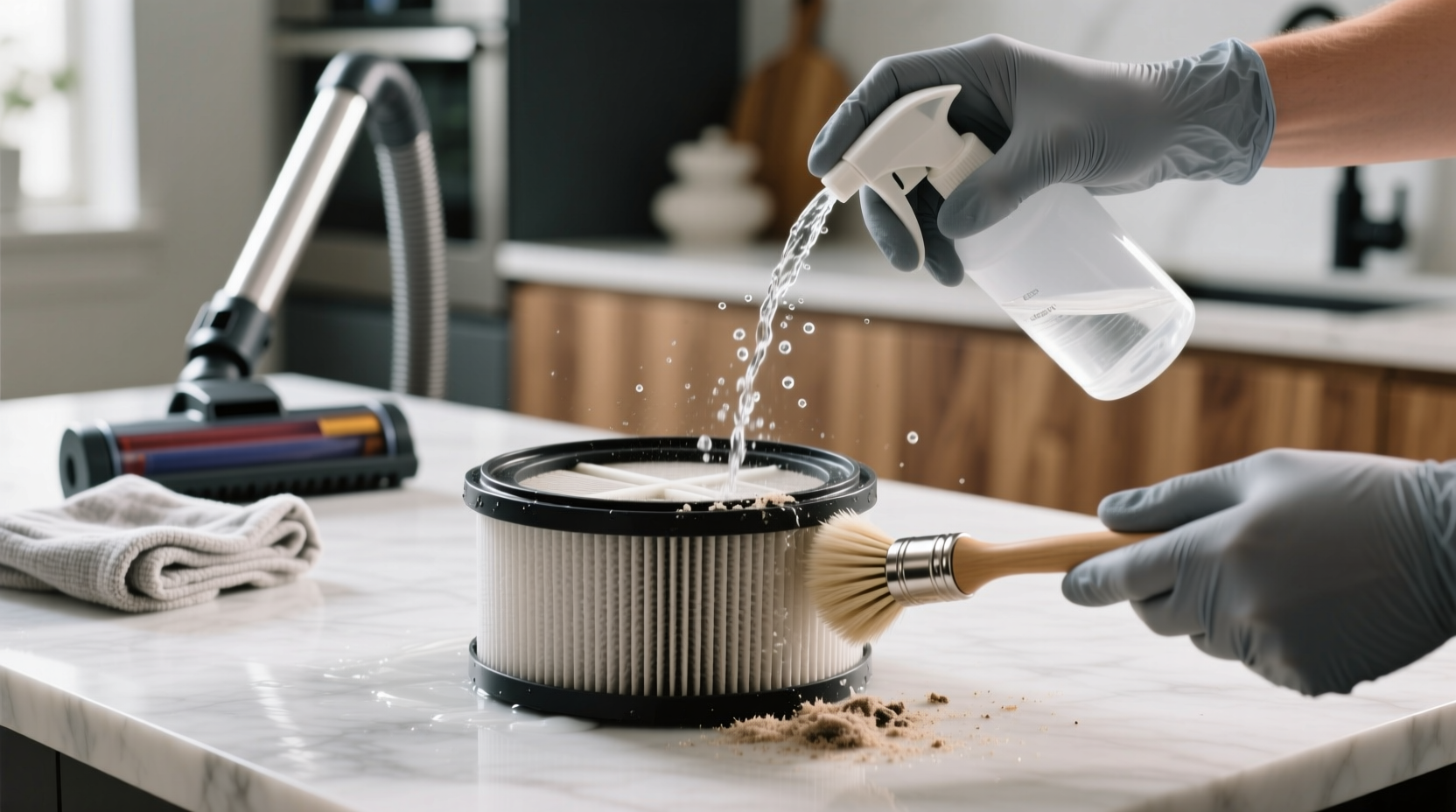
A HEPA filter should only be washed if the label clearly says “washable.” Most are not.
Water damages the fine fibers that trap dust, turning a high-efficiency filter into a blockage that strains airflow.
That strain forces the motor to work harder, leading to overheating, weak suction, and early failure.
The Short Answer
The Critical Rule: Only wash a HEPA filter if it is explicitly labeled “washable.”
Most HEPA filters use tightly packed glass fibers or melt-blown polypropylene held together with an electrostatic charge.
Water collapses the structure and removes that charge. The result is poor airflow and overheating, which can burn out the motor.
The Physics of Filtration
A proper HEPA filter works because of three forces. Water interferes with all of them.
1. Interception
Dust particles follow airflow and brush against fibers, sticking to them.
What water does: It flattens and clumps the fibers, reducing surface area. Fewer particles get caught.
2. Impaction
Larger particles can’t follow airflow curves and crash into fibers.
What water does: Wet fibers lose their spacing and rigidity.
Gaps close unevenly, forcing air through narrow channels instead of trapping debris.
3. Diffusion
Tiny particles move randomly and collide with fibers.
What water does: It removes the electrostatic charge that helps attract these fine particles. Without it, the filter loses its “magnetic” effect.
Bottom line: A washed non-washable HEPA filter doesn’t just perform worse. It actively chokes airflow, which is harder on the motor than a dirty filter.
Washable vs. Permanent vs. Replaceable
Not all filters are built the same. Mixing them up is where most damage happens.
Washable Filters
- Usually foam or synthetic pleated material
- Found in many bagless vacuums
- Designed to handle water
Reality check: Even these wear out. Washing extends life, but doesn’t make them permanent.
Non-Washable HEPA Filters
- Dense, paper-like material made from glass fibers
- Common in high-end machines
- Built for filtration efficiency, not durability
Hard truth: Once wet, performance drops permanently. Drying doesn’t fix it.
Activated Carbon / AirClean Filters
- Infused with charcoal for odor control
- Often paired with HEPA systems
Key point: Water destroys the carbon’s ability to absorb smells.
How to “Dry Clean” a HEPA Filter
For non-washable filters, cleaning means removing loose dust without damaging the structure.
Method 1: The Tap Method
- Hold the filter over a bin
- Tap gently to release surface dust
- Stop when debris stops falling
Do not: hit it hard. That cracks the internal structure.
Method 2: Compressed Air (Carefully)
- Blow air from a distance
- Aim from the clean side outward
Warning: Too much pressure tears fibers. Keep it light.
Reality check: These methods buy time. They don’t restore full performance.
Filter Compatibility Table
| Filter Type | Material | Can You Wash? | Life Expectancy |
|---|---|---|---|
| Standard HEPA | Glass Fiber / Paper | NO | 6–12 Months |
| Washable HEPA | Woven Synthetic | YES (Cold water only) | Up to 24 Months |
| Active AirClean | Charcoal Infused | NO | 12 Months |
The Mistake That Kills Vacuums
A washed non-washable filter often feels clean. It smells better. It even looks fine.
But inside, airflow is restricted.
That restriction forces the motor to:
- run hotter
- draw more power
- lose suction gradually
This is why vacuums “mysteriously” fail a few months after a filter gets rinsed.
When Replacement Is the Only Sensible Move
Replace the filter immediately if:
- it turned gray and stays gray
- there’s a musty smell after drying
- it was washed by mistake
- suction dropped suddenly
Trying to stretch it further usually costs more in the long run.
Final Thought
Cleaning a filter feels like maintenance. In many cases, it quietly causes damage.
The rule is simple: if water wasn’t part of the design, keep it away.
When airflow drops, don’t fight the machine. Replace the filter and protect the motor.