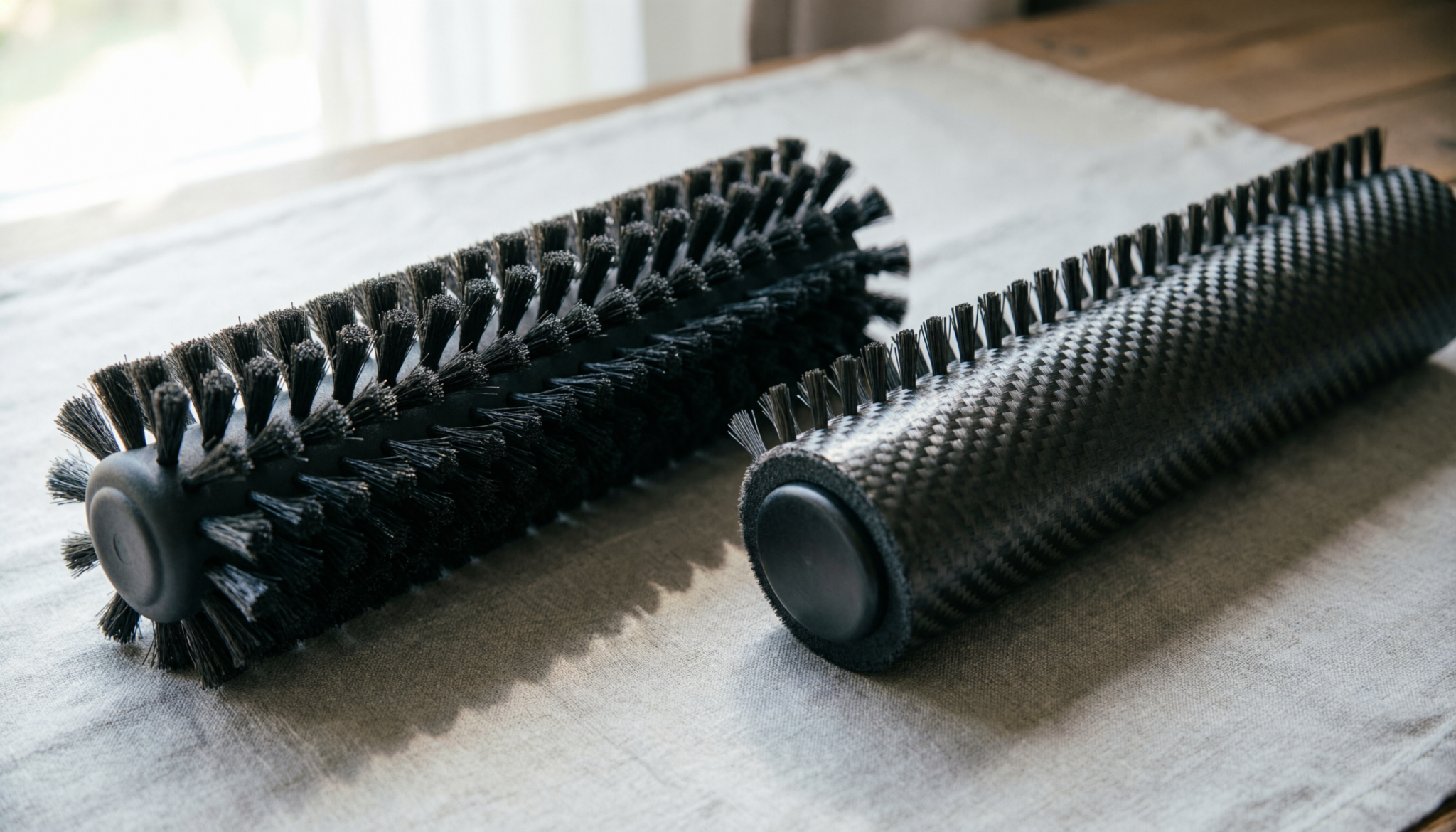
Vacuum brushrolls may look similar, but the material of the bristles changes how a vacuum actually cleans.
Nylon and carbon fiber serve completely different purposes.
One beats grit out of carpet fibers. The other neutralizes static so fine dust releases from hard floors instead of clinging.
Quick Distinction
Nylon bristles are engineered for agitation. Their stiffness and resilience beat carpet fibers and flick out embedded grit.
Carbon fiber filaments are engineered for anti-static dusting.
Conductive strands neutralize the static bond between fine dust and hard floors, allowing suction to lift particles cleanly.
The Anatomy of a Carpet-Safe Brushroll: Nylon vs. Carbon Fiber
A brushroll has a simple job: loosen debris so airflow can carry it away.
The method changes depending on the floor beneath it.
Carpet traps debris deep between fibers. Hard flooring holds dust through static charge. Different materials solve each problem.
A brush built for carpet must agitate aggressively without shredding fibers.
A brush built for hard floors must release dust gently without scattering it across the room.
Nylon: The Carpet Beater
Nylon bristles dominate carpet brushrolls for one reason: strength with controlled flex.
Carpet acts like a filter. Sand, crumbs, hair, and soil settle near the base of the pile. Suction alone rarely reaches that layer.
Stiff nylon bristles solve the problem through mechanical agitation.
When the brushroll spins:
- Bristles dig into carpet fibers
- Fibers flex and rebound
- Trapped grit gets flicked upward into the airflow
That grit often includes fine mineral particles.
On carpet, these particles behave like sandpaper. Without strong agitation, they remain buried and slowly wear down fibers.
Why nylon works well:
- High tensile strength
- Resists bending fatigue
- Maintains shape after thousands of rotations
Soft plastic bristles flatten quickly. Nylon springs back. That rebound keeps the beating action consistent.
Result: grit lifts out of carpet instead of grinding deeper.
Carbon Fiber: The Hard Floor Specialist
Hard floors face a completely different cleaning problem: static electricity.
Dust particles carry a small electric charge.
Smooth surfaces such as hardwood, laminate, or tile often build static as air moves across them. That static bond holds fine dust in place.
Traditional plastic bristles push dust around instead of lifting it. A familiar result appears: dust streaks or smears across the floor.
Carbon fiber filaments fix this through conductivity.
Carbon fiber allows tiny electrical charges to move along the filament and dissipate into the vacuum body.
Once the charge neutralizes, dust loses its grip on the floor. Then suction does the rest.
Key advantages of carbon fiber:
- Conducts electricity
- Neutralizes static charge
- Extremely thin filaments reach fine dust
Instead of sweeping particles sideways, the brushroll gently releases them into the airflow.
This approach works especially well on:
- hardwood
- tile
- polished stone
- laminate
Fine dust, pollen, and allergens lift cleanly without streaking.
The “Hybrid” Brushroll
Modern vacuums often combine both materials in a single brushroll.
A hybrid design usually places:
- Stiff nylon bristles for carpet agitation
- Carbon fiber filaments for static control on hard floors
This combination creates an all-floor brush head capable of switching between surfaces without manual changes.
However, compromises appear.
Hybrid brushrolls typically provide:
- Good carpet cleaning
- Good hard-floor dust pickup
But rarely match the specialized performance of a dedicated carpet head or a soft hard-floor roller.
Homes with heavy carpet traffic still benefit from strong nylon agitation.
Homes with mostly hardwood floors often clean better with a soft roller packed with carbon fiber strands.
Brushroll Material Comparison
| Feature | Stiff Nylon | Carbon Fiber Filaments |
|---|---|---|
| Primary Surface | Carpet / Rugs | Hardwood / Tile |
| Action | Mechanical Agitation | Static Dissipation |
| Target Debris | Sand, Hair, Grit | Fine Dust, Allergens |
Practical Buying Insight
Brushroll material often matters more than suction power.
Strong suction without agitation leaves grit buried in carpet. Strong agitation without static control pushes dust across hardwood.
The right brushroll solves the specific problem underfoot.
- Carpet-heavy homes benefit from stiff nylon bristles.
- Hardwood-heavy homes benefit from carbon fiber filaments.
- Mixed flooring often works best with hybrid brushrolls.
Understanding that difference prevents a common mistake: assuming every spinning brushroll performs the same task.
It does not. The material decides the job.