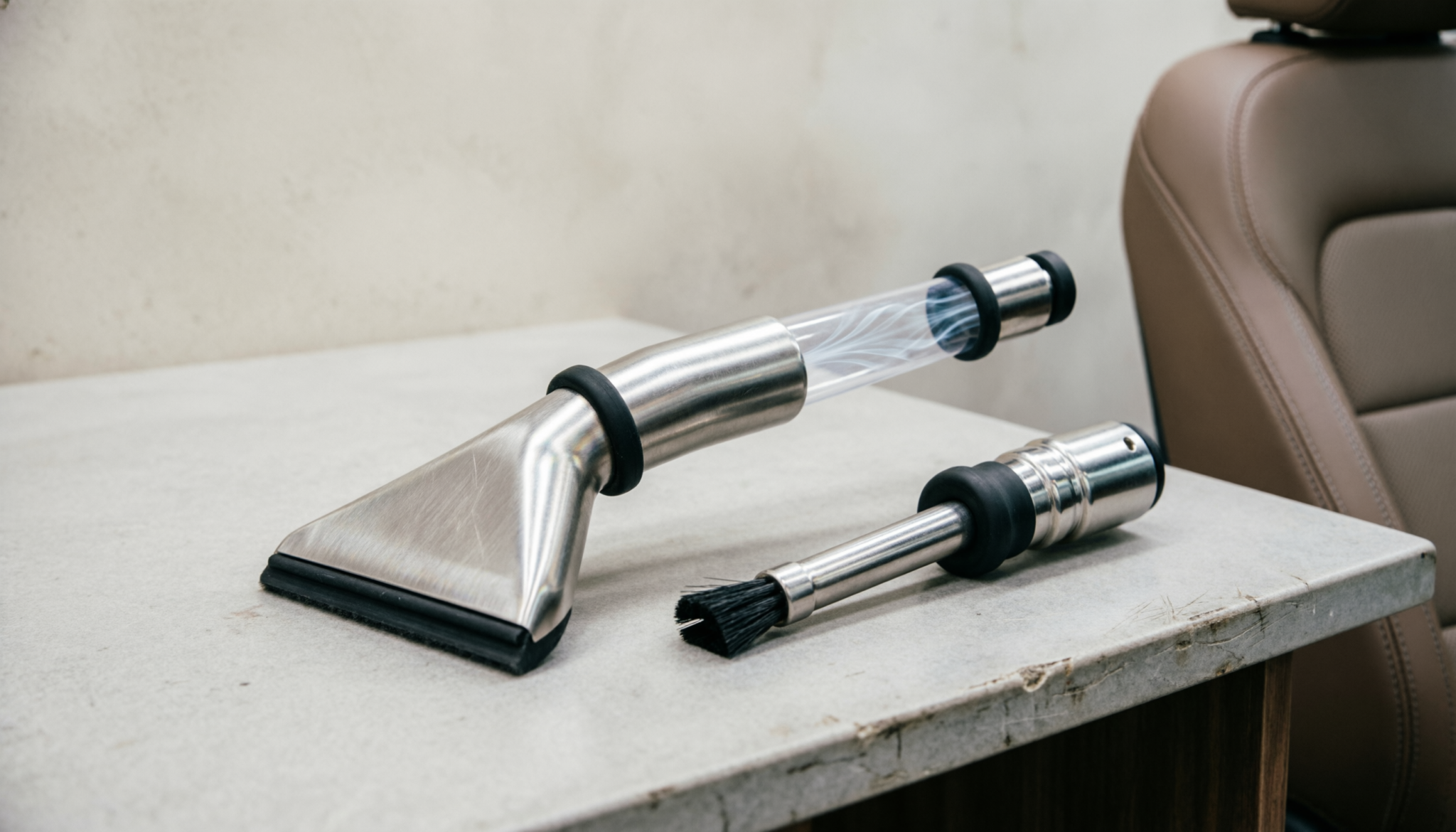
Thin crevice tools often feel powerful but leave debris behind. The reason comes down to airflow physics, not motor strength.
Narrow tips boost air speed while choking total airflow, reducing real cleaning power.
Understanding this helps prevent overheating, weak pickup, and wasted time during detailed vacuum work.
The Short Answer
The Science: A narrow crevice tool creates a bottleneck.
Air velocity increases at the tip, but total airflow (CFM) drops because the motor cannot pull enough volume through the restriction.
This can lead to motor cavitation and overheating. The fix is a vented crevice tool that maintains airflow while focusing suction.
Why Thin Crevice Tools Kill Suction: Understanding the Venturi Effect in Detailing
Air Velocity vs. Air Volume
High speed at the nozzle feels strong, but speed alone does not lift dirt.
Vacuum performance depends on two factors:
- Air velocity (speed): how fast air moves
- Air volume (CFM): how much air moves
A thin crevice tool increases speed but cuts volume. That tradeoff is where performance collapses.
Picture trying to clean sand from a crack. Fast air skims the surface, but without enough volume, it cannot carry debris out.
The result is dust shifting around instead of being removed.
Technical benchmarks prove that strong debris pickup needs balanced airflow, not extreme restriction.
Why Motors Overheat
Airflow is not just for cleaning. It also cools the motor.
When a narrow attachment restricts airflow:
- Less air passes through the motor housing
- Heat builds up faster than it can escape
- Internal components strain under reduced cooling
This condition is often mistaken for weak suction, but the real issue is airflow starvation.
Extended use like this can lead to:
- Premature motor wear
- Thermal shutdowns
- Reduced lifespan
The vacuum is not underpowered. It is being suffocated.
The Venturi Effect in Real Use
The Venturi principle explains the behavior clearly.
When air is forced through a tight space:
- Speed increases
- Pressure drops
- Volume decreases
In vacuum cleaning, that pressure drop does not help once airflow becomes too restricted. Dirt needs consistent volume to move, not just speed at the tip.
A narrow crevice tool exaggerates this effect to the point where performance drops instead of improves.
The Practical Fix: Vented Crevice Tools
A vented crevice tool solves the bottleneck problem.
Small side openings allow extra air to enter, which:
- Maintains airflow through the system
- Keeps the motor cooler
- Improves real debris pickup
This design sacrifices a bit of raw speed but restores the balance needed for effective cleaning.
For tight detailing, this approach works far better than forcing air through a sealed, narrow tube.
Where High-CFM Vacuums Fit In
High-CFM shop vacs handle restriction better because they move more air overall.
Even then, extreme narrowing still reduces efficiency. A strong motor helps, but it cannot fully overcome poor airflow design.
The best results come from pairing:
- High airflow machines
- Attachments that do not choke volume
That combination keeps both suction and cooling stable.
Bottom Line
Thin crevice tools create the illusion of power while quietly reducing performance.
High air speed without enough volume cannot lift debris and puts strain on the motor.
Balanced airflow always wins. Use vented tools and avoid unnecessary restriction to keep suction strong and equipment running longer.