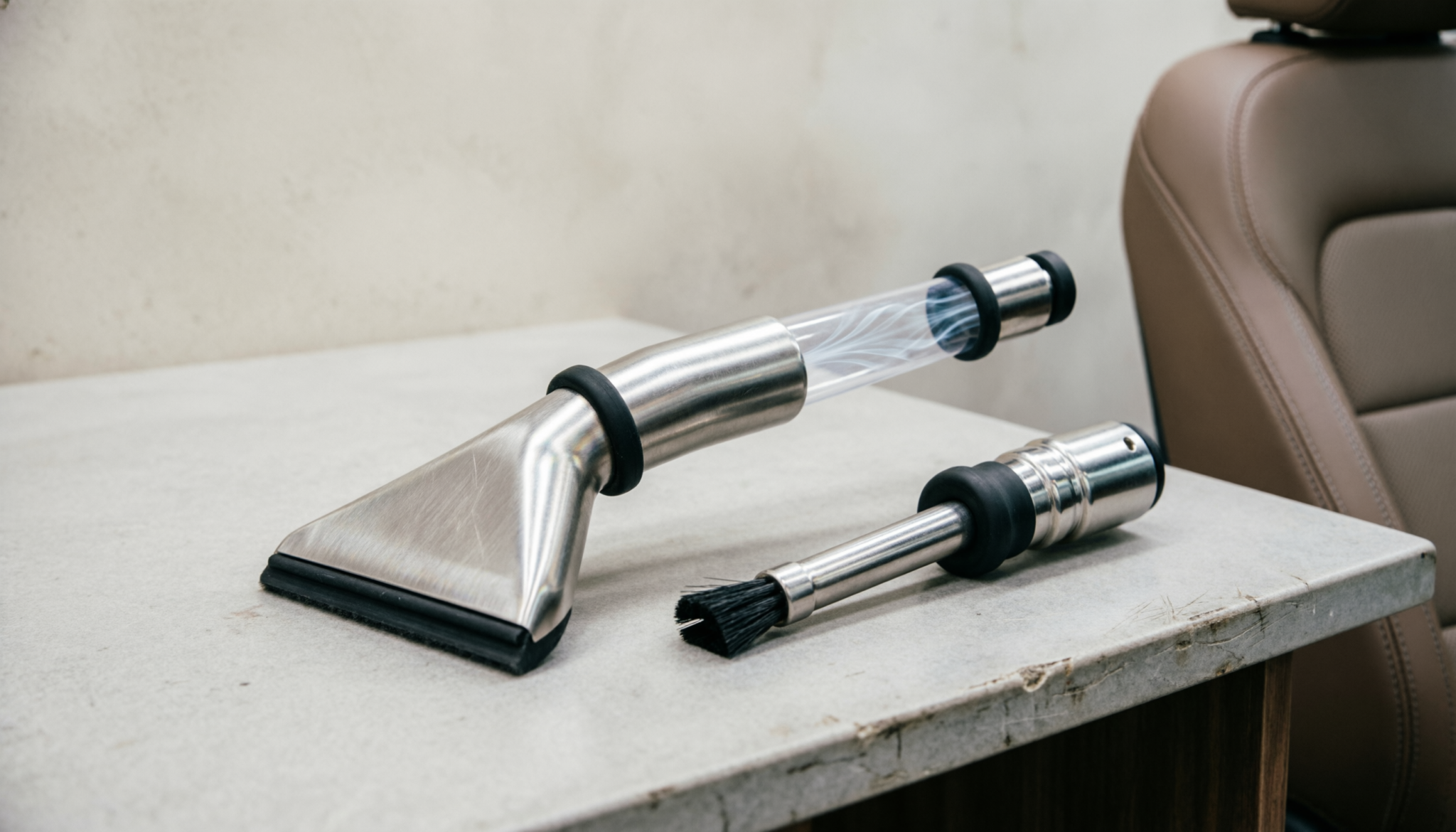
Diagnostic Summary: Thin crevice tools concentrate airflow into a narrow passage, increasing air velocity while reducing static pressure. Excessive restriction forces vacuum motors to work harder, raises heat levels, lowers usable airflow at the nozzle tip, and weakens debris pickup on dense dust, sand, and pet hair trapped in tight detailing areas.
Warning
Extended use of ultra-thin crevice tools can overheat vacuum motors and trigger thermal shutoff protection. Fine drywall dust, ash, and powdered debris worsen restriction inside narrow nozzles.
Frequent overheating shortens motor life, weakens suction seals, and damages hose connections through excessive internal pressure imbalance.
Comparison Table
| Airflow Condition | Air Velocity Outcome | Static Pressure Effect | Cleaning Performance |
|---|---|---|---|
| Wide floor nozzle | Moderate | Stable | Strong bulk debris pickup |
| Standard crevice tool | High | Slight pressure drop | Effective edge cleaning |
| Ultra-thin detailing nozzle | Extremely high | Severe pressure loss | Weak real-world suction despite strong airflow sound |
Why Thin Crevice Tools Kill Suction: Understanding the Venturi Effect in Detailing
Air Velocity vs. Air Volume
High speed at the nozzle feels strong, but speed alone does not lift dirt.
Vacuum performance depends on two factors:
- Air velocity (speed): how fast air moves
- Air volume (CFM): how much air moves
A thin crevice tool increases speed but cuts volume. That tradeoff is where performance collapses.
Picture trying to clean sand from a crack. Fast air skims the surface, but without enough volume, it cannot carry debris out.
The result is dust shifting around instead of being removed.
Technical benchmarks prove that strong debris pickup needs balanced airflow, not extreme restriction.
The Physics Behind Thin Nozzle Suction Loss
Many vacuum owners assume narrower tools create stronger suction because airflow feels sharper against skin. Real cleaning performance works differently.
Vacuum cleaning depends on airflow volume and pressure balance together, not velocity alone. The Venturi effect explains the problem.
Inside a narrow crevice tool, airflow accelerates rapidly as passage size decreases. Faster airflow lowers static pressure within the nozzle. Reduced pressure limits the vacuum’s ability to lift dense debris from surfaces.
A vacuum motor cannot create unlimited airflow. Every motor operates within a specific airflow range. Restrictive tools force the motor into a high-resistance condition where air speed increases but usable air volume collapses.
That imbalance creates several detailing problems:
- Sand remains trapped in seat seams
- Pet hair clings to carpet edges
- Fine dust circles inside corners
- Debris sticks inside the crevice tool itself
- Motor pitch becomes louder without stronger pickup
High airflow velocity sounds powerful. Actual debris extraction often becomes weaker.
The issue becomes severe with aftermarket “precision” detailing nozzles that reduce opening width excessively. Many third-party attachments prioritize reach rather than airflow engineering.
Why Narrow Attachments Overwork Vacuum Motors
Vacuum motors rely on moving air for cooling. Restricted airflow reduces cooling efficiency while increasing motor strain.
Thin nozzles create resistance similar to partially blocking a vacuum hose by hand. Motor RPM rises, heat accumulates faster, and electrical components operate under greater stress.
Common symptoms include:
- Hot exhaust air
- Burning dust smell
- Intermittent thermal shutdowns
- Reduced suction after several minutes
- Whistling airflow noises
- Hose vibration
Bagless vacuums suffer heavily because cyclonic systems require balanced airflow to separate debris efficiently. Restriction weakens cyclone performance and increases filter loading.
Cordless stick vacuums experience additional battery stress. Higher resistance demands more motor effort, draining batteries faster while reducing cleaning efficiency.
Cheap plastic crevice tools worsen the problem through poor internal shaping. Sharp interior corners create turbulence that interrupts smooth airflow movement. Turbulence wastes energy before airflow reaches the debris source.
Professional detailing attachments avoid abrupt narrowing. Better designs taper gradually to preserve pressure stability while maintaining usable airflow volume.
Technician’s Insight
Technician’s Insight: Loud suction noise from a thin detailing tool often signals airflow restriction rather than cleaning strength. Professional service technicians check airflow volume first, not sound intensity.
Stable airflow with moderate velocity removes more embedded debris than extreme velocity through a heavily restricted nozzle with collapsing internal pressure balance.
Why Debris Gets Stuck Inside Thin Crevice Tools
Thin attachments create another hidden issue: internal clogging.
Large debris particles collide against narrow walls before reaching the hose. Hair strands twist into compact bundles. Powder mixes with moisture and forms hardened buildup.
Several materials commonly jam restrictive nozzles:
- Cat litter dust
- Baking soda residue
- Coffee grounds
- Fireplace ash
- Construction dust
- Pet fur clusters
Clogs reduce airflow further, multiplying Venturi-related pressure loss.
Static electricity also increases inside narrow plastic tools. Fast-moving particles rubbing against thin walls generate electrostatic attraction, causing dust to cling to interior surfaces instead of flowing toward the bin.
Professional-grade detailing tools often use:
- Wider internal channels
- Anti-static materials
- Smooth tapered interiors
- Reinforced airflow geometry
- Pressure-relief grooves
These features maintain airflow stability while preventing internal accumulation.
A wider nozzle opening frequently cleans faster than an ultra-thin attachment because airflow remains balanced across the debris field.
Better Alternatives for Precision Vacuum Detailing
Effective detailing requires airflow control rather than extreme restriction.
Several attachment styles outperform ultra-thin crevice tools in real homes and vehicles.
Flexible Crevice Tools
Flexible designs maintain moderate airflow width while bending into narrow areas. Better airflow stability improves dust extraction deep inside cushions and vents.
Brush-Assisted Nozzles
Soft detailing brushes loosen embedded debris mechanically instead of relying entirely on suction force. Reduced restriction lowers motor strain.
Tapered Airflow Tools
Professional tapered tools narrow gradually instead of abruptly. Gradual transitions preserve pressure consistency and reduce turbulence.
Micro-Hose Attachments
Micro-hose systems divide airflow through multiple small tubes while maintaining overall air volume. Electronics detailing kits commonly use this design safely around keyboards and vents.
Controlled Vent Designs
Some premium attachments include pressure-relief vents near the handle. These vents stabilize airflow and prevent excessive motor loading during tight-surface cleaning.
Proper vacuum detailing depends on balancing:
- Airflow volume
- Air velocity
- Pressure stability
- Tool geometry
- Surface agitation
Restriction alone never guarantees stronger cleaning.
FAQs
1. Why does a thin crevice tool sound stronger but clean worse?
Narrow passages increase airflow speed and noise while reducing usable airflow volume. Faster air movement creates the illusion of stronger suction even though debris-lifting capability drops significantly.
2. Can thin attachments damage a vacuum motor?
Extended use can overheat motors due to restricted cooling airflow. Repeated thermal stress shortens motor lifespan and weakens electrical components over time.
3. Which crevice tool design works best for detailing?
Moderately narrow tapered tools with smooth internal airflow paths provide the best balance between reach, airflow stability, and debris extraction performance.
Bottom Line
Ultra-thin crevice tools create high airflow velocity but often reduce true cleaning performance through excessive restriction and pressure loss.
The Venturi effect explains why loud suction noise does not guarantee better debris pickup.
Balanced airflow, gradual tapering, and proper attachment geometry protect vacuum motors while improving real-world detailing efficiency.