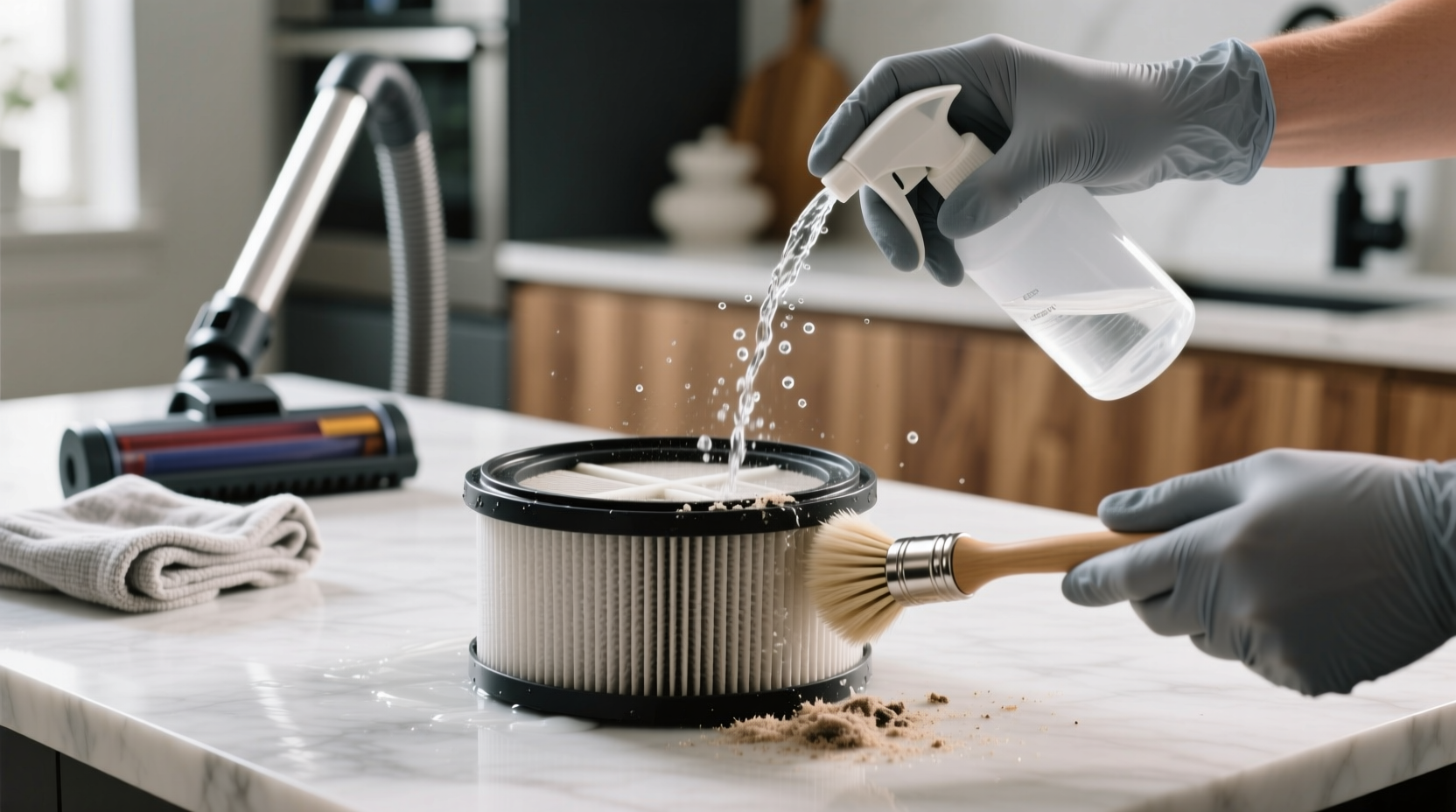
Maintenance Quick-Start: Most HEPA filters fail after improper washing, not normal use. Water weakens the fiber matrix, enlarges micron gaps, and allows fine dust to bypass the filtration system directly into the motor housing.
A vacuum motor depends on unrestricted airflow and controlled filtration. Once a HEPA filter loses structural integrity, microscopic dust enters the fan chamber, coats the carbon brushes, overheats the armature, and shortens motor life dramatically.
Many homeowners assume rinsing equals maintenance. In reality, washing the wrong filter often causes permanent damage long before visible failure appears.
WARNING: Water Damage Inside HEPA Media Is Often Invisible
A HEPA filter may appear clean after rinsing while internal filtration efficiency has already collapsed.
Common damage caused by washing non-washable HEPA filters includes:
- Fiber separation inside the pleats
- Mold growth between damp layers
- Reduced airflow from swollen media
- Dust bypass into the motor chamber
- Premature thermal shutdowns
- Burnt motor odor during operation
A vacuum can continue running for weeks after filter damage begins. Motor failure usually appears later, making the filter problem difficult to trace.
THE FILTRATION HIERARCHY
| Filter Grade | Particle Size Outcome | Capture Efficiency | Medical Application |
|---|---|---|---|
| Standard Foam Filter | Captures large debris above 10 microns | Low | General household debris control |
| HEPA H13 Filter | Captures particles down to 0.3 microns | 99.95% | Hospital isolation rooms |
| ULPA Filter | Captures particles down to 0.12 microns | 99.9995% | Pharmaceutical clean rooms |
A damaged HEPA filter can perform worse than a basic foam filter because compromised media allows unrestricted particle leakage under motor pressure.
The Physics of Filtration
A proper HEPA filter works because of three forces. Water interferes with all of them.
1. Interception
Dust particles follow airflow and brush against fibers, sticking to them.
What water does: It flattens and clumps the fibers, reducing surface area. Fewer particles get caught.
2. Impaction
Larger particles can’t follow airflow curves and crash into fibers.
What water does: Wet fibers lose their spacing and rigidity.
Gaps close unevenly, forcing air through narrow channels instead of trapping debris.
3. Diffusion
Tiny particles move randomly and collide with fibers.
What water does: It removes the electrostatic charge that helps attract these fine particles. Without it, the filter loses its “magnetic” effect.
Bottom line: A washed non-washable HEPA filter doesn’t just perform worse. It actively chokes airflow, which is harder on the motor than a dirty filter.
Why Washing a HEPA Filter Often Destroys It
HEPA filters use tightly packed fiberglass or synthetic fibers arranged in dense microscopic layers. These fibers trap particles through interception, diffusion, and inertial impaction.
Water changes the spacing between those fibers.
Once spacing expands, the filter loses the ability to trap microscopic contaminants consistently. Drying does not restore original filtration density.
Three major failures happen after improper washing:
1. Pleat Collapse
Wet pleats soften and deform under airflow pressure. Air begins flowing unevenly through larger gaps instead of across the full filter surface.
Result:
- Reduced suction
- Louder motor operation
- Increased heat buildup
2. Adhesive Breakdown
Many HEPA filters use industrial adhesive to bond filter media to plastic frames. Repeated rinsing weakens those seals.
Result:
- Dust bypass around filter edges
- Internal contamination
- Motor carbon buildup
3. Mold Contamination
Moisture trapped deep inside folded media creates ideal mold conditions.
Result:
- Musty exhaust odor
- Air quality contamination
- Respiratory irritation indoors
The “Sealed System” Requirement: Testing for Air Bypass in Bagless Vacuums
A true HEPA system requires more than a HEPA label.
Many vacuums contain HEPA filters while leaking contaminated air through loose seals, cracked housings, or improperly seated dust bins.
A sealed system prevents microscopic dust from escaping before reaching the exhaust filter.
Signs of Air Bypass Failure
- Fine dust around filter compartments
- Gray residue near exhaust vents
- Sneezing during vacuuming
- Burning dust smell
- Dust accumulation behind the HEPA filter
Simple Tissue Test
Run the vacuum with a clean white tissue near:
- Dust-bin seams
- Hose connections
- Exhaust vents
- Filter doors
Visible fluttering or dust discharge indicates seal leakage.
Cheap bagless vacuums often fail this test after several years because plastic locking tabs weaken from heat and vibration.
Micron Math: Understanding the Difference Between 0.3 Microns and 10 Microns
Most visible household dust measures between 10 and 100 microns.
HEPA filtration targets particles far smaller than visible debris.
Particle Size Comparison
| Contaminant | Approximate Size |
|---|---|
| Human hair | 70 microns |
| Fine dust | 10 microns |
| Pollen | 5–10 microns |
| Mold spores | 3–40 microns |
| Bacteria | 0.3–5 microns |
| Smoke particles | Below 1 micron |
The 0.3-micron benchmark matters because particles at that size are hardest to capture consistently.
A damaged HEPA filter may still stop visible dirt while allowing dangerous microscopic particles to circulate freely indoors.
That difference explains why some vacuums appear clean while worsening indoor air quality.
Expert’s Insight
If dust is visible on the outside of the vacuum’s HEPA cover, the internal seals have failed. The vacuum is no longer sanitizing the air; it is polluting it.
Professional repair technicians frequently identify motor failure after repeated filter washing.
Fine drywall dust, ash, pet dander, and baking flour create the highest risk because those particles easily bypass weakened filtration media.
Once contamination reaches the motor fan assembly, repair costs usually exceed the value of mid-range vacuums.
How to Clean a Permanent Filter without Destroying the Micron-Mesh
Not all filters are disposable HEPA filters.
Some vacuums contain washable pre-motor foam or synthetic “permanent” filters designed for rinsing.
Correct identification matters.
Safe Cleaning Procedure for Washable Filters
Step 1: Verify Washable Status
Check:
- Printed filter label
- Owner’s manual
- Manufacturer markings
“HEPA,” “H13,” or “Exhaust Filter” usually indicates non-washable construction unless specifically labeled washable.
Step 2: Remove Loose Debris First
Tap the filter gently against a trash bin.
Never:
- Scrub aggressively
- Use detergent
- Use brushes
- Use compressed air
Aggressive cleaning tears filtration fibers.
Step 3: Rinse with Cool Water Only
Run water from the clean side outward.
Hot water damages synthetic mesh layers.
Step 4: Air-Dry for 24–48 Hours
A damp filter can destroy a vacuum motor within minutes.
No sunlight.
No hair dryers.
No heaters.
Heat warps filter frames and weakens adhesives.
Step 5: Reinstall Carefully
Improper seating creates air bypass gaps around the filter edge.
Even premium vacuums lose filtration performance from incorrect installation.
When Replacement Makes More Sense Than Cleaning
Filter replacement costs far less than motor replacement.
Replace a HEPA filter immediately after:
- Drywall cleanup
- Fireplace ash vacuuming
- Flood restoration cleanup
- Fine construction dust exposure
- Persistent odor development
- Visible pleat damage
Most HEPA filters last:
- 6–12 months in pet homes
- 12–18 months in standard homes
Heavy debris environments shorten lifespan significantly.
Common HEPA Filter Myths
“A Clean-Looking Filter Still Works”
False.
Microscopic fiber damage cannot be seen visually.
“Higher Suction Means Better Filtration”
False.
A vacuum can produce strong suction while leaking microscopic contaminants internally.
“Compressed Air Cleans Filters Safely”
False.
Compressed air ruptures delicate HEPA fiber layers.
“Every HEPA Filter Is Washable”
False.
Most sealed HEPA exhaust filters are disposable.
FAQs
1. Can a washed HEPA filter be reused safely?
Only if the manufacturer explicitly labels the filter washable. Standard HEPA exhaust filters usually lose efficiency permanently after rinsing.
2. Why does a vacuum smell worse after washing the filter?
Moisture trapped inside the media promotes mold growth and bacterial contamination during operation.
3. Can a clogged HEPA filter damage a vacuum motor?
Yes. Restricted airflow forces the motor to run hotter, increasing wear on bearings, brushes, and internal wiring.
Bottom Line
HEPA filtration depends on microscopic precision. Water, scrubbing, compressed air, and improper drying destroy that precision quickly.
A damaged HEPA filter rarely fails immediately. Performance drops slowly while fine dust enters the motor chamber unnoticed. By the time suction weakens or burning odors appear, internal contamination has often already occurred.
Safe maintenance starts with proper filter identification. Wash only filters designed for rinsing. Replace sealed HEPA filters on schedule. Protect airflow, protect seals, and protect the motor before expensive damage begins.