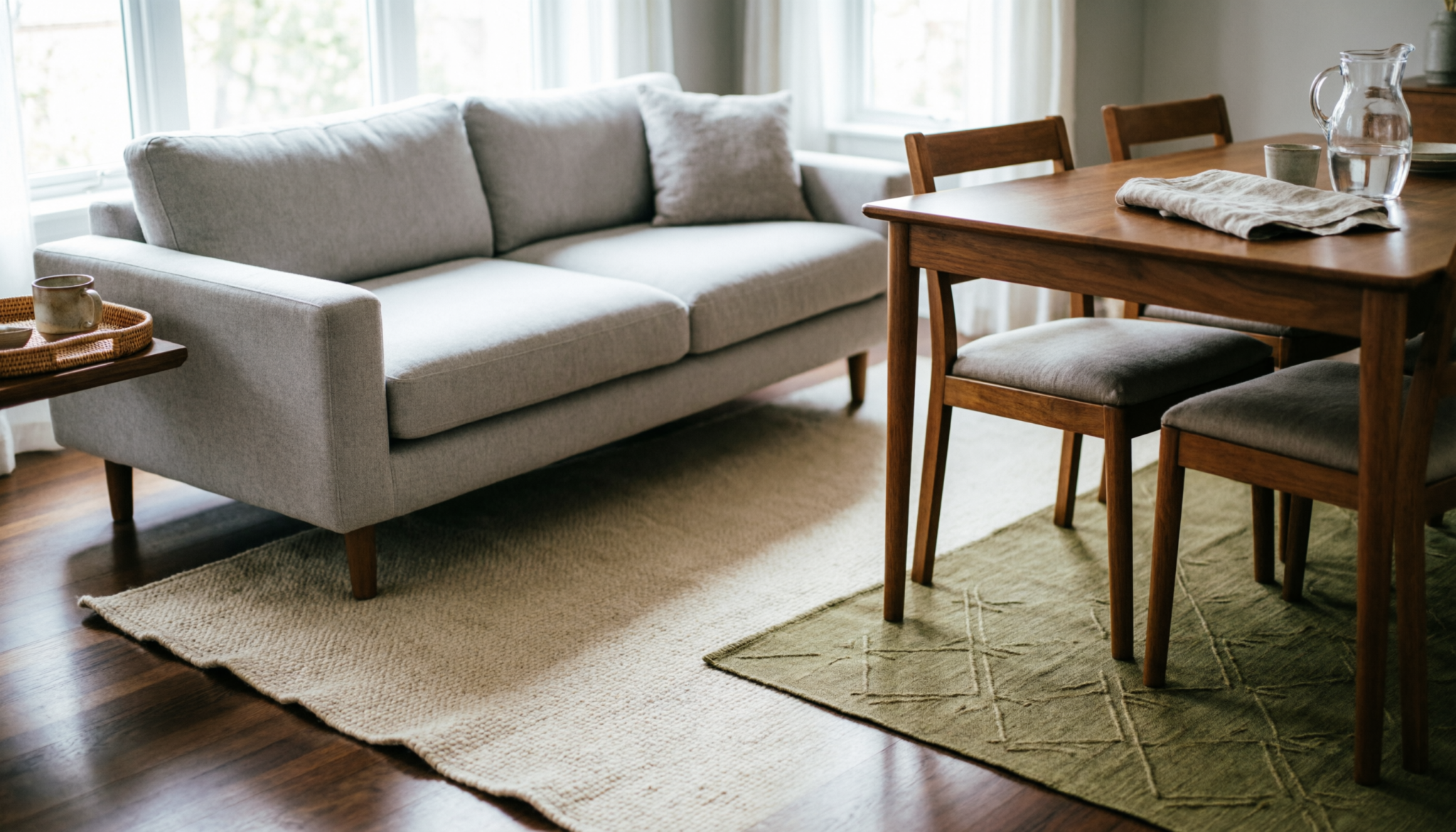
A rug anchors furniture, defines space, and controls visual balance. Wrong size breaks the room faster than any color choice.
The simplest fix relies on one clear rule: front legs must sit on the rug.
Follow this, and even basic furniture starts to feel grounded, cohesive, and properly scaled.
The Short Answer
To avoid the “floating island” look, a rug must be large enough so that at least the front two legs of all major furniture pieces sit on it.
In a living room, this usually requires an 8×10 or 9×12 rug. Using a 5×7 rug in a large room is the #1 design mistake that makes a space feel smaller.
The Living Room Layout: All Legs On vs. Front Legs Only
Two workable layouts exist. Choice depends on room size, budget, and furniture scale.
All Legs On the Rug (Best for Larger Rooms)
- Sofa, chairs, and tables sit fully on the rug
- Creates a unified zone with strong visual weight
- Works well in open-plan spaces where seating needs clear boundaries
Reality check: This setup demands a large rug, often 9×12 or bigger. Anything smaller forces awkward furniture placement or cramped spacing.
Front Legs Only (Best for Most Homes)
- Front legs of sofa and chairs sit on the rug
- Back legs remain off
- Maintains connection without crowding the room
Why this works: Visual anchoring happens at the front edge. That single line ties the layout together without needing oversized rugs.
Common Mistake: The “Postage Stamp” Rug
- Small rug floats in the middle
- Furniture sits completely off
- Room feels disjointed and smaller than actual size
Fix: Step up at least one size. A slightly oversized rug always looks intentional. A too-small rug always looks like a mistake.
The Bedroom Layout: The “Rule of Thirds” for Rug Placement Under a Bed
Bedroom rugs follow a different logic. Comfort and proportion matter more than full coverage.
The Rule of Thirds
- Place the rug under the lower two-thirds of the bed
- Leave the headboard and nightstands off the rug
- Extend rug far enough on each side for feet to land on softness
Ideal Rug Sizes by Bed Type
- Queen bed: 8×10 rug
- King bed: 9×12 rug
Why This Works
- Keeps focus on the bed without swallowing the room
- Provides softness where needed most
- Avoids bulky layering near the headboard
Common Bedroom Mistake
- Small rug placed under only the foot of the bed
- Looks disconnected and offers little comfort
Fix: Increase size so the rug reaches at least halfway under the bed, preferably two-thirds.
FAQs
1. Can a rug be too big for a room?
Yes. A rug that touches every wall edge feels wall-to-wall without intention. Leave 8–18 inches of visible floor around the perimeter for balance.
2. What size rug works under a coffee table only?
Skip that approach. A rug must connect seating, not just sit under a table. Choose a size that reaches at least the front legs of surrounding furniture.
3. How far should a rug extend past a sofa?
Aim for at least 6–12 inches beyond each side of the sofa. Shorter extensions feel tight and unfinished.
Final Thought
Good rug sizing solves more problems than color, pattern, or texture ever will. A properly sized rug makes furniture feel intentional and the room feel complete.
When in doubt, go larger, anchor the front legs, and keep proportions consistent. That single decision brings order, comfort, and quiet confidence to any space.