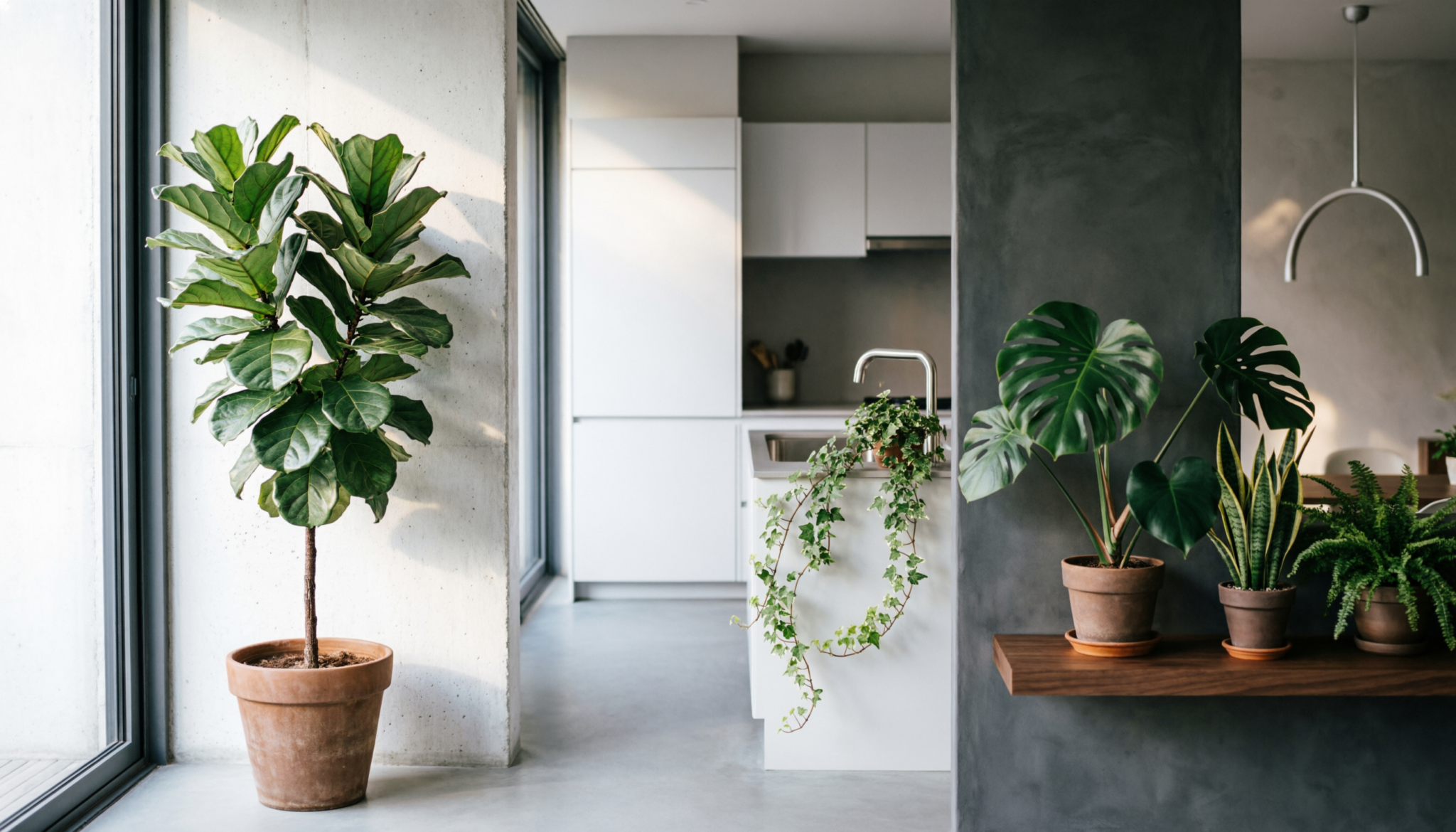
Minimalist homes often feel sharp and unwelcoming when hard surfaces dominate every line of sight. Greenery solves that problem without clutter.
The right plants soften edges, add movement, and introduce life into rigid spaces, making rooms feel balanced, calm, and comfortably lived-in without sacrificing clean design principles or simplicity.
The Short Answer
Minimalist architecture often suffers from “Visual Hardness” due to straight lines and cold materials like concrete and glass.
Organic shapes from plants like Monstera deliciosa or Ficus benjamina provide “Visual Relief.” Placing greenery near sharp angles breaks rigid lines and shifts the room toward a more human-centered feel.
The Design Solution Table
| Architectural Issue | The Plant Solution | Why it Works |
|---|---|---|
| Hard Corners | Large Leaf (Monstera) | Curved leaves soften sharp 90° angles. |
| Low Ceilings | Tall/Slim (Snake Plant) | Vertical lines guide the eye upward. |
| Cold Materials | Soft/Feathery (Ferns) | Adds gentle texture against hard surfaces. |
Where to Place Plants in a Modern Room
Start with the problem areas. Corners, long blank walls, and spaces beside furniture often feel stiff because nothing interrupts the geometry.
A tall plant tucked into a corner immediately softens a hard angle. Low plants placed near seating reduce the “floating furniture” effect common in minimalist layouts.
Avoid symmetry that feels forced. A slightly off-center plant placement creates a more natural rhythm, closer to how greenery appears outdoors.
Window edges also matter. Instead of leaving them bare, frame them with plants to soften incoming light.
Harsh daylight bouncing off glass and concrete becomes gentler when filtered through leaves.
Choosing Leaf Shapes That Contrast with Your Walls
Flat walls need contrast, not decoration. Plants provide that contrast through shape and texture.
Broad, split leaves like Monstera deliciosa interrupt straight lines with curves. Fine, feathery foliage like Nephrolepis exaltata softens harsh materials such as metal or polished stone.
Avoid matching plant shapes to the architecture. Sleek interiors already have enough straight lines. What’s missing is irregularity.
That tension between structured space and organic form is what makes the room feel balanced instead of cold.
A common mistake is using too many small plants. They scatter attention and create visual noise. Fewer, larger plants hold presence and calm the space.
Using Hanging Plants to Break Up High, Flat Ceilings
High ceilings often feel empty rather than spacious. Hanging plants solve this by drawing the eye upward without adding bulk.
Trailing plants like Epipremnum aureum or Chlorophytum comosum introduce movement where ceilings feel static. Suspended greenery also softens the harsh line where wall meets ceiling.
Placement matters more than quantity. One well-positioned hanging plant above a reading chair or near a window adds depth. Too many create clutter and defeat the minimalist intent.
Use simple planters and thin cords. Heavy or ornate hangers pull attention away from the plant and reintroduce visual heaviness.
FAQs
1. How many plants are enough in a minimalist home?
Start with two to four well-placed plants per room. More than that often creates clutter instead of softness. Focus on scale and placement rather than quantity.
2. Do artificial plants work for this purpose?
Only if quality is high. Poor imitations make a space feel more artificial. Real plants offer natural variation, which is what softens rigid architecture effectively.
3. Which rooms benefit most from greenery?
Living rooms and entryways show the biggest improvement because they often contain the most hard surfaces. Bedrooms also benefit, especially near windows or empty corners.
Final Thought
Minimalist design works best when it feels livable, not rigid. Greenery brings that missing layer of comfort without adding clutter.
A few well-chosen plants, placed with care, can soften harsh lines, calm bright spaces, and make a home feel grounded, balanced, and quietly welcoming every single day.