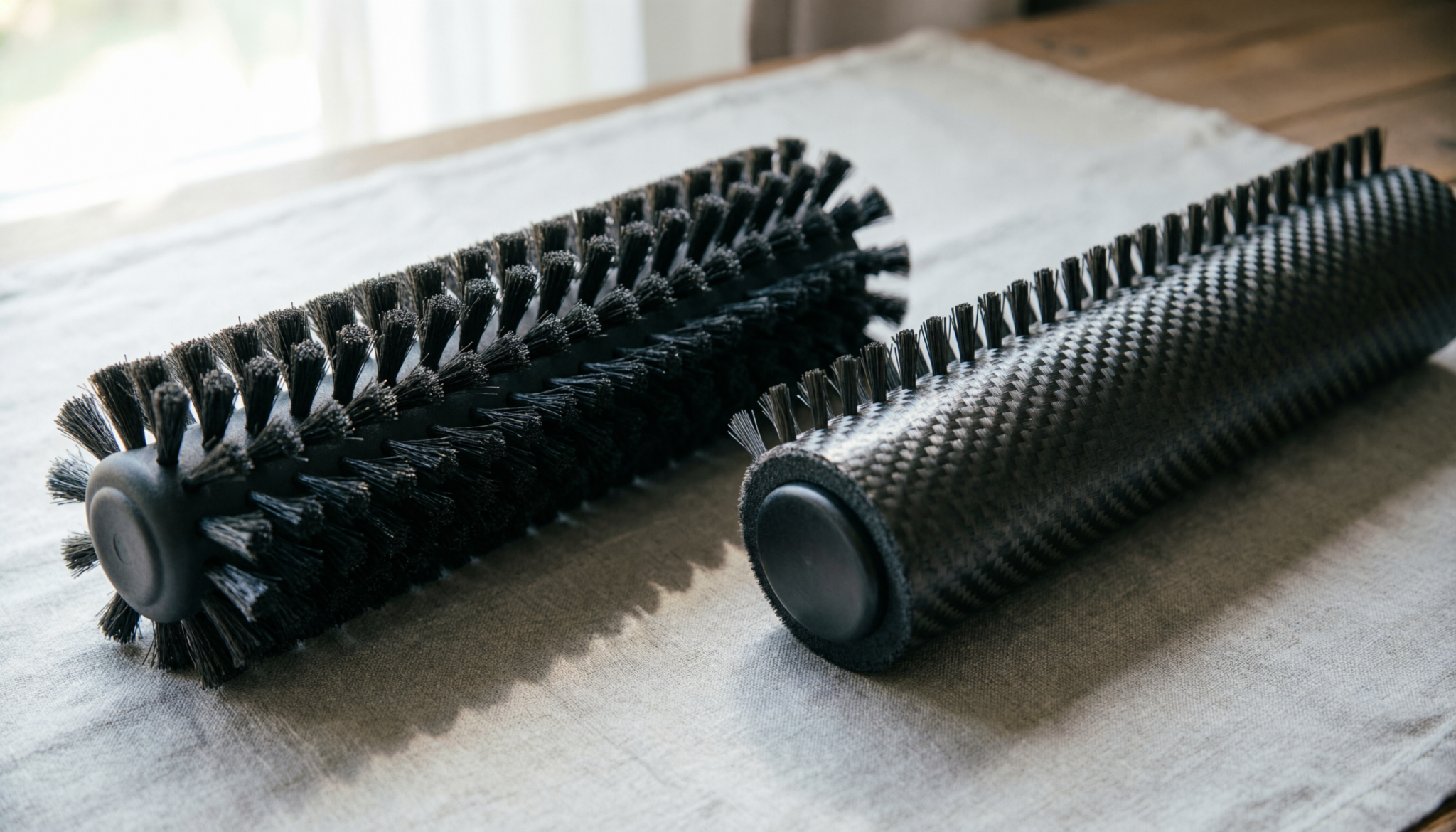
Diagnostic Summary: Nylon brushrolls generate stronger carpet agitation and resist abrasion from grit, pet hair, and sand. Carbon fiber brushrolls reduce static buildup and improve fine-dust pickup on hard flooring.
Mixed-material brushrolls combine aggressive grooming with anti-static dust control for balanced whole-home cleaning performance.
WARNING
Carbon fiber filaments fracture under aggressive scraping against concrete, tile grout edges, or exposed tack strips. Damaged fibers reduce static dissipation and may scratch glossy hardwood coatings.
Nylon bristles tolerate rough debris better but create more static electricity on synthetic flooring surfaces.
THE BRUSHROLL MATERIAL HIERARCHY
| Brushroll Material | Surface Performance Outcome | Debris Pickup Efficiency | Best Real-World Application |
|---|---|---|---|
| Standard Nylon | Deep carpet agitation | Excellent for sand, crumbs, and pet hair | Thick carpets and high-traffic homes |
| Carbon Fiber | Static-neutral fine dust removal | Excellent for powder and ash | Hardwood, laminate, and low-pile flooring |
| Hybrid Nylon + Carbon Fiber | Balanced agitation with static reduction | Highest multi-surface versatility | Mixed-floor households |
Quick Distinction
Nylon bristles are engineered for agitation. Their stiffness and resilience beat carpet fibers and flick out embedded grit.
Carbon fiber filaments are engineered for anti-static dusting.
Conductive strands neutralize the static bond between fine dust and hard floors, allowing suction to lift particles cleanly.
The Anatomy of a Carpet-Safe Brushroll: Nylon vs. Carbon Fiber
A brushroll has a simple job: loosen debris so airflow can carry it away.
The method changes depending on the floor beneath it.
Carpet traps debris deep between fibers. Hard flooring holds dust through static charge. Different materials solve each problem.
A brush built for carpet must agitate aggressively without shredding fibers.
A brush built for hard floors must release dust gently without scattering it across the room.
Nylon: The Carpet Beater
Nylon bristles dominate carpet brushrolls for one reason: strength with controlled flex.
Carpet acts like a filter. Sand, crumbs, hair, and soil settle near the base of the pile. Suction alone rarely reaches that layer.
Stiff nylon bristles solve the problem through mechanical agitation.
When the brushroll spins:
- Bristles dig into carpet fibers
- Fibers flex and rebound
- Trapped grit gets flicked upward into the airflow
That grit often includes fine mineral particles.
On carpet, these particles behave like sandpaper. Without strong agitation, they remain buried and slowly wear down fibers.
Why nylon works well:
- High tensile strength
- Resists bending fatigue
- Maintains shape after thousands of rotations
Soft plastic bristles flatten quickly. Nylon springs back. That rebound keeps the beating action consistent.
Result: grit lifts out of carpet instead of grinding deeper.
Carbon Fiber: The Hard Floor Specialist
Hard floors face a completely different cleaning problem: static electricity.
Dust particles carry a small electric charge.
Smooth surfaces such as hardwood, laminate, or tile often build static as air moves across them. That static bond holds fine dust in place.
Traditional plastic bristles push dust around instead of lifting it. A familiar result appears: dust streaks or smears across the floor.
Carbon fiber filaments fix this through conductivity.
Carbon fiber allows tiny electrical charges to move along the filament and dissipate into the vacuum body.
Once the charge neutralizes, dust loses its grip on the floor. Then suction does the rest.
Key advantages of carbon fiber:
- Conducts electricity
- Neutralizes static charge
- Extremely thin filaments reach fine dust
Instead of sweeping particles sideways, the brushroll gently releases them into the airflow.
This approach works especially well on:
- hardwood
- tile
- polished stone
- laminate
Fine dust, pollen, and allergens lift cleanly without streaking.
The “Hybrid” Brushroll
Modern vacuums often combine both materials in a single brushroll.
A hybrid design usually places:
- Stiff nylon bristles for carpet agitation
- Carbon fiber filaments for static control on hard floors
This combination creates an all-floor brush head capable of switching between surfaces without manual changes.
However, compromises appear.
Hybrid brushrolls typically provide:
- Good carpet cleaning
- Good hard-floor dust pickup
But rarely match the specialized performance of a dedicated carpet head or a soft hard-floor roller.
Homes with heavy carpet traffic still benefit from strong nylon agitation.
Homes with mostly hardwood floors often clean better with a soft roller packed with carbon fiber strands.
The “Static Control” Requirement
Vacuum brushrolls perform two separate jobs. First, bristles agitate carpet fibers to release embedded debris.
Second, the brushroll controls airflow movement near the floor surface. Material choice changes both functions dramatically.
Nylon creates aggressive contact pressure. Thick nylon strands flex against carpet backing and pull embedded grit upward into the suction channel.
Homes with pets, children, and entryway traffic benefit from nylon because sand and hair require physical agitation before airflow can remove debris.
Carbon fiber works differently. Conductive fibers reduce electrostatic buildup during cleaning.
Fine powders such as flour, fireplace ash, pollen, and drywall dust cling to hard floors because static electricity holds particles in place.
Carbon fiber neutralizes that charge and allows airflow to pull particles into the vacuum path.
Many premium vacuums now use hybrid brushrolls because flooring changed over the last decade. Older homes relied heavily on carpet.
Modern homes combine hardwood, luxury vinyl plank, tile, rugs, and low-pile synthetic carpet. One material no longer handles every cleaning condition efficiently.
Static control matters more than most homeowners realize. Dry climates, synthetic socks, vinyl flooring, and low humidity increase electrostatic charge dramatically.
Standard nylon brushrolls often scatter dust sideways before suction captures it. Carbon fiber reduces that “snowplow effect.”
Expert Insight
Technician’s Insight: Burned brushroll bearings often start with wrapped hair and thread buildup near the end caps. Nylon bristles hide debris accumulation longer because dense strands conceal internal jams.
Carbon fiber layouts expose tangles earlier, making maintenance easier and reducing long-term motor strain inside the cleaner head.
Micron-Level Dust Pickup and Floor Material Interaction
Fine particle pickup separates average vacuums from genuinely effective machines.
Large debris removal looks impressive during demonstrations. Real indoor air contamination comes from microscopic dust particles invisible to the eye.
Nylon excels at lifting larger debris:
- cereal
- pet fur
- soil
- sand
- lint
Carbon fiber excels at controlling:
- flour
- ash
- skin flakes
- pollen
- drywall powder
Hard flooring exposes this difference immediately. Bright sunlight often reveals a haze after vacuuming with aggressive nylon-only brushrolls. Dust redistributes instead of entering the airflow stream completely.
Carbon fiber reduces airborne redistribution because conductive strands discharge static buildup during rotation.
Floor finish also changes results.
Glossy hardwood coatings reveal micro-scratching more easily. Stiff nylon can accelerate dulling over time if trapped grit remains inside the brush chamber.
Carbon fiber strands apply less abrasive pressure against finished surfaces.
Tile and grout create opposite conditions. Deep grout lines trap abrasive sand particles. Nylon survives these abrasive conditions longer. Carbon fiber wears faster against textured tile edges.
No single material dominates every floor type.
Heat, Friction, and Brushroll Longevity
Brushroll failure rarely starts with the motor. Heat buildup causes most premature wear.
Friction develops in four areas:
- End-cap bearings
- Hair tangles
- Belt contact zones
- Floor resistance
Nylon tolerates heat better than carbon fiber. Continuous friction from pet hair and carpet fibers causes less structural weakening in nylon strands.
Carbon fiber performs best in controlled environments with smoother flooring and lower abrasion exposure.
Brushroll lifespan depends heavily on maintenance frequency.
Warning signs of brushroll deterioration include:
- Loud ticking noises
- Uneven sweeping patterns
- Visible bald strips
- Burning odors
- Reduced edge cleaning
- Dust trails behind the vacuum
Neglected brushrolls overload vacuum motors because resistance increases rotational drag.
Many homeowners replace entire vacuums when a $20 brushroll assembly caused the performance drop.
How to Clean a Brushroll without damaging the Bristles
Incorrect cleaning destroys brushroll geometry faster than normal use.
Avoid scissors near carbon fiber strips. Sharp blades fracture conductive filaments permanently.
Safe cleaning procedure:
- Disconnect power completely.
- Remove the brushroll housing.
- Pull wrapped hair manually using needle-nose pliers.
- Cut thick thread buildup only along designated cleaning grooves.
- Wipe bristles with a dry microfiber cloth.
- Inspect end-cap bearings for resistance.
- Remove dust buildup from airflow channels before reassembly.
Never soak carbon fiber brushrolls in water for extended periods. Moisture intrusion weakens adhesive mounting strips inside many cleaner heads.
Nylon tolerates mild soap washing better, but complete drying remains essential before reinstalling.
Compressed air works well for fine dust removal inside hybrid brush assemblies.
FAQs
1. Does carbon fiber replace nylon completely?
No. Carbon fiber improves fine-dust pickup and static reduction but lacks the aggressive carpet agitation needed for deep debris removal. Hybrid systems balance both strengths.
2. Why do some vacuums scatter debris on hard floors?
Excessive brush stiffness, poor airflow design, or static buildup usually causes debris scattering. Nylon-only brushrolls often create this problem on lightweight dust and dry flooring surfaces.
3. Which brushroll lasts longer in pet homes?
Nylon generally survives longer under heavy pet-hair loads because thicker bristles resist friction and abrasion better than delicate carbon fiber strands.
Bottom Line
Brushroll material changes cleaning behavior more than raw suction numbers. Nylon dominates deep carpet agitation and durability. Carbon fiber excels at static reduction and microscopic dust pickup on hard floors.
Hybrid brushrolls deliver the strongest real-world versatility because modern homes rarely contain one flooring type alone.