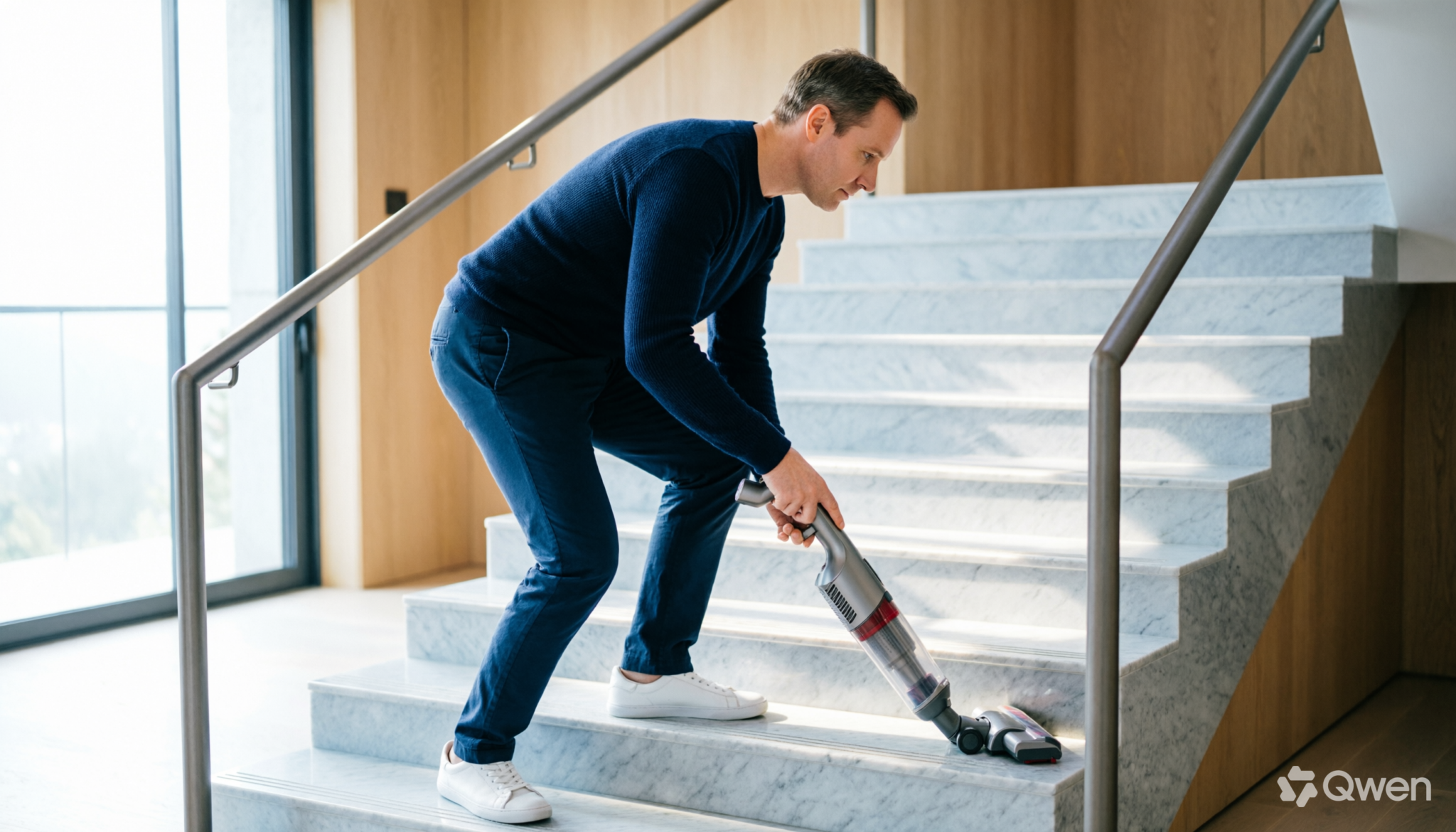
Vacuum stairs with a neutral spine, short controlled strokes, two-point footing, and frequent pauses; limiting awkward reaches reduces spinal loading and improves cleaning stability across repeated stair cycles.
Vacuuming stairs creates a surprisingly demanding ergonomic task. Each tread sits at a different height, footing changes continuously, and conventional vacuum handles often force excessive reaching.
Unlike floor cleaning, stair vacuuming combines bending, twisting, pulling, lifting, and balance control. Repetition magnifies every poor movement pattern.
A 20-step staircase can require dozens of reaches and repeated equipment repositioning before cleaning ends.
The safest approach starts with body position rather than vacuum power. Stable footing, neutral spinal alignment, controlled handle movement, and sensible equipment placement reduce unnecessary mechanical stress.
Warning: Never Vacuum From Unstable Footing
WARNING: Never vacuum stairs while standing on a loose tread, stretching across multiple steps, twisting under load, or balancing equipment against the body; unstable footing increases fall risk significantly.
Stair-Vacuuming Techniques Compared
| Technique | Spinal Demand | Stability |
|---|---|---|
| Upright standing with long reach | High | Low |
| Kneeling or low-position cleaning | Moderate | High |
| Short strokes with stable footing | Low | High |
Neutral Spine Reduces Repetitive Stair Strain
A neutral spine maintains a relatively natural alignment between the head, rib cage, pelvis, and lower back. Stair cleaning becomes more demanding when repeated reaching pushes the torso forward or sideways.
Forward bending increases the mechanical demand placed on spinal extensor muscles. Adding a loaded vacuum hose or machine increases that demand further. Twisting while bent creates another unnecessary stressor.
A better technique keeps the torso relatively upright while the arms perform controlled movements. The vacuum head should remain close enough to prevent excessive shoulder and trunk extension.
Shorter strokes also matter. A six-inch controlled stroke requires less body displacement than a long sweeping movement across an entire tread. Repeated short movements can therefore reduce exaggerated reaching.
Keep the Vacuum Close During Each Stroke
Equipment position determines posture. A vacuum placed several steps away encourages long hose extensions, shoulder elevation, trunk rotation, or forward bending.
A safer arrangement keeps the machine on a stable landing or lower step whenever manufacturer instructions permit that position.
Hose length should provide cleaning reach without forcing the torso beyond a comfortable upright position.
For portable equipment, carrying weight becomes another consideration. A heavy machine held against the body increases load on the shoulders and trunk.
A lighter hand-held unit can reduce carrying demand, although excessive wrist deviation or prolonged gripping can create separate fatigue.
Handle height also matters. A handle positioned too low encourages trunk flexion. A handle positioned too high can elevate the shoulders.
Elbows should remain relatively relaxed instead of locked straight during repeated strokes.
Stable Foot Placement Controls Stair Cleaning
Foot placement provides the foundation for safe stair vacuuming. One foot should never need to reach several steps away while the cleaning head travels in the opposite direction.
A stable stance keeps both feet supported on secure surfaces whenever possible. Cleaning should proceed systematically from one section to the next instead of forcing large lateral reaches.
Kneeling can provide additional stability for some stair designs, particularly when tread depth permits secure positioning. However, kneeling should never occur on narrow or slippery surfaces where balance becomes compromised.
The cleaning sequence should also prevent backward movement on the staircase. Working from the lowest accessible section upward can reduce the need to step over equipment or navigate around a trailing cord.
Cord management deserves special attention because loose cords create trip hazards.
A useful ergonomic rule involves movement before force: reposition the body before extending the arm beyond a comfortable range.
Pacing Prevents Fatigue From Accumulating
Back strain rarely results from one ordinary vacuum stroke. Repetition, fatigue, awkward posture, and insufficient recovery create the larger problem.
A 20-step staircase can produce hundreds of repetitive movements during detailed cleaning. Fatigue gradually reduces postural control, making excessive reaching and twisting more likely.
Short work intervals help preserve movement quality. A brief pause after several stair sections allows the shoulders, hands, and lower back to relax before cleaning continues.
Pacing should also match equipment weight. A heavy canister, long hose, and multiple attachments create cumulative handling demands even when individual movements seem easy.
Changing movement patterns can reduce localized fatigue. Alternating hand position where equipment design allows safe control can prevent one shoulder and forearm from receiving all repetitive load.
Pain represents a stopping signal rather than a challenge to overcome. Persistent or worsening pain warrants professional medical assessment rather than continued cleaning.
Expert Insight: Reposition First, Reach Second
Expert Insight: Stair vacuuming becomes safer when body repositioning replaces excessive reaching; neutral alignment, stable footing, short strokes, and planned pauses reduce cumulative mechanical loading during repetitive cleaning cycles.
Choose Movement Over Maximum Reach
Maximum hose reach often looks efficient but can create poor ergonomics. A vacuum head may technically reach an entire tread while the operator bends, rotates, or leans outside a stable base.
Efficiency should instead mean completing cleaning with minimal unnecessary body movement. Moving one step or repositioning equipment can require less physical effort than maintaining an extended posture for several seconds.
The same principle applies to corners. Instead of twisting the torso toward a difficult edge, the operator should reposition the feet and shoulders toward the cleaning zone.
Attachments can also influence posture. A narrow stair tool may allow closer cleaning without excessive wrist or shoulder deviation. A flexible hose can improve reach, but flexibility should support better positioning rather than encourage extreme extension.
Match Equipment Weight With Stair Layout
Stair architecture changes ergonomic demands. Narrow staircases provide less room for equipment placement. Open staircases can create greater fall exposure. Deep treads allow more stable kneeling than shallow treads.
Heavy equipment becomes especially problematic when machines must be carried repeatedly between floors. Weight should therefore be evaluated as a handling factor rather than simply a suction specification.
Cordless equipment eliminates cord-trip hazards but does not automatically eliminate ergonomic problems. Battery weight, handle balance, trigger pressure, and cleaning-head resistance still affect fatigue.
A well-balanced vacuum can feel easier to control than a lighter machine with poor weight distribution. Handle geometry also matters because a comfortable grip can reduce excessive wrist bending during repeated passes.
FAQs
1. What is the safest posture for vacuuming stairs?
A relatively upright torso, neutral spinal alignment, stable foot placement, relaxed shoulders, and short controlled strokes provide a safer starting position.
2. Should stairs be vacuumed standing or kneeling?
Standing works well when stable footing and suitable equipment reach are available. Kneeling can improve control on sufficiently deep, secure treads but creates problems on narrow or slippery stairs.
3. How often should breaks occur during stair vacuuming?
Break frequency should match fatigue rather than follow a rigid timer. Short pauses after several stair sections can help maintain posture, grip control, and movement accuracy.
Bottom Line
Safe stair vacuuming depends more on movement mechanics than raw suction power.
Neutral spinal alignment, stable footing, short strokes, sensible equipment placement, controlled pacing, and timely repositioning reduce unnecessary strain while maintaining thorough cleaning performance across demanding stair surfaces and repeated cleaning sessions.