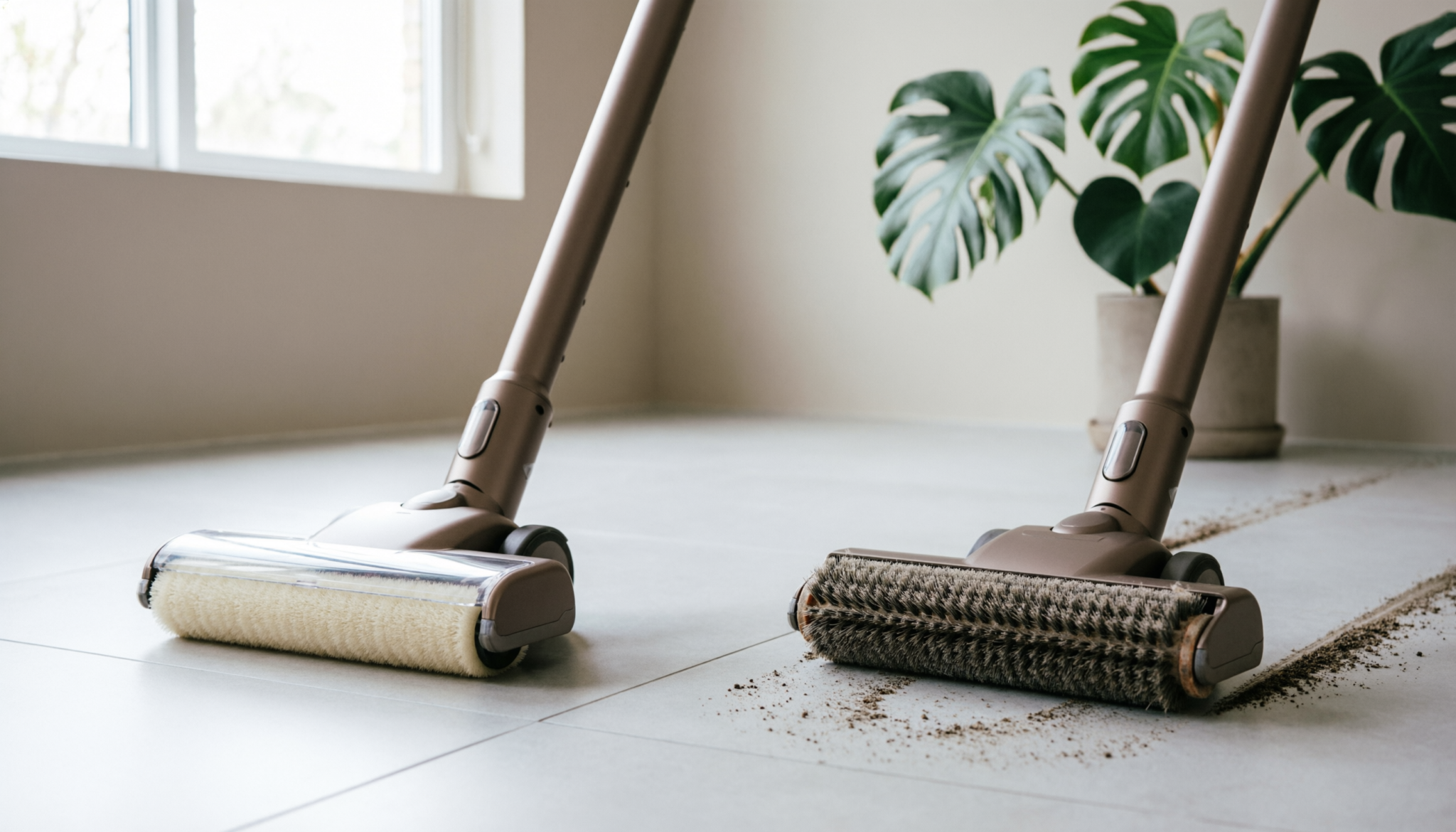
Hard floors expose every weakness in a vacuum head. Crumbs scatter, fine dust clings, and cleaning takes longer than it should.
The problem is not suction power. The problem is the wrong tool for the surface.
Soft roller technology fixes what standard brushrolls simply cannot handle.
The Short Answer
The Concept:
A soft roller head replaces stiff bristles with dense woven nylon and carbon fiber filaments.
Instead of flicking debris or pushing it forward, the roller wraps around particles and seals against the floor.
Both large debris and fine dust get lifted in a single pass.
The “Snowplow” Effect
Standard brushrolls were built for carpets, not hard floors. Stiff bristles spin fast and strike debris at an angle.
That impact sends larger particles forward instead of pulling them in.
Think of cereal, rice, or cat litter. A low-profile head meets resistance, then pushes debris across the floor. More passes follow. Frustration builds.
The failure comes down to three flaws:
- Wrong contact angle: Bristles hit debris instead of scooping it
- Air gaps: Poor sealing reduces suction at floor level
- Excess agitation: Spinning motion scatters instead of collects
Soft rollers solve this by staying in constant contact with the floor. The material bends, grips, and lifts instead of batting debris away.
Static Dissipation: Why Fine Dust Won’t Budge
Hard floors hold onto fine dust through static electricity. Standard brush heads ignore this completely.
Dust sticks, then settles back down after each pass, leaving faint streaks often called “ghost lines.”
Carbon fiber filaments inside soft rollers address this directly. These fibers reduce static charge at the surface, breaking the bond between dust and floor.
What actually changes:
- Dust releases instead of clinging
- Fewer repeat passes
- Cleaner finish without streaks
This is the difference between a floor that looks clean and one that actually is clean.
Why the Standard Brushroll Is Outdated
The classic brushroll made sense decades ago when most homes had wall-to-wall carpet. That design focused on digging dirt out of fibers.
Hard flooring has taken over many homes, but the default vacuum head has not caught up. Using a carpet tool on tile, hardwood, or laminate leads to poor pickup, scattered debris, and wasted time.
A soft roller is not an upgrade. It is the correct tool for the surface.
When NOT to Use a Soft Roller
Soft rollers fail on carpet. No sugarcoating here.
- No deep agitation
- No ability to lift embedded dirt
- Weak performance on thick pile
Carpet needs stiff bristles to reach down and loosen debris. Soft rollers glide over the surface without doing real work.
Best setup in a practical home:
- Soft roller for hard floors
- Bristle brushroll for carpets and rugs
Anything else is a compromise.
Performance Comparison
| Metric | Standard Bristle Head | Soft Roller Head |
|---|---|---|
| Large Debris | Pushes or flicks forward | Envelops and captures |
| Micro-Dust | Leaves streaks behind | Lifts and removes fully |
| Static Bond | No effect | Neutralizes and releases |
The Bottom Line
Cleaning struggles on hard floors rarely come from weak suction. Most of the time, the wrong head is doing the job.
Standard brushrolls push debris around and leave fine dust behind. Soft rollers grip, seal, and lift everything in one motion.
For hard floors, sticking with a traditional head is not practical. It is outdated.