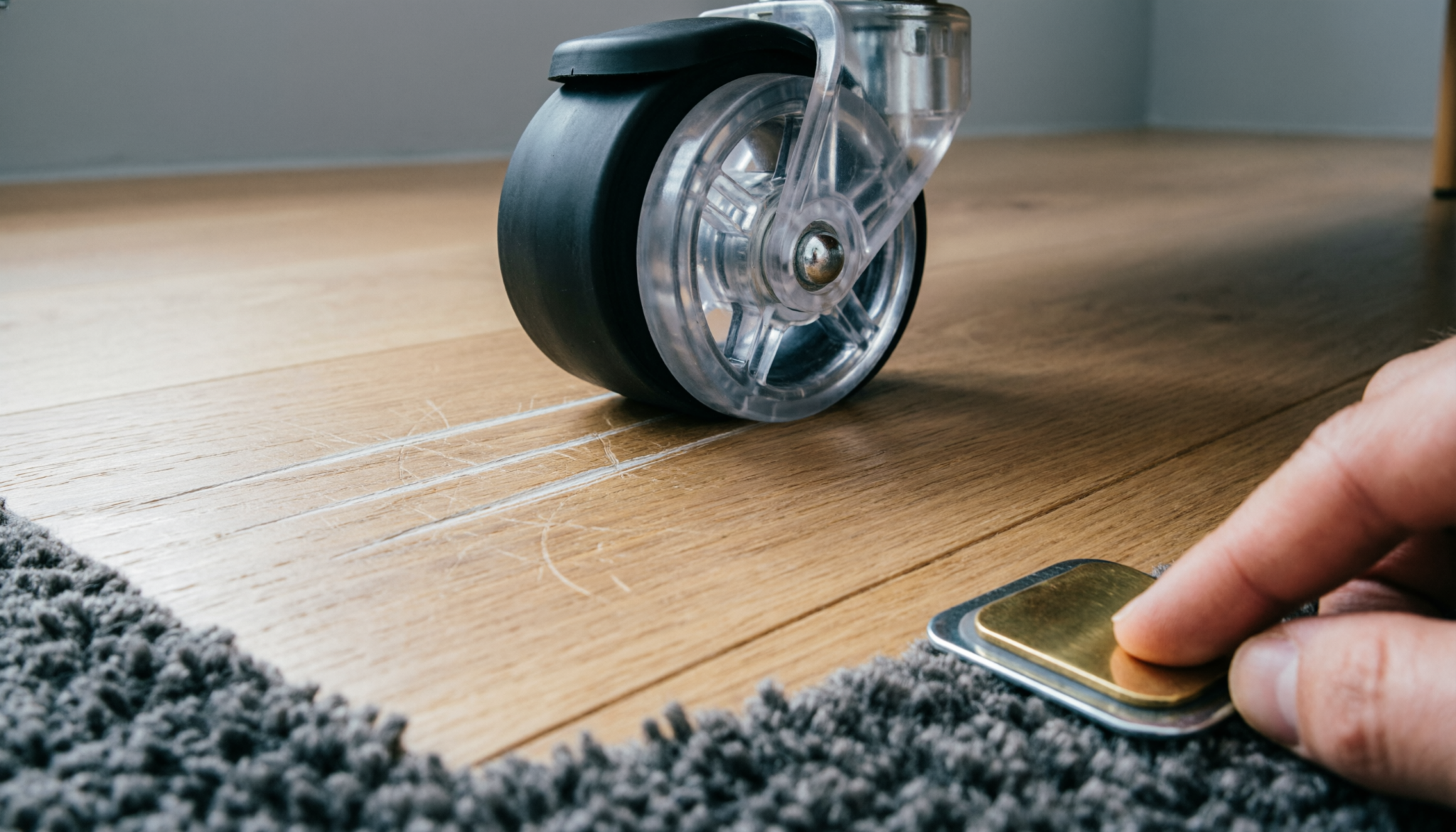
Maintenance Quick-Start: Preventing vacuum-induced floor scratches requires weekly wheel cleaning, debris removal from axle housings, and replacement of hardened plastic rollers before edge cracking occurs.
WARNING
Plastic wheel damage often appears gradually. Small scratches accumulate until reflective flooring develops permanent haze patterns under sunlight.
Never use a vacuum with:
- Cracked wheel edges
- Embedded sand or glass fragments
- Flattened caster rollers
- Missing rubber wheel coatings
- Seized bearings
- Misaligned brush heads
Dragging a locked wheel across hardwood creates pressure gouges that sanding cannot always remove.
The Wheel Protection Hierarchy
| Wheel Grade | Surface Outcome | Friction Control | Best Flooring Application |
|---|---|---|---|
| Soft Rubber-Coated Wheels | Minimal scratching risk | Excellent grip and cushioning | Hardwood, luxury vinyl plank |
| Thermoplastic Elastomer (TPE) Wheels | Reduced drag marks | Moderate shock absorption | Laminate, tile |
| Hard Plastic Wheels | High scratch potential | Poor debris isolation | Concrete, utility flooring |
Soft wheel compounds distribute weight more evenly. Hard plastic concentrates pressure at sharp wheel edges.
The Short Answer
The Danger:
Standard vacuums often use high-density polyethylene (HDPE) plastic wheels. These wheels trap fine debris like sand and tiny stones.
This “grit embedding” turns each pass into a scraping motion, causing visible linear scuffs on hardwood, laminate, and luxury vinyl plank (LVP).
The Solution:
Use vacuums with rubberized wheels or felt-lined casters. Clean wheels frequently to remove trapped debris before it causes damage.
The Science of “Grit Embedding”
Floor finishes may look tough, but hardness tells a different story. On the Mohs scale, quartz (common in sand) ranks around 7.
Most polyurethane floor finishes sit much lower. That gap matters.
Plastic wheels do not flex. Pressure from body weight and movement forces embedded grit downward.
Instead of rolling smoothly, the wheel becomes a rigid carrier that drags abrasive particles across the surface.
Over time, this creates straight, dull scratch lines that cannot be polished out.
Soft flooring like LVP fares even worse. The thinner wear layer shows damage quickly, often within weeks of regular use.
Anatomy of a Floor-Safe Wheel
Rubber Treads
Rubber behaves differently under pressure. Shore A hardness measures how soft or firm rubber is.
Softer rubber absorbs small particles instead of pinning them against the floor.
A quality rubber tread slightly compresses as it rolls. That compression spreads weight and reduces point pressure.
Less pressure means less chance of grit cutting into the surface.
Cheap rubber blends, however, can be too hard. If the wheel feels slick and rigid, performance will not improve much over plastic.
Felt-Lined Casters
Felt-lined casters provide an added layer of protection. Felt acts like a buffer, trapping fine dust before it reaches the floor.
High-end canister vacuums often use this design because the wheels swivel in all directions.
That movement increases friction risk. Felt reduces that risk by softening every contact point.
Drawback: felt collects debris over time. Without cleaning, it can become another source of abrasion.
3-Step Prevention Protocol
1. The Finger Test
Run a finger slowly along each wheel.
- Rough edges signal worn plastic
- Tiny bumps suggest embedded grit
- Sharp seams can act like blades
Any irregularity means immediate cleaning or replacement.
2. Wheel Grooming
Routine cleaning prevents buildup.
- Use a soft cloth with isopropyl alcohol
- Rotate wheels while wiping to reach all sides
- Remove hair, threads, and sticky residue
Alcohol breaks down grime that water alone cannot remove. Dry fully before use.
3. Aftermarket Fixes
Existing vacuum with hard wheels does not require immediate replacement.
- Apply adhesive felt tape to wheel edges
- Use small furniture socks for temporary protection
- Replace worn wheels if compatible parts exist
These fixes reduce friction but require regular checks. Loose or dirty coverings can cause new problems.
Expert’s Insight
Expert’s Insight: “Most floor scratches blamed on brush rollers actually originate from contaminated rear wheels. Axle housings collect grit silently. A perfectly clean brush head still scratches hardwood once embedded silica hardens inside plastic rollers.
Wheel Material vs. Scratch Potential
| Wheel Material | Hardwood Floors | Laminate | LVP (Luxury Vinyl) | Tile |
|---|---|---|---|---|
| Hard Plastic (HDPE) | High Risk | High Risk | Very High Risk | Low |
| Hard Rubber | Moderate Risk | Moderate | Moderate Risk | Low |
| Soft Rubber | Low Risk | Low Risk | Low Risk | Very Low |
| Felt-Lined Casters | Very Low Risk | Very Low | Very Low Risk | Very Low |
Flooring Types Most Vulnerable to Vacuum Scratches
Hardwood
Most vulnerable surface. Gloss coatings show wheel trails immediately.
Luxury Vinyl Plank (LVP)
Thin wear layers scratch under concentrated wheel pressure.
Laminate
Surface coatings resist moisture but not embedded grit abrasion.
Polished Concrete
Resists scratching well but reveals drag haze under angled lighting.
Ceramic Tile
Usually safe unless grout lines trap abrasive debris.
Smart Prevention Habits
Small maintenance routines prevent expensive refinishing bills.
Use Floor-Safe Wheel Mats
Parking vacuums on dirty garage floors contaminates wheels instantly.
Vacuum Slowly
Fast directional changes force wheels sideways.
Lift Across Thresholds
Dragging wheels over metal transitions chips wheel edges.
Replace Wheels Every Few Years
Wheel material degrades even without visible cracking.
Keep Entryways Clean
Most abrasive debris enters from outdoors.
FAQs
1. Why do vacuum wheels scratch hardwood floors?
Embedded grit inside hard plastic wheels acts like sandpaper. Worn wheels also develop sharp edges that drag across protective floor coatings.
2. Are rubber vacuum wheels safer than plastic wheels?
Yes. Rubber-coated wheels absorb pressure better and isolate microscopic debris more effectively than hard plastic.
3. Can scratched floors recover after vacuum damage?
Minor haze sometimes improves with polishing. Deep scratches in hardwood usually require sanding and refinishing.
Bottom Line
Plastic vacuum wheels damage floors slowly, silently, and expensively. Embedded grit, hardened wheel compounds, and poor maintenance create most scratches.
Regular wheel cleaning, proper filtration care, and early wheel replacement protect hardwood, laminate, and vinyl surfaces far more effectively than expensive floor repair products.t.