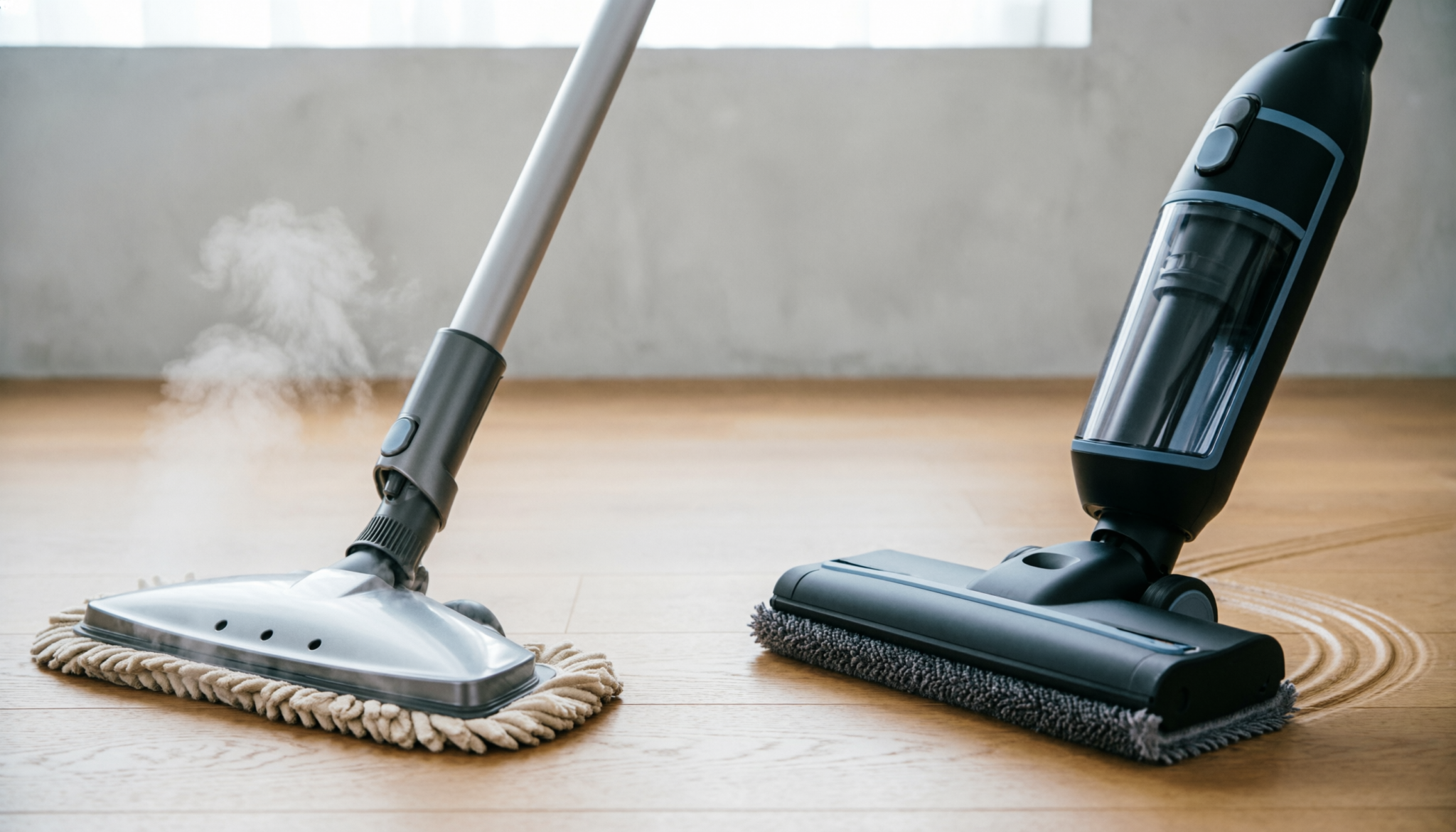
The Safety Brief: Laminate flooring fails when moisture penetrates seams and swells the fiberboard core beneath the wear layer. Steam mops create high heat and vapor pressure that can force moisture into microscopic gaps.
Vacuum mops reduce standing water but still risk edge damage when dirty pads or excessive liquid remain on the surface. Proper moisture control matters more than cleaning speed.
Warning: Most laminate-floor warranties specifically prohibit wet steam cleaning. Excessive heat can weaken adhesive layers, warp planks, and cause irreversible edge swelling.
Even “water-resistant” laminate has limits. Damage often begins silently beneath locking seams before visible bubbling appears.
Comparison Table
| Cleaning Method | Moisture Exposure | Heat Output | Laminate Risk Level |
|---|---|---|---|
| Steam Mop | High vapor penetration | High | Severe |
| Vacuum Mop | Controlled liquid application | Low | Moderate |
| Dry Vacuum + Damp Microfiber | Minimal surface moisture | None | Lowest |
The Core Problem: Laminate Is Not Waterproof
Laminate flooring is built in layers. The top wear layer resists scratches, but the core is compressed fiberboard. That core acts like a sponge once moisture gets in.
Here is where most cleaning advice goes wrong: surface dryness does not equal internal dryness.
Steam creates pressure that forces water past seams and edges, where it cannot evaporate easily.
Once moisture enters, the damage starts quietly. Edges lift. Boards swell. Seams split. No cleaning product fixes that.
Why Laminate Flooring Fails Faster Than Hardwood
Laminate flooring contains a photographic wear layer bonded over a high-density fiberboard core.
Unlike sealed hardwood, laminate absorbs moisture aggressively through seams, scratches, and chipped edges. Heat accelerates expansion inside the compressed core.
Steam creates two problems simultaneously:
- Elevated temperature softens adhesives
- Pressurized vapor pushes moisture into joints
A laminate plank rarely fails from one cleaning session. Damage accumulates gradually. Edges begin lifting. Corners swell slightly.
Locking mechanisms weaken. Months later, the floor develops soft spots and permanent ridges.
Vacuum mops create less thermal stress because cleaning relies on suction and controlled water distribution rather than vapor pressure. However, excessive liquid saturation still creates long-term swelling.
Floor failure often begins near:
- Kitchen sink transitions
- Entryways
- Plank ends
- Expansion gaps
- Areas with direct sunlight
Heat plus moisture creates the highest-risk combination for laminate flooring.
Steam Mop vs. Vacuum Mop: The Engineering Difference
Steam mops heat water to near-boiling temperatures and force vapor through microfiber pads. Cleaning power comes from thermal agitation and moisture release.
Vacuum mops combine suction with limited water dispensing. Dirty liquid gets extracted before prolonged surface exposure occurs.
The engineering trade-off centers around dwell time.
Steam leaves microscopic moisture inside seams because vapor condenses after penetration. Vacuum mops remove much of the liquid immediately.
Steam Mop Characteristics
- High thermal output
- Deep grout cleaning capability
- Effective grease breakdown
- Poor compatibility with laminate seams
- Increased adhesive stress
Vacuum Mop Characteristics
- Lower moisture exposure
- Simultaneous debris pickup
- Faster drying time
- Reduced edge saturation
- Better control over water usage
Steam excels on sealed tile and stone. Laminate flooring lacks the mineral stability required for repeated thermal cycling.
Moisture Retention: The Hidden Cause of Edge Swelling
Most laminate damage comes from residual moisture trapped along seams. Even small amounts of water expand compressed fiberboard permanently.
Three factors determine floor survival:
- Moisture quantity
- Exposure duration
- Surface temperature
Steam mops score poorly in all three categories.
Hot vapor condenses gradually after application. Moisture migrates downward into joints before evaporation occurs. Repeated cycles cause cumulative expansion.
Vacuum mops reduce retention because suction removes suspended liquid quickly. Problems arise when:
- Dirty rollers smear water
- Recovery tanks overflow
- Pads remain oversaturated
- Users pause in one spot too long
Drying speed matters more than cleaning intensity.
Laminate flooring should dry completely within two minutes after cleaning. Longer evaporation times indicate excessive moisture exposure.
Laminate Floor Cleaning Risk Analysis
| Cleaning Method | Moisture Penetration | Drying Speed | Long-Term Laminate Safety |
|---|---|---|---|
| Steam Mop | High | Slow | Poor |
| Vacuum Mop | Moderate | Fast | Fair |
| Dry Vacuum + Damp Microfiber | Low | Very Fast | Excellent |
Heat Damage and Surface Delamination
Steam weakens laminate through repeated thermal expansion. The decorative wear layer and fiberboard core expand at different rates under heat stress.
Over time, this creates:
- Surface bubbling
- Edge lifting
- Peeling corners
- Texture separation
- Faded finish zones
Cheap laminate fails fastest because thinner wear layers provide less dimensional stability.
Dark-colored laminate absorbs more heat and becomes especially vulnerable after steam exposure near windows or sunlit areas.
Vacuum mops avoid most thermal stress because water remains near room temperature. Less expansion means fewer failures at locking seams.
Manufacturers rarely advertise this limitation clearly because steam cleaning sounds sanitary and efficient. Real-world flooring failures tell a different story.
Safe Cleaning Protocols for Laminate Flooring
The safest laminate-cleaning method remains simple:
- Dry vacuum first
- Use minimal moisture
- Dry immediately
Best practices include:
- Microfiber pads instead of cotton
- Distilled water instead of mineral-heavy tap water
- Low-moisture spray application
- Cleaning along plank direction
- Immediate drying of spills
Avoid:
- Saturated mop heads
- Standing water
- High-temperature steam
- Abrasive scrubbers
- Oil-based cleaners
Laminate requires surface cleaning, not deep saturation.
Many homeowners over-clean floors with excessive moisture because glossy finishes create a false sense of waterproof protection.
The core beneath the surface tells the real story.
Expert Insight
Technician’s Insight: Steam damage rarely appears immediately. Laminate flooring often swells internally for weeks before visible cupping forms.
Most failed planks show moisture infiltration around locking seams rather than center-surface damage.
Fast drying protects laminate better than aggressive scrubbing. Heat accelerates adhesive fatigue and permanently weakens edge stability.
Why Marketing Terms Create Confusion
Terms like “water-resistant,” “sealed,” and “steam compatible” often mislead homeowners.
Water-resistant laminate handles accidental spills briefly. Continuous steam exposure differs completely from a dropped glass of water.
Manufacturers test flooring under controlled laboratory conditions:
- Stable humidity
- Precise temperature ranges
- Short exposure times
- Perfect installation conditions
Real homes contain:
- Humidity fluctuations
- Uneven subfloors
- Tiny seam gaps
- Worn protective coatings
Marketing language rarely reflects these realities.
Vacuum mops fit laminate better because liquid exposure stays measurable and controlled. Steam cleaning depends heavily on user technique, floor condition, and room temperature.
That margin for error becomes expensive quickly.
FAQs
1. Can steam mops ruin laminate flooring permanently?
Yes. Repeated steam exposure can swell the fiberboard core, weaken seams, and separate wear layers permanently. Damage usually cannot be repaired without plank replacement.
2. Are vacuum mops completely safe for laminate floors?
No. Excessive water usage, dirty rollers, and slow drying can still damage laminate. Vacuum mops simply reduce risk compared to steam cleaning.
3. What is the safest way to clean laminate flooring?
Dry vacuuming followed by a lightly damp microfiber pad remains the safest long-term cleaning method. Minimal moisture and fast drying protect seams and adhesive layers.
Bottom Line
Steam mops clean aggressively but create the highest risk for laminate flooring because heat and vapor penetrate vulnerable seams.
Vacuum mops reduce thermal stress and moisture retention but still require careful water control.
Dry vacuuming with a lightly damp microfiber cloth remains the safest maintenance method for preserving laminate structure, finish integrity, and locking-system durability over time.