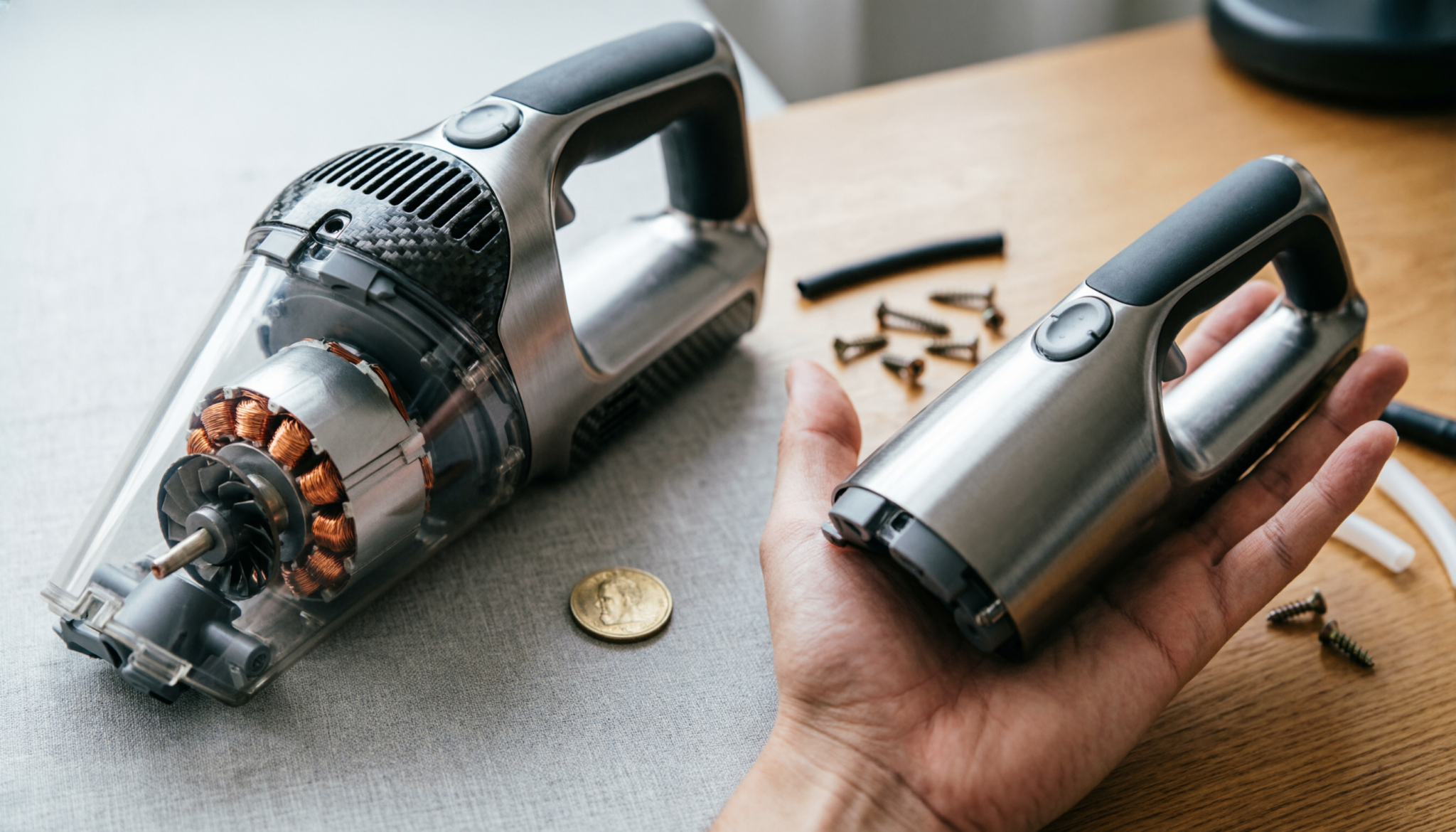
A 5-pound vacuum feels effortless in hand, but that comfort comes at a cost.
Smaller motors, lighter batteries, and compact bins all force compromises.
The real question is not whether lightweight vacuums work, but what performance limits show up once daily cleaning moves beyond quick touch-ups.
The Short Answer
The Reality: Engineering a lightweight vacuum requires trade-offs in battery density and bin capacity. T
o keep weight under 6 lbs, manufacturers often use 6-cell batteries with shorter runtime and smaller 0.5L dust bins.
Smaller motors rely on higher RPMs to match suction, which often produces a sharper, more noticeable noise.
Suction vs. Portability: The Core Trade-off
Weight reduction is not just about trimming plastic. It forces a full redesign of the motor, battery, and airflow system.
A heavier vacuum uses a larger motor that generates strong airflow at lower speeds. That delivers deep carpet agitation without excessive strain.
A lightweight model shrinks that motor.
To compensate, engineers push RPM higher, which increases noise and heat while still falling short on deep debris removal.
This is where expectations break. A 5-pound vacuum handles surface dirt well but struggles with embedded dust, especially in thick carpets or high-traffic areas.
What this means in real use:
- Great for daily maintenance
- Weak for deep weekly cleaning
- Noticeable drop in performance on rugs and pet hair buildup
Energy Density Limitations
Why a lightweight vacuum rarely cleans a large home in one go
Battery technology is the biggest constraint, not motor design.
A lightweight vacuum typically uses a 6-cell lithium-ion battery. That keeps weight down but limits total energy storage.
More cells mean more runtime, but also more weight. There is no shortcut here.
In practical terms:
- Average runtime: 20–40 minutes on standard mode
- High-power mode: often under 10 minutes
- Recharge time: 3–5 hours
Cleaning a 3,000 sq. ft. home on one charge sounds good on paper but breaks down in reality.
High-power mode drains the battery quickly, and standard mode often lacks the strength for deep cleaning.
Where this fails most:
- Multi-room homes with mixed flooring
- Homes with pets
- Deep carpet cleaning sessions
A second battery can solve this, but that adds cost and defeats the simplicity that lightweight models promise.
Bin Capacity: The Hidden Friction
Weight reduction forces smaller dust bins, often around 0.4–0.5 liters.
That sounds manageable until cleaning starts:
- Frequent emptying interrupts workflow
- Fine dust compacts quickly, reducing airflow
- Pet hair fills bins faster than expected
In a small apartment, this is manageable. In a larger home, it becomes frustrating. The cleaning rhythm breaks, and efficiency drops.
Noise Profile: The Trade You Hear Immediately
Smaller motors spin faster. That changes the sound, not just the volume.
Instead of a low, steady hum, lightweight vacuums often produce a high-pitched tone.
It cuts through a room more sharply and feels louder even when decibel levels are similar.
This matters in daily life:
- More noticeable in quiet homes
- More disruptive during early or late cleaning
- Fatiguing over longer sessions
Material Science
Polycarbonate vs. Magnesium: where premium models pull ahead
Weight reduction without durability loss depends heavily on materials.
Polycarbonate (common in mid-range models):
- Lightweight and affordable
- Resistant to impact but prone to flex over time
- Can feel less solid under heavy use
Magnesium alloys (used in high-end models):
- Stronger and lighter than many plastics
- Maintains structural rigidity
- Handles long-term stress better
Premium brands invest in magnesium to offset the downsides of miniaturization.
It does not improve suction directly, but it preserves build quality while shaving off weight.
Reality check:
Better materials improve durability, not performance. A magnesium body still cannot compensate for a smaller motor or battery.
Where Lightweight Vacuums Make Sense
This design works best in specific situations, not as a universal solution.
Strong fit:
- Small to medium homes
- Hard floors and low-pile carpets
- Quick daily cleaning
Weak fit:
- Large homes
- Thick carpets
- Heavy pet shedding
Trying to force a lightweight vacuum into heavy-duty cleaning leads to frustration. It is not a flaw in the product.
It is a mismatch between design and expectation.
The Smarter Approach
Treat lightweight vacuums as maintenance tools, not primary deep cleaners.
A practical setup often looks like this:
- Lightweight vacuum for daily use
- Heavier, corded model for weekly deep cleaning
This combination avoids overloading a single machine with conflicting demands.
Bottom Line
A 5-pound vacuum trades raw power for convenience. That trade is intentional, not a flaw.
The problem starts when lightweight models are expected to perform like full-size machines.
Understand the limits upfront, and the tool works well. Ignore them, and every cleaning session feels like a compromise.