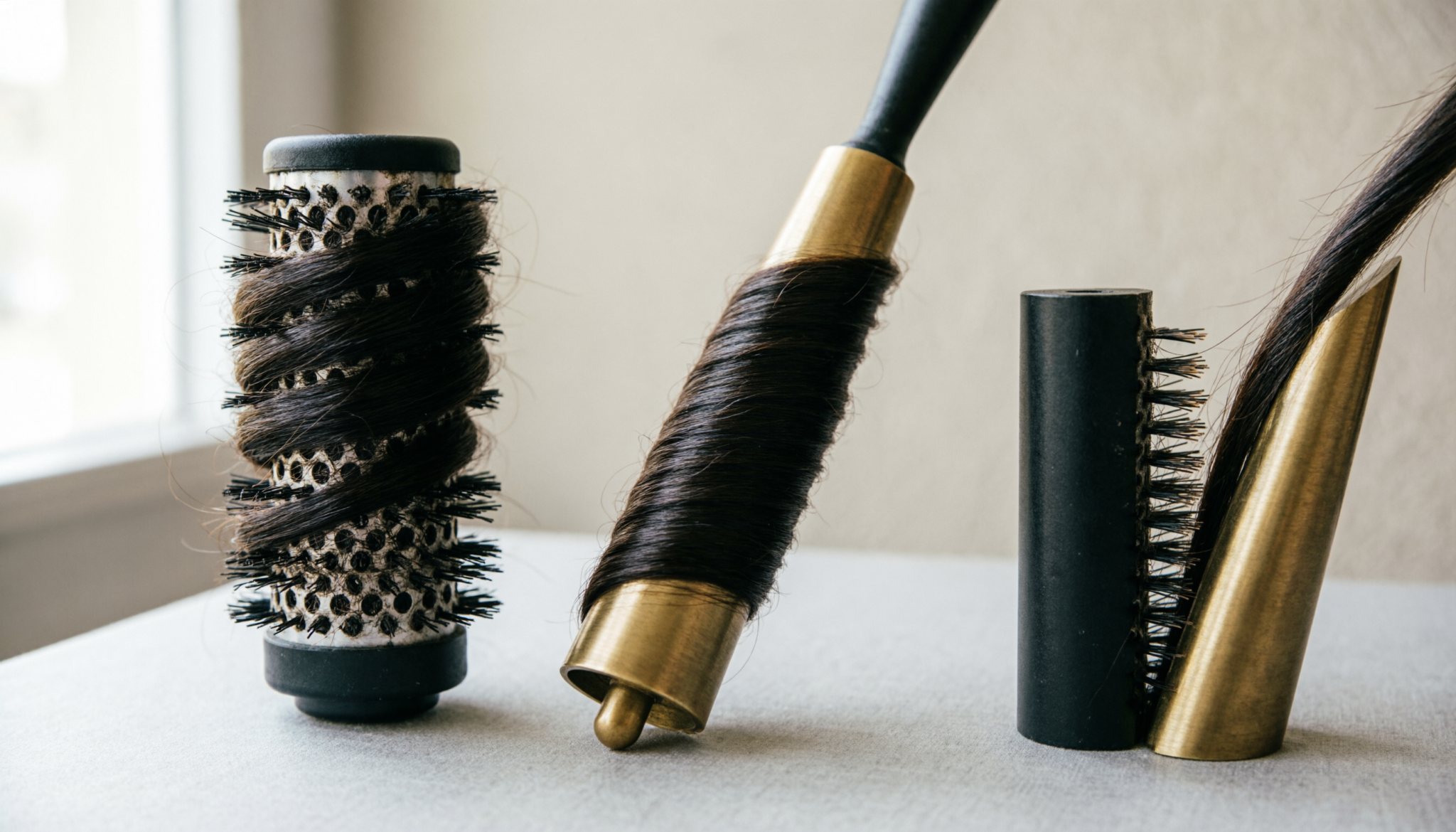
Hair wrap is not bad luck. It is predictable physics.
When a brushroll spins, hair should be lifted and pulled into suction before it completes a full rotation.
When that fails, strands coil tightly around the spindle, choke airflow, and slowly wear down belts, bearings, and motors.
The Short Answer
The Science:
Hair wrap happens when centrifugal force from the spinning brushroll is too weak to fling hair into the suction path before a full 360-degree rotation.
Once hair grips the spindle, friction builds, RPM drops, and strain shifts to the belt or motor.
Modern Fix:
Anti-tangle systems rely on active hair removal.
This includes comb teeth that strip hair off mid-spin or conical brushrolls that guide strands toward a narrow end for immediate suction.
Why Standard Brushrolls Fail
A traditional cylindrical brushroll is symmetrical. That is the core flaw.
Hair lands anywhere along the roller and has no directional bias.
As the brush spins, strands follow the path of least resistance, which is wrapping around the widest part of the cylinder.
Once one strand catches, others follow. That creates a tightening loop with every rotation.
Three forces are at work:
- Centrifugal force tries to fling debris outward
- Friction between hair and the spindle resists that motion
- Airflow attempts to pull debris into the vacuum channel
In a clean system, airflow wins. In a real home with long hair, pet fur, and dust buildup, friction wins early. That is when wrapping starts.
A weak brush motor makes it worse. Lower RPM means less outward force, giving hair more time to wrap before it can be lifted.
Nylon vs. Rubber Fins: What Actually Works
Nylon Bristles
Nylon bristles are stiff and effective at digging into carpet fibers. That part works. The failure point is how they handle hair.
- Long strands thread through the bristles easily
- Once threaded, rotation tightens the wrap
- Removal becomes manual, often with scissors
Best use case: Deep carpet agitation, especially where debris is embedded
Weakness: Long human hair and pet fur build up fast
Rubber Fins
Rubber fins behave differently. They do not trap hair the same way bristles do.
- Smooth surfaces reduce friction points
- Hair stays on the surface instead of threading through
- Short strands are more likely to stay loose and get suctioned away
Best use case: Short hair, pet dander, and hard floors
Weakness: Long hair can still wrap if airflow is weak or speed drops
The Hard Truth
No single material solves hair wrap on its own. Material choice only delays the problem. Without a mechanism to actively remove hair during rotation, buildup is inevitable.
The “Conical Solution”: Why Shape Beats Material
A conical brushroll changes the physics completely.
Instead of a uniform cylinder, the roller tapers from wide to narrow. That small design shift forces hair to migrate in one direction during rotation.
This uses the same principle as the Archimedes’ screw:
- As the brush spins, angled surfaces guide hair sideways
- Each rotation nudges strands toward the narrow end
- Suction is strongest at that point, pulling hair off before it wraps
The key advantage is movement. Hair is never allowed to stay in one place long enough to coil tightly.
Why Conical Tools Work Better in Real Homes
Conical systems solve the root problem, not just the symptom.
- Continuous hair migration prevents buildup zones
- Reduced friction keeps motor speed stable
- Consistent airflow improves pickup over time
That matters in daily cleaning. A brush that performs well for five minutes but clogs after ten is not efficient.
Conical designs maintain performance across an entire cleaning session.
Where Even Conical Designs Struggle
No system is perfect. There are limits.
- Extremely long, wet, or sticky hair can still cling
- Low suction reduces the effectiveness of the narrow-end extraction
- Poor maintenance (clogged filters, full bins) cancels out the advantage
The design works, but only if airflow stays strong.
Practical Takeaways
- Hair wrap is a physics problem, not a quality issue
- Cylindrical brushrolls fail because they lack directional control
- Nylon bristles trap long hair; rubber fins delay wrapping but do not stop it
- Conical brushrolls solve the issue by forcing hair to move and exit
Bottom Line
Standard brushrolls fight hair and lose over time. The moment hair completes one full wrap, the system is already compromised.
Designs that guide hair away during rotation avoid that trap entirely.
Shape, not just material, determines whether a vacuum keeps working or slowly chokes under its own brush.