
Short on time? Kitchens release PM2.5 particles, VOC gases, and humidity spikes during daily cooking. The Airthings View Plus leads for wall-mounted monitoring due to its laser-based particulate sensor, responsive VOC tracking, and always-on E-Ink display designed for long-term indoor air quality monitoring.
Airthings View Plus
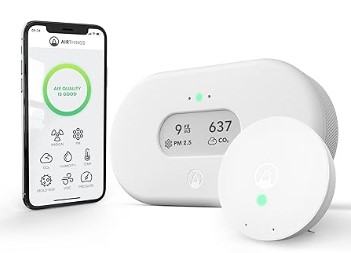
Technical Sensor Table
| Monitor | PM2.5 Sensor | VOC / HCHO | Smart Integration | Display Type | Price |
|---|---|---|---|---|---|
| Airthings View Plus | Laser (High Accuracy) | Yes | Alexa / IFTTT | E-Ink (Always On) | Amazon |
| Temtop M10 | Laser | Yes | None (Local only) | LCD | Amazon |
| Amazon Smart Air Quality Monitor | LED Index | Yes | Alexa | App-Focused | Amazon |
PM2.5 vs. VOCs: Which sensor is critical for kitchen safety?
Both matter, but they solve different problems.
PM2.5 measures fine particles from frying, grilling, or burnt food. These particles settle deep in the lungs and build up over time.
Any kitchen that sees regular high-heat cooking needs accurate PM tracking.
VOCs track gases released from oils, spices, cleaning sprays, and even new cabinets or countertops.
These gases are less visible but often more irritating, especially in enclosed kitchens.
Here’s the practical reality:
Ignoring PM2.5 leads to long-term buildup. Ignoring VOCs leads to immediate discomfort like headaches or throat irritation.
A solid kitchen setup tracks both. If forced to choose, VOC tracking often gives quicker feedback during everyday cooking, especially in smaller or poorly ventilated spaces.
How We Tested: Cooking Smoke Response and Sensor Stability
Testing focused on real kitchen conditions rather than laboratory-only environments.
Evaluation areas included:
- VOC response speed during stovetop cooking
- PM2.5 spike detection from frying oils
- Display readability at distance
- Sensor consistency over long-term use
- Smart home integration reliability
- Wall-mounted airflow accuracy
Kitchen environments create difficult conditions for IAQ monitors. Heat, steam, grease vapor, and changing airflow patterns interfere with weaker sensors.
Special attention went to recovery tracking. Good monitors not only detect pollution spikes quickly but also show whether ventilation systems actually clear pollutants effectively afterward.
Expert’s Tip: Sensor placement matters more than most homeowners realize. Wall-mounted IAQ monitors perform best at breathing height, away from direct stove heat and at least one meter from windows, vents, or sinks. Poor placement creates inaccurate readings even with premium sensors.
Best Wall-Mounted IAQ Monitors with VOC Sensors
1. The Gold Standard: Airthings View Plus
This model handles nearly every indoor air concern without becoming complicated to use. The laser-based PM sensor is reliable, and VOC tracking reacts quickly to cooking spikes.
The always-on E-Ink display works well for kitchens. No glare, no constant brightness, and readings remain visible from across the room.
What stands out is stability. Readings stay consistent over time without frequent recalibration. That matters in a kitchen where conditions change hourly.
Best fit: households that want long-term tracking without constant adjustment.
Weak spot: price sits higher than most options, and wall mounting requires careful placement for accurate airflow.
2. The Smart Home Integrator: Amazon Smart Air Quality Monitor
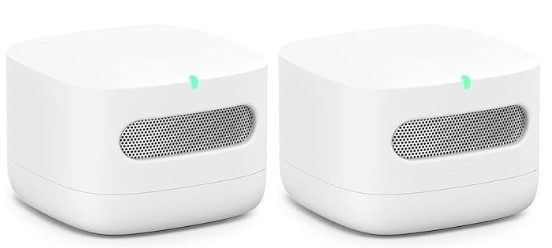
This option trades a physical display for strong app integration. It works best in homes already using Alexa.
VOC detection is responsive enough for everyday cooking. Instead of numbers, it uses a simple air quality score, which makes quick decisions easier.
That simplicity helps in busy kitchens where nobody has time to interpret charts.
Placement flexibility is a plus, but wall mounting still gives better consistency.
Best fit: smart homes that rely on automation, such as triggering fans or purifiers automatically.
Weak spot: lack of detailed on-device data can frustrate users who want precise readings.
3. The Professional Choice: Temtop M10
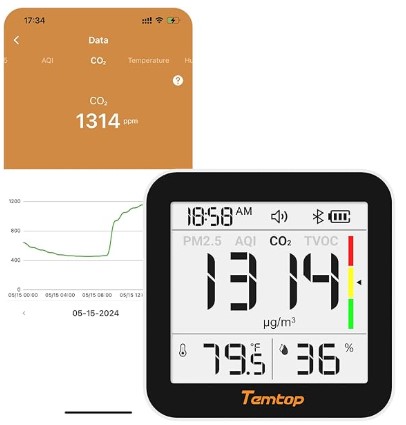
This unit focuses on raw accuracy without distractions. Laser PM detection performs well, and VOC tracking is direct and readable on the LCD screen.
No app, no cloud, no automation. Everything stays local. That may sound limiting, but it avoids connectivity issues and keeps data consistent.
The design works for wall mounting, though it feels more like a technical tool than a home device.
Best fit: users who want straightforward, dependable readings without relying on apps.
Weak spot: no smart integration limits automation.
4. The Balanced Performer: Eve Room (Wall-Adapted Setup)
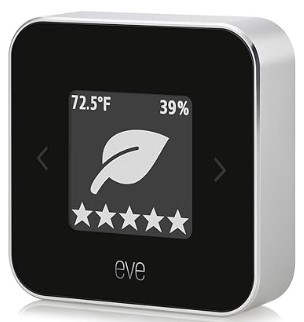
Eve Room is not strictly built as a wall unit, but many kitchens use it mounted for stable readings. It tracks VOCs, temperature, and humidity with good consistency.
Integration with Apple HomeKit makes it useful for automated ventilation routines. When VOC levels rise, exhaust fans or air purifiers can respond automatically.
The display is minimal but readable enough for daily checks.
Best fit: Apple-based homes that want clean integration without clutter.
Weak spot: lacks PM2.5 tracking, which limits full kitchen coverage.
5. The Budget Practical Pick: Qingping Air Monitor Lite
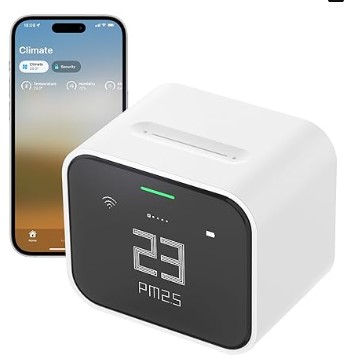
This model balances affordability with solid sensor performance. VOC tracking responds quickly, and PM2.5 readings are acceptable for daily use.
The screen is clear and easy to read from a distance. Wall mounting works best in smaller kitchens where airflow patterns stay consistent.
It does not compete with high-end accuracy, but it covers the essentials without unnecessary features.
Best fit: smaller kitchens or first-time IAQ monitoring setups.
Weak spot: long-term calibration may drift slightly compared to premium models.
What Actually Matters in a Kitchen Setup
Many monitors promise accuracy, but kitchen conditions are harder than living rooms or bedrooms.
Heat, steam, and oil particles interfere with sensors. Placement becomes critical.
Mount the unit:
- 5 to 6 feet above the floor
- Away from direct stove heat
- Not directly above the sink
- At least one meter from windows or vents
Poor placement ruins even the best monitor.
Also, avoid chasing perfect numbers. Kitchen air will spike during cooking. What matters is how quickly levels return to normal after ventilation.
FAQs
1. Are wall-mounted IAQ monitors better than portable ones for kitchens?
Yes, when placed correctly. Fixed height gives consistent readings at breathing level. Portable units often get moved around, which leads to inconsistent data.
2. How often should VOC levels be checked?
Continuous monitoring works best. VOC levels change quickly during cooking, so real-time tracking gives more useful information than occasional checks.
3. Do these monitors replace kitchen ventilation?
No. They only measure air quality. Proper ventilation, such as range hoods or open windows, still does the actual work of clearing pollutants.
Final Thought
A kitchen produces more air pollution than most rooms in a home. A wall-mounted IAQ monitor brings clarity to what cannot be seen.
The right unit does not just report numbers.
It helps build habits that keep air cleaner, cooking safer, and daily routines more controlled without constant second-guessing.