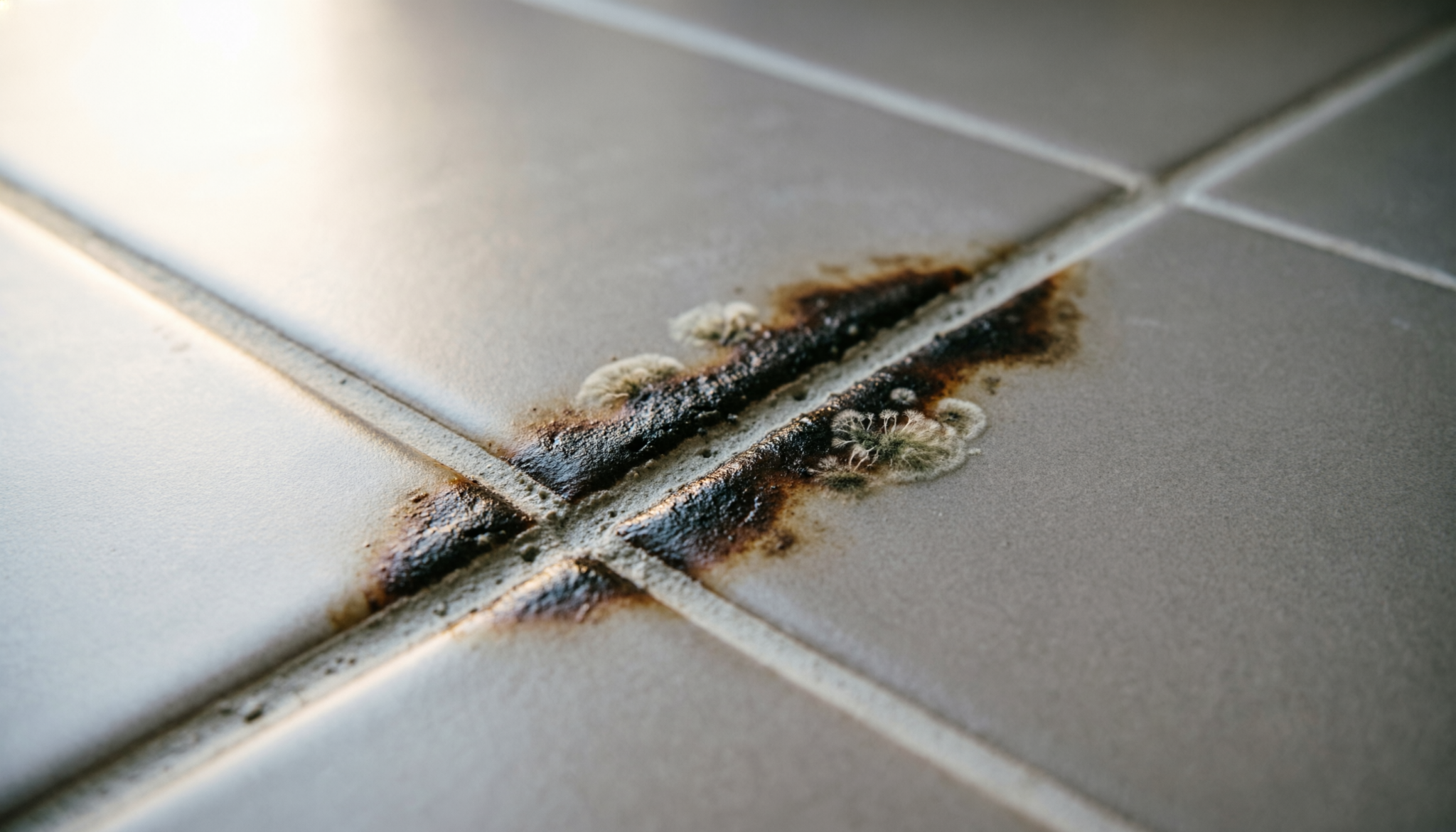
Grout does not turn black by accident. Everyday cleaning habits, especially vacuuming, often make the problem worse.
Standard vacuum heads miss what matters most: recessed lines. Dust gets trapped, compacted, and slowly stains porous grout.
The issue is not effort. The issue is physics working against the wrong tool.
The Short Answer
The Reason:
Standard vacuum heads are built for flat floors. When passing over grout lines, an air gap forms.
This gap drops static pressure sharply. Instead of lifting debris, airflow scatters fine dust.
Brushroll agitation and exhaust airflow push particles deeper into porous grout, leading to organic staining over time.
The Solution:
Use a vacuum with high water lift (measured in inches of H₂O) or a wet/dry scrubbing system.
These systems maintain pressure inside crevices or suspend debris in liquid before extraction, preventing buildup.
The “Air Gap” Problem
High airflow (CFM) sounds impressive, but it fails in one critical situation: uneven surfaces.
Grout lines sit lower than tile surfaces. When a vacuum head glides across tiles, edges never fully seal against the floor.
That tiny gap allows outside air to rush in. Once that happens, suction pressure collapses exactly where it is needed most.
Here is the hard truth:
- Air always follows the easiest path
- Open gaps reduce resistance
- Reduced resistance kills suction force inside crevices
Instead of pulling dust out, airflow spreads it sideways. Fine particles settle into grout lines and stay there.
Brushrolls make it worse. Rotating bristles flick debris with force. On flat surfaces, that helps loosen dirt.
Over grout, that same motion drives particles straight into porous channels.
Result: deeper contamination after every pass.
Atmospheric Pressure vs. Suction
Suction is not just about power. It depends on pressure difference.
A vacuum works by lowering pressure inside the nozzle. Atmospheric pressure outside then pushes debris into the vacuum.
That system breaks down when depth increases.
Grout lines create a small but important depth change. Even a few millimeters matter.
Here is what happens:
- On flat tile: pressure difference stays stable → debris lifts easily
- Inside grout lines: pressure drops unevenly → lifting force weakens
- With an air gap: pressure equalizes → debris stays put or sinks deeper
This is why strong suction ratings on paper fail in real homes. Without a proper seal, pressure cannot concentrate inside narrow recesses.
Water lift becomes the key metric here. Unlike airflow, water lift measures how well a vacuum maintains suction under resistance.
Higher water lift means better performance in tight, deep spaces like grout lines.
Why Grout Turns Black Over Time
Grout is porous. That is not a flaw. That is the design.
Those tiny pores absorb:
- Dust
- Skin flakes
- Cooking residue
- Moisture
Once trapped, organic material breaks down and darkens. Regular vacuuming, when done with the wrong head, accelerates this cycle.
Instead of removing debris, repeated passes:
- Compact particles deeper
- Spread fine dust evenly across lines
- Feed staining with moisture and organic buildup
Cleaning more often does not fix this. It compounds the problem.
What Actually Works
Fixing grout discoloration requires matching the tool to the physics.
Effective options:
- High water lift vacuums
Maintain suction inside narrow gaps where airflow models fail - Sealed head designs
Reduce air leakage and preserve pressure at floor level - Wet/dry systems
Use liquid to suspend debris before extraction, preventing re-depositing - Targeted attachments
Crevice tools with narrow openings focus suction where standard heads cannot
Dry vacuuming alone struggles with embedded grime.
Adding moisture changes the equation by loosening and lifting particles that airflow cannot move.
The Bottom Line
Black grout is not a cleaning failure. It is a tool mismatch.
Standard vacuums prioritize speed over precision. Flat surfaces get cleaned. Crevices get ignored or damaged.
Technical benchmarks tell the story clearly:
- High airflow without sealing fails in recessed lines
- Low water lift cannot overcome depth resistance
- Brush agitation without extraction drives contamination deeper
Fix the physics, and grout stays clean. Ignore it, and every cleaning session quietly makes the problem worse.