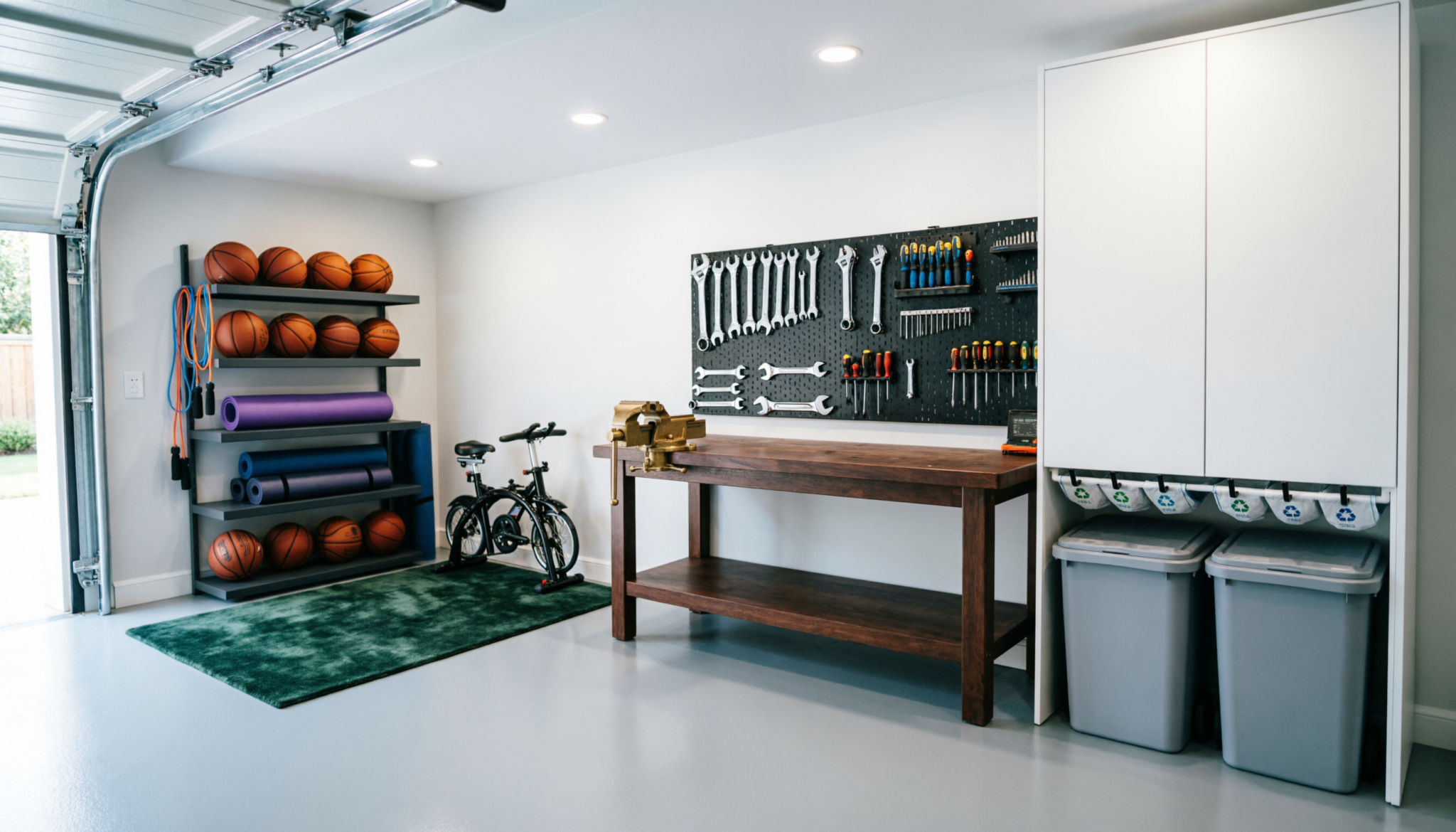
A cluttered garage rarely lacks space. It lacks structure. Clear zones create order, reduce cleanup time, and protect belongings from damage.
With the right layout and storage choices, even a busy garage can handle sports gear, messy tools, and household waste without overlap or frustration.
The Short Answer
Effective garage zoning uses the Frequency of Use principle to divide the space into five zones. Zone 1 (by the door) is for high-frequency items like shoes/keys. Zone 2 (the walls) is for tools.
Zone 3 (the ceiling) is for seasonal storage. Creating these “Physical Boundaries” prevents cross-contamination of grease and dirt into sports gear or household items.
The Zoning Layout Table
| Zone | Activity | Best Storage Solution |
|---|---|---|
| Transition | Entry/Exit | Shoe Racks & Wall Hooks |
| Project | Building/Repair | Workbench & Pegboard (Link) |
| Leisure | Bikes/Kayaks/Sports | Vertical Wall Mounts (Link) |
| Seasonal | Holiday/Camping | Overhead Racks (Link) |
| Utility | Recycling/Trash | Sliding Bin Trays |
Zone 1: The Mudroom Transition
This zone sits closest to the entry door. It handles the daily mess before it spreads.
What works here:
- A sturdy 3-tier metal shoe rack that handles mud without staining
- Heavy-duty wall hooks with rubber coating for bags, helmets, and jackets
- A narrow bench with hidden storage for quick seating and stash space
Hard truth:
Most garages fail right here. Shoes pile up, bags land anywhere, and dirt travels inside. Without a defined drop zone, the rest of the system breaks down.
Fix:
Keep this area tight and simple. No overflow allowed. If it does not fit here, it belongs in another zone.
Zone 2: The Workshop (Dust Control Logic)
Tools create dust, grease, and chaos. This zone contains it.
Core setup:
- A solid adjustable-height workbench with a hardwood or steel top
- A steel pegboard wall system with labeled hooks for quick access
- Stackable clear-front tool drawers for small parts
Dust control logic:
Tools stay off the floor. Vertical storage keeps sawdust and grime from spreading. Pegboards work better than drawers for frequently used tools because nothing gets buried.
Weak setup to avoid:
Plastic bins stacked in corners. Tools disappear, and the mess returns fast.
Zone 3: The ‘Deep Storage’ Ceiling
Ceiling space carries the items that are rarely touched.
Best options:
- Heavy-duty overhead racks (600 lb+ capacity) mounted into ceiling joists
- Adjustable-height systems for different box sizes
- Labeled, uniform storage bins that slide in and out easily
Reality check:
Without overhead storage, seasonal items eat valuable floor space year-round. That is wasted square footage.
Safety note:
Only install into joists. Anything less risks collapse over time.
Zone 4: Leisure Storage (Sports & Outdoor Gear)
This zone needs breathing room. Sports gear is bulky and awkward.
Smart setup:
- Vertical bike wall mounts to free floor space
- Ball and equipment racks with open wire design for airflow
- Freestanding multi-sport racks for mixed gear like bats, helmets, and rackets
Common mistake:
Throwing sports gear into bins. Moisture builds up, odors follow, and gear wears out faster.
Better approach:
Keep items visible and ventilated.
Zone 5: Utility Zone (Trash & Recycling)
Often ignored, but this area quietly affects the entire garage.
Reliable setup:
- Sliding bin tray systems that tuck under shelves
- Dual or triple color-coded bins for sorting
- A wall-mounted holder for garbage bags to keep refills handy
Why it matters:
Loose trash areas invite clutter creep. Once bins overflow or sit awkwardly, everything nearby becomes a dumping ground.
Product Picks That Hold Up Over Time
These are consistent, high-retention choices that solve real problems:
- Seville Classics UltraHD Workbench – stable, adjustable, handles heavy loads without wobble
- Wall Control Metal Pegboard System – stronger than traditional boards, no sagging hooks
- Fleximounts Overhead Garage Rack – dependable ceiling storage with solid load capacity
- StoreYourBoard Bike Wall Mount – simple, space-saving, and secure
- Simple Houseware 3-Tier Shoe Rack – durable, easy to clean, fits tight entry zones
- Rubbermaid FastTrack Rail System – flexible wall storage that grows over time
FAQs
1. How many zones should a garage have?
Five works well for most homes. Fewer zones create overlap. More zones can feel forced unless the space is very large.
2. What is the biggest zoning mistake?
Mixing clean and dirty items. Sports gear and tools should never share storage. Dust and grease transfer quickly.
3. Is overhead storage safe?
Yes, when installed into ceiling joists with proper hardware. Skipping this step creates long-term risk.
Final Thought
A garage works best when every item has a clear home and purpose. Zoning brings that order. Start with the entry, contain the mess at the source, and build upward.
The space will feel larger, cleaner, and easier to maintain without constant effort or frustration.