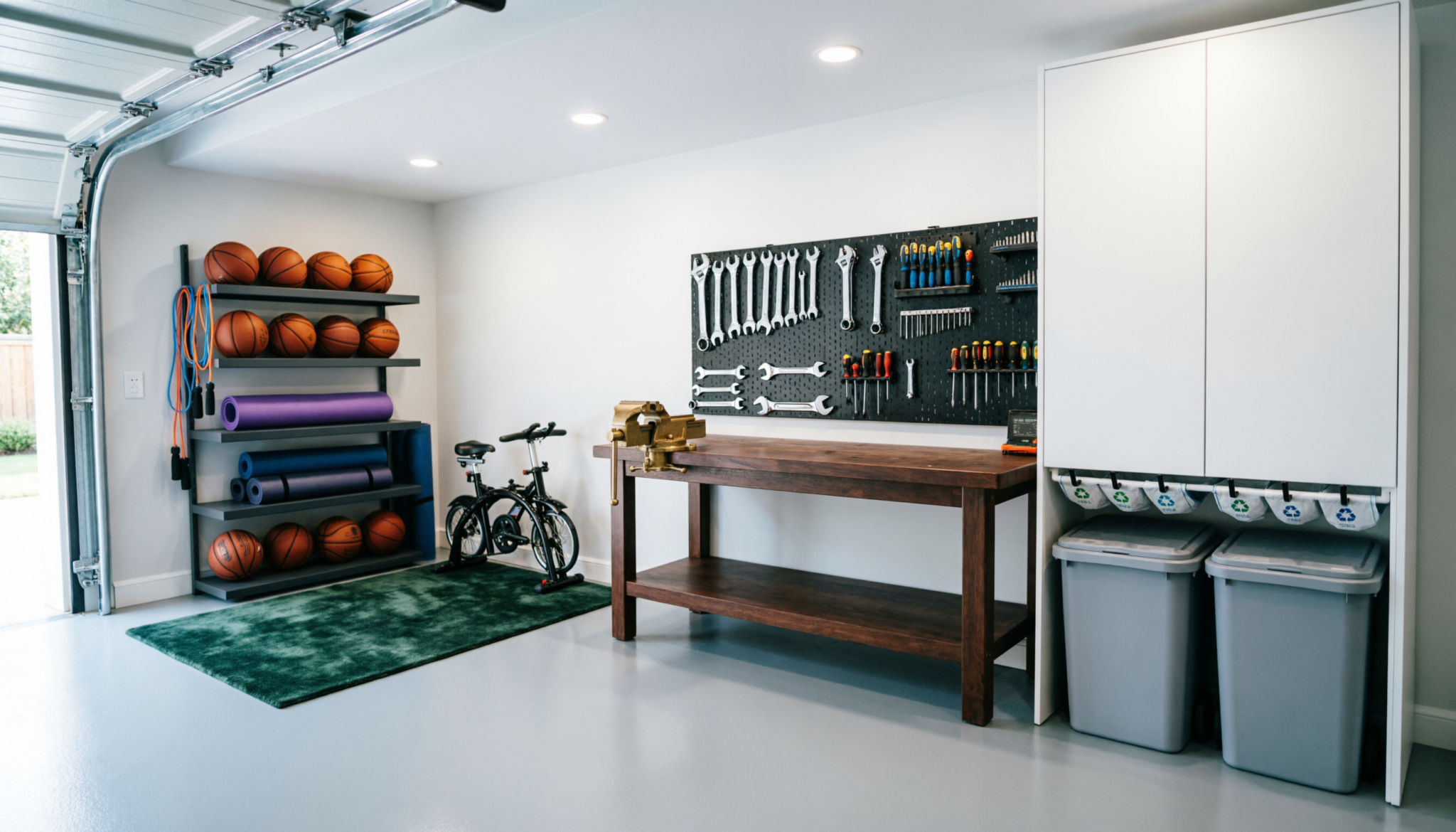
A garage without zoning creates motion waste, duplicate storage, blocked pathways, and equipment damage.
Structured garage zoning increases retrieval speed, improves safety, reduces clutter migration, and supports long-term inventory control.
Effective garage zoning separates active equipment, maintenance tools, and waste handling into fixed operational zones. High-frequency items require immediate access.
Heavy equipment requires low placement. Waste management requires containment and airflow. Structured placement reduces retrieval time and prevents storage overflow.
Garage Storage Tier Comparison
| Storage Tier | Frequency of Use | Height Placement | Visual Accessibility |
|---|---|---|---|
| Daily Access Zone | High | Waist to shoulder level | Immediate visibility |
| Weekly Access Zone | Moderate | Knee to overhead level | Partial visibility |
| Long-Term Storage Zone | Low | Ceiling or rear-wall level | Labeled-only visibility |
Zone 1: The Mudroom Transition
This zone sits closest to the entry door. It handles the daily mess before it spreads.
What works here:
- A sturdy 3-tier metal shoe rack that handles mud without staining
- Heavy-duty wall hooks with rubber coating for bags, helmets, and jackets
- A narrow bench with hidden storage for quick seating and stash space
Hard truth:
Most garages fail right here. Shoes pile up, bags land anywhere, and dirt travels inside. Without a defined drop zone, the rest of the system breaks down.
Fix:
Keep this area tight and simple. No overflow allowed. If it does not fit here, it belongs in another zone.
Zone 2: The Workshop (Dust Control Logic)
Tools create dust, grease, and chaos. This zone contains it.
Core setup:
- A solid adjustable-height workbench with a hardwood or steel top
- A steel pegboard wall system with labeled hooks for quick access
- Stackable clear-front tool drawers for small parts
Dust control logic:
Tools stay off the floor. Vertical storage keeps sawdust and grime from spreading. Pegboards work better than drawers for frequently used tools because nothing gets buried.
Weak setup to avoid:
Plastic bins stacked in corners. Tools disappear, and the mess returns fast.
Zone 3: The ‘Deep Storage’ Ceiling
Ceiling space carries the items that are rarely touched.
Best options:
- Heavy-duty overhead racks (600 lb+ capacity) mounted into ceiling joists
- Adjustable-height systems for different box sizes
- Labeled, uniform storage bins that slide in and out easily
Reality check:
Without overhead storage, seasonal items eat valuable floor space year-round. That is wasted square footage.
Safety note:
Only install into joists. Anything less risks collapse over time.
Zone 4: Leisure Storage (Sports & Outdoor Gear)
This zone needs breathing room. Sports gear is bulky and awkward.
Smart setup:
- Vertical bike wall mounts to free floor space
- Ball and equipment racks with open wire design for airflow
- Freestanding multi-sport racks for mixed gear like bats, helmets, and rackets
Common mistake:
Throwing sports gear into bins. Moisture builds up, odors follow, and gear wears out faster.
Better approach:
Keep items visible and ventilated.
Zone 5: Utility Zone (Trash & Recycling)
Often ignored, but this area quietly affects the entire garage.
Reliable setup:
- Sliding bin tray systems that tuck under shelves
- Dual or triple color-coded bins for sorting
- A wall-mounted holder for garbage bags to keep refills handy
Why it matters:
Loose trash areas invite clutter creep. Once bins overflow or sit awkwardly, everything nearby becomes a dumping ground.
Expert’s Tip: Prioritize Retrieval Speed Over Storage Volume
Maximum storage density often reduces operational efficiency. Retrieval delays create clutter migration and abandoned inventory. Fixed placement, clear labeling, and uninterrupted walking paths outperform high-capacity stacking systems during long-term daily use.
Using Vertical Space Without Creating Visual Congestion
Vertical storage increases capacity but frequently creates visual overload.
Efficient garages balance visibility with density.
Open shelving works best for high-turnover inventory. Closed cabinets work best for hazardous, dusty, or visually noisy equipment.
Ceiling storage should support only low-frequency inventory such as:
- Holiday decorations
- Camping gear
- Seasonal tires
- Archived household supplies
Every overhead system requires load-rated hardware. Drywall anchors alone fail under sustained weight stress.
Color zoning improves recognition speed.
Examples include:
- Black bins for automotive supplies
- Blue bins for sports
- Red bins for emergency equipment
- Green bins for gardening
Label placement should remain consistent across all shelving rows.
Large typography improves retrieval speed during low-light conditions.
Lighting also affects zoning performance. Poor illumination creates dead storage zones where inventory disappears into shadow. LED strip lighting beneath shelves improves visibility dramatically.
Avoid mixed-storage shelves whenever possible.
A single shelf containing sports gear, paint cans, and extension cords creates inventory confusion and increases retrieval time.
Maintaining Long-Term Garage Efficiency Through Inventory Control
Most garage systems fail from maintenance neglect rather than inadequate hardware.
Inventory drift gradually destroys zoning discipline.
Monthly audits prevent overflow accumulation. Broken equipment, duplicate tools, expired chemicals, and abandoned storage bins consume operational space unnecessarily.
Effective inventory control follows five rules:
- Fixed category placement
- Clear labeling
- Annual purge cycles
- Defined overflow limits
- Dedicated return locations
Return discipline matters most.
Objects without assigned return points migrate toward floors, corners, and vehicle pathways. Repetition eventually destroys access efficiency.
Capacity limits also matter.
Storage systems fail when categories exceed available containment volume. Overflow indicates either excessive acquisition or insufficient disposal cycles.
Operational garages resemble supply rooms rather than dumping grounds.
Efficiency depends on predictability.
Product Picks That Hold Up Over Time
These are consistent, high-retention choices that solve real problems:
- Seville Classics UltraHD Workbench – stable, adjustable, handles heavy loads without wobble
- Wall Control Metal Pegboard System – stronger than traditional boards, no sagging hooks
- Fleximounts Overhead Garage Rack – dependable ceiling storage with solid load capacity
- StoreYourBoard Bike Wall Mount – simple, space-saving, and secure
- Simple Houseware 3-Tier Shoe Rack – durable, easy to clean, fits tight entry zones
- Rubbermaid FastTrack Rail System – flexible wall storage that grows over time
FAQs
1. How many zones should a garage have?
Five works well for most homes. Fewer zones create overlap. More zones can feel forced unless the space is very large.
2. What is the biggest zoning mistake?
Mixing clean and dirty items. Sports gear and tools should never share storage. Dust and grease transfer quickly.
3. Is overhead storage safe?
Yes, when installed into ceiling joists with proper hardware. Skipping this step creates long-term risk.
Final Thought
A garage works best when every item has a clear home and purpose. Zoning brings that order. Start with the entry, contain the mess at the source, and build upward.
The space will feel larger, cleaner, and easier to maintain without constant effort or frustration.