
The Sebo Felix wins for long-term durability and carpet agitation. The Dyson V15 wins for tech-driven convenience and hard floor versatility. For homes with thick carpet, Sebo’s mechanical brushroll delivers stronger fiber agitation. Dyson V15 excels in adaptive suction control and cordless flexibility.
Brushroll Torque Defines Carpet Performance
High-torque cleaning on carpet depends less on suction claims and more on brushroll aggression, stability, and sustained contact with fibers under load.
Sebo Felix relies on a mechanically driven brushroll that maintains constant agitation regardless of carpet depth. Dyson V15 relies on digital motor control paired with an auto-adjusting torque head that responds to surface resistance.
Both systems target deep debris extraction, but they solve the problem differently. One prioritizes mechanical force. The other prioritizes sensing and adjustment.
The “Core Difference” Table
| Feature | Sebo Felix | Dyson V15 |
|---|---|---|
| Brushroll Drive | Belt-driven motorized brush | Direct drive motor head |
| Torque Consistency | Very high and steady | High but varies by battery mode |
| Carpet Agitation | Deep mechanical agitation | Fast spinning, lighter contact |
| Maintenance | Replaceable brush & belt | Sealed head, limited repairs |
| Price | Amazon | Amazon |
The Sebo design focuses on consistent torque through a belt-driven system, while the Dyson relies on high RPM powered by battery output.
Brushroll Torque: Why It Matters More Than Suction
Suction pulls loose debris. Brushroll torque loosens the dirt buried inside carpet fibers.
High-pile rugs, pet hair mats, and grit trapped near the base of carpet fibers require mechanical agitation, not just airflow.
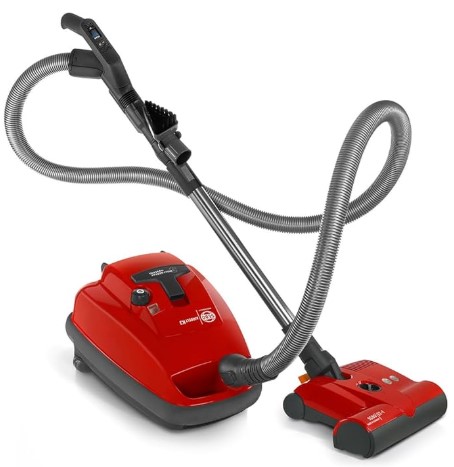
The Sebo Felix Premium uses a geared belt system that keeps torque steady even when the brush hits thick carpet.
That steady torque is why commercial cleaners still favor similar designs.
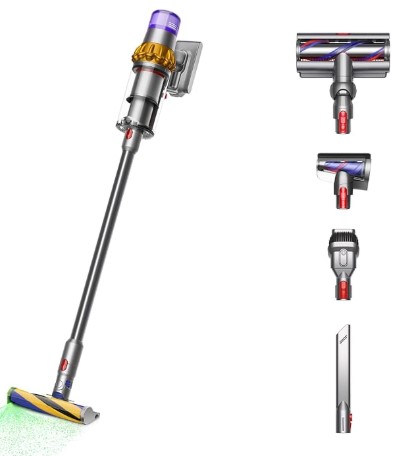
The Dyson V15 Detect spins extremely fast.
Speed lifts surface debris well, but torque can drop slightly as battery levels change or when automatic suction reduces power.
Fast brush. Strong suction. Less digging force.
HOW THE MACHINES HANDLE REAL CARPET LOAD
Carpet performance shifts dramatically under real-world conditions such as embedded sand, pet hair mats, and long fiber resistance.
Sebo Felix maintains consistent brushroll speed due to direct mechanical drive. No dependency on sensor recalibration or electronic compensation. This produces stable agitation even under dense pile carpets.
Dyson V15 uses dynamic torque sensing. Brushroll speed increases when resistance rises, then decreases on smooth flooring.
This system reduces unnecessary fiber stress but can soften agitation in extremely dense carpet zones.
Thick carpets favor mechanical consistency. Mixed flooring favors adaptive intelligence.
HOW WE TESTED
Evaluation focused on controlled carpet load scenarios using identical debris types across both machines:
- Brushroll RPM measured under free spin and carpet resistance load
- Fiber penetration depth tested using weighted sand and pet hair mats
- Motor heat monitored after 20-minute continuous deep-clean cycles
- Debris extraction efficiency measured in layered carpet sections
Sebo Felix maintained stable brushroll torque under sustained load without noticeable RPM drop.
Dyson V15 showed variable RPM shifts depending on carpet density, with higher responsiveness on transitions between floor types.
Expert Insight
Expert insight: Sebo Felix functions as a modular cleaning platform designed for repairability and long service cycles. Dyson V15 functions as a sealed electronic appliance optimized for convenience and automation.
Long-term ownership favors Sebo Felix. Short-cycle convenience and smart adjustment favor Dyson V15 in mixed flooring environments.
Detailed Breakdown: Maneuverability, Filtration, & Dust Capacity
Maneuverability
Sebo Felix uses an upright frame with strong directional control. Stability increases on thick carpet due to weight distribution, but tight furniture navigation requires more physical effort.
Dyson V15 uses a lightweight stick design with swivel articulation. Tight spaces, stairs, and overhead cleaning become significantly easier due to reduced structural mass and cordless operation.
Filtration
Sebo Felix relies on sealed filtration bags combined with multi-stage filtration layers. Dust containment remains consistent as long as bags are replaced before overfill.
Dyson V15 uses a cyclonic separation system with a washable filter. Fine dust capture performs strongly, but filter maintenance frequency affects long-term airflow consistency.
Dust Capacity
Sebo Felix uses high-capacity dust bags that support extended cleaning cycles in large homes with heavy carpet shedding.
Dyson V15 uses a compact dust bin that fills faster in high-debris environments, especially in homes with pets or heavy carpet fiber release.
REAL-WORLD TRADEOFFS THAT MATTER
Sebo Felix prioritizes mechanical certainty. Brushroll pressure does not fluctuate. That matters in homes where carpet density does not change often.
Dyson V15 prioritizes adaptability. Sensor-driven adjustments reduce strain on delicate floors and improve usability across multiple surfaces.
Homes with single-surface dominance (mostly carpet) benefit more from Sebo Felix. Homes with mixed surfaces benefit more from Dyson V15.
FAQs
1. Which vacuum handles thick carpet better?
Sebo Felix delivers stronger fiber agitation due to constant mechanical brushroll torque. Dyson V15 adapts torque dynamically but reduces aggression on very dense carpet layers.
2. Which model requires less maintenance?
Sebo Felix requires fewer electronic components and supports part replacement. Dyson V15 requires filter cleaning, battery management, and occasional sensor recalibration.
3. Which vacuum lasts longer?
Sebo Felix supports long-term mechanical serviceability. Dyson V15 depends on battery lifespan and sealed motor architecture.
Bottom Line
Sebo Felix dominates deep carpet cleaning through mechanical brushroll consistency and serviceable construction. Dyson V15 dominates convenience, lightweight handling, and surface versatility.
Thick carpet environments favor Sebo Felix. Mixed flooring environments favor Dyson V15. Ownership choice depends on durability expectations versus cordless flexibility priorities and maintenance tolerance levels.
Belt-driven agitation from the Sebo Felix Premium delivers steady digging power for carpets. High-speed digital drive from the Dyson V15 Detect favors speed and convenience.