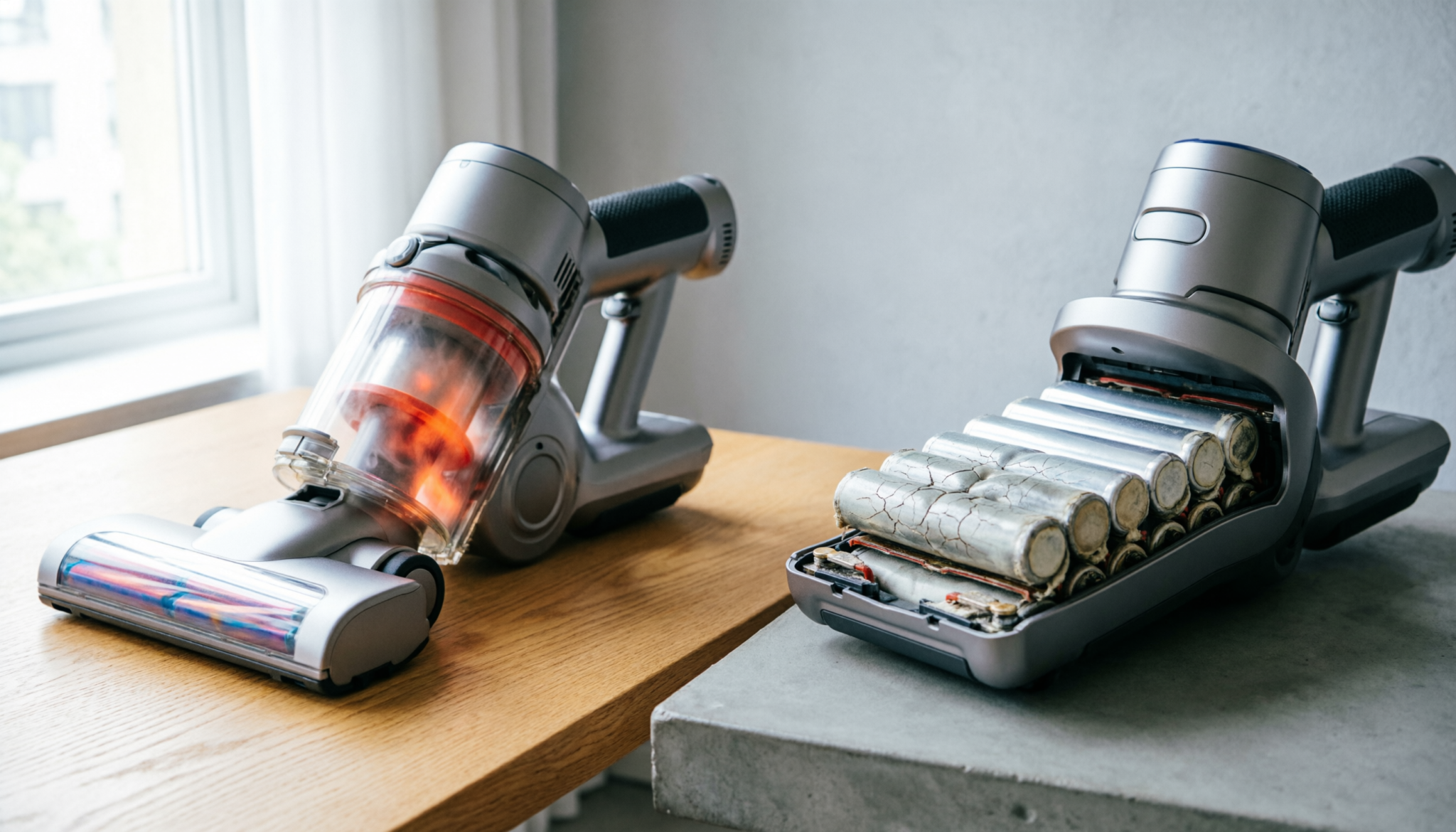
Maintenance Quick-Start: Lithium-ion vacuum batteries last longest when stored between 40% and 80% charge, kept below 86°F, and removed from constant charging docks after full recharge.
Blocked filters and overheated motors force higher power draw, accelerating battery degradation and reducing total charging cycles significantly.
Warning
Warning: Swollen batteries, burning smells, leaking cells, or excessive heat during charging require immediate disconnection from power. Damaged lithium-ion batteries can ignite without warning. Never puncture, crush, freeze, or expose battery packs to direct sunlight inside vehicles or garages.
Battery Stress Factors Comparison Table
| Usage Condition | Heat Generation | Battery Wear Rate | Long-Term Runtime Impact |
|---|---|---|---|
| Frequent MAX power mode | High | Severe | Runtime drops rapidly within 12–18 months |
| Dirty filters and airflow blockage | Moderate to High | Accelerated | Reduced efficiency and overheating |
| Proper airflow with balanced charging | Low | Minimal | Stable runtime across several years |
How high-suction settings destroy Li-Ion cells
Max mode feels satisfying, but it is the fastest way to age a battery. High current draw creates heat inside the cells.
Heat speeds up chemical breakdown and causes lithium plating, which permanently blocks capacity.
In real homes, this shows up as shorter runtime after a few months. Daily max mode use can cut battery life in half. Use it only for deep dirt, not routine cleaning.
Heat: The Silent Battery Killer
Heat destroys vacuum batteries faster than almost any other factor. Cordless vacuums generate heat from three separate areas: the motor, airflow resistance, and charging cycles. Poor maintenance compounds all three.
Blocked filters force the motor to work harder. Hair wrapped around brush rolls increases resistance.
Dust-filled cyclones restrict airflow. Internal temperatures rise quickly, especially during long cleaning sessions on carpeted surfaces.
Lithium-ion cells degrade faster once temperatures consistently exceed safe operating limits. Capacity loss becomes permanent.
Runtime shrinks gradually until full-home cleaning becomes impossible on a single charge.
Many households unintentionally accelerate battery damage by storing vacuums in hot garages, enclosed laundry rooms, or direct sunlight.
Summer heat inside parked vehicles can permanently damage cells within hours.
Signs of heat-related battery stress include:
- Reduced runtime after charging
- Battery becoming unusually warm
- Random power cutoffs
- Slower charging speed
- Weak suction despite clean filters
Temperature management matters more than many users realize. Even premium cordless vacuums cannot compensate for repeated thermal overload.
Charging Habits That Shorten Battery Life
Constant charging weakens lithium-ion batteries over time. Many cordless vacuums remain docked 24 hours a day, seven days a week. Convenience improves, but long-term battery health suffers.
Modern lithium-ion systems include protection circuits, but continuous topping-off still generates micro-heat cycles that slowly degrade internal chemistry.
The most damaging charging habits include:
- Leaving batteries on chargers permanently
- Charging immediately after heavy vacuuming while hot
- Using third-party chargers with unstable voltage
- Fully draining batteries repeatedly
- Storing empty batteries for long periods
Battery chemistry performs best within moderate charge ranges. Complete discharge places unnecessary stress on lithium-ion cells. Frequent deep-drain cycles reduce the total number of usable charging cycles.
Fast charging also creates additional heat. Some high-powered cordless vacuums sacrifice long-term battery longevity for shorter recharge times. Convenience often comes at the cost of accelerated cell wear.
Proper charging routines significantly extend lifespan:
- Allow batteries to cool before recharging
- Disconnect charging docks after full charge
- Store batteries partially charged during long inactivity
- Use manufacturer-approved charging equipment only
- Avoid overnight charging whenever possible
Simple charging discipline often adds years of usable performance.
Expert Insight
Technician’s Insight: Most premature vacuum battery failures originate from airflow neglect, not defective batteries.
Clogged filters increase motor amperage draw dramatically. Internal heat then damages nearby lithium-ion cells repeatedly.
Clean airflow pathways reduce electrical stress, stabilize operating temperature, and preserve charging capacity far longer than expensive replacement batteries.
Airflow Restriction and Motor Overload
Battery drain and suction performance connect directly. Restricted airflow forces the vacuum motor into higher resistance operation, increasing power consumption immediately.
Cordless vacuums rely on efficient airflow cooling. Unlike larger corded systems, compact cordless designs operate within tighter thermal limits. Dust buildup quickly disrupts internal cooling efficiency.
Common airflow restrictions include:
- Clogged HEPA filters
- Packed cyclone chambers
- Hair-wrapped brush rolls
- Crushed hoses
- Full dust bins
- Fine powder buildup around vents
Fine dust presents a particular problem. Construction debris, flour, fireplace ash, and drywall particles clog filters rapidly. Once airflow weakens, motor temperature rises and battery strain increases.
MAX or BOOST cleaning modes worsen the issue. High suction settings already draw significant current. Combined with blocked airflow, battery temperatures spike rapidly.
Routine maintenance prevents most battery stress:
- Empty bins before reaching maximum capacity
- Wash reusable filters monthly
- Replace worn filters annually
- Remove brush roll tangles weekly
- Inspect vents regularly
Neglected airflow systems force batteries into constant high-load operation. Runtime loss follows quickly.
Battery Aging vs. Battery Damage
Not every weak battery indicates misuse. Lithium-ion batteries naturally degrade over time. Every charge cycle slowly reduces total capacity.
Most cordless vacuum batteries maintain acceptable performance for roughly 300 to 500 full charging cycles. Heavy daily use shortens lifespan considerably.
Natural battery aging usually appears gradually:
- Slightly shorter runtime each year
- Longer charging periods
- Reduced MAX-mode duration
Damage-related failure appears differently:
- Sudden runtime collapse
- Battery overheating during light cleaning
- Charger blinking error lights
- Abrupt shutdowns at partial charge
Battery replacement becomes unavoidable once cell degradation reaches critical levels. However, replacement alone rarely solves underlying maintenance problems.
Installing a fresh battery into a vacuum with clogged airflow, overheating motors, or poor charging habits often leads to another premature failure cycle.
Vacuum longevity depends on system-wide maintenance, not battery replacement alone.
FAQs
1. Why does vacuum battery life drop so quickly after one year?
Heat buildup, blocked filters, frequent MAX-mode use, and constant charging commonly reduce lithium-ion capacity within the first year.
High motor resistance increases battery stress daily, accelerating internal chemical wear faster than normal aging alone.
2. Can overnight charging damage a cordless vacuum battery?
Repeated overnight charging creates unnecessary heat cycles and prolonged high-voltage stress.
Modern protection systems reduce severe damage, but continuous dock charging still shortens overall lithium-ion lifespan gradually over time.
3. Why does a vacuum shut off even after full charging?
Overheating protection systems often trigger shutdowns when airflow becomes restricted. Dirty filters, tangled brush rolls, or failing battery cells interrupt power delivery to prevent internal motor and battery damage.
Bottom Line
Premature vacuum battery failure usually starts with heat, airflow restriction, and poor charging routines. Lithium-ion systems perform best under moderate temperatures, balanced charging, and clean airflow conditions.
Consistent maintenance prevents excessive motor strain, protects battery chemistry, and extends cordless vacuum runtime far longer than replacement batteries alone ever can.