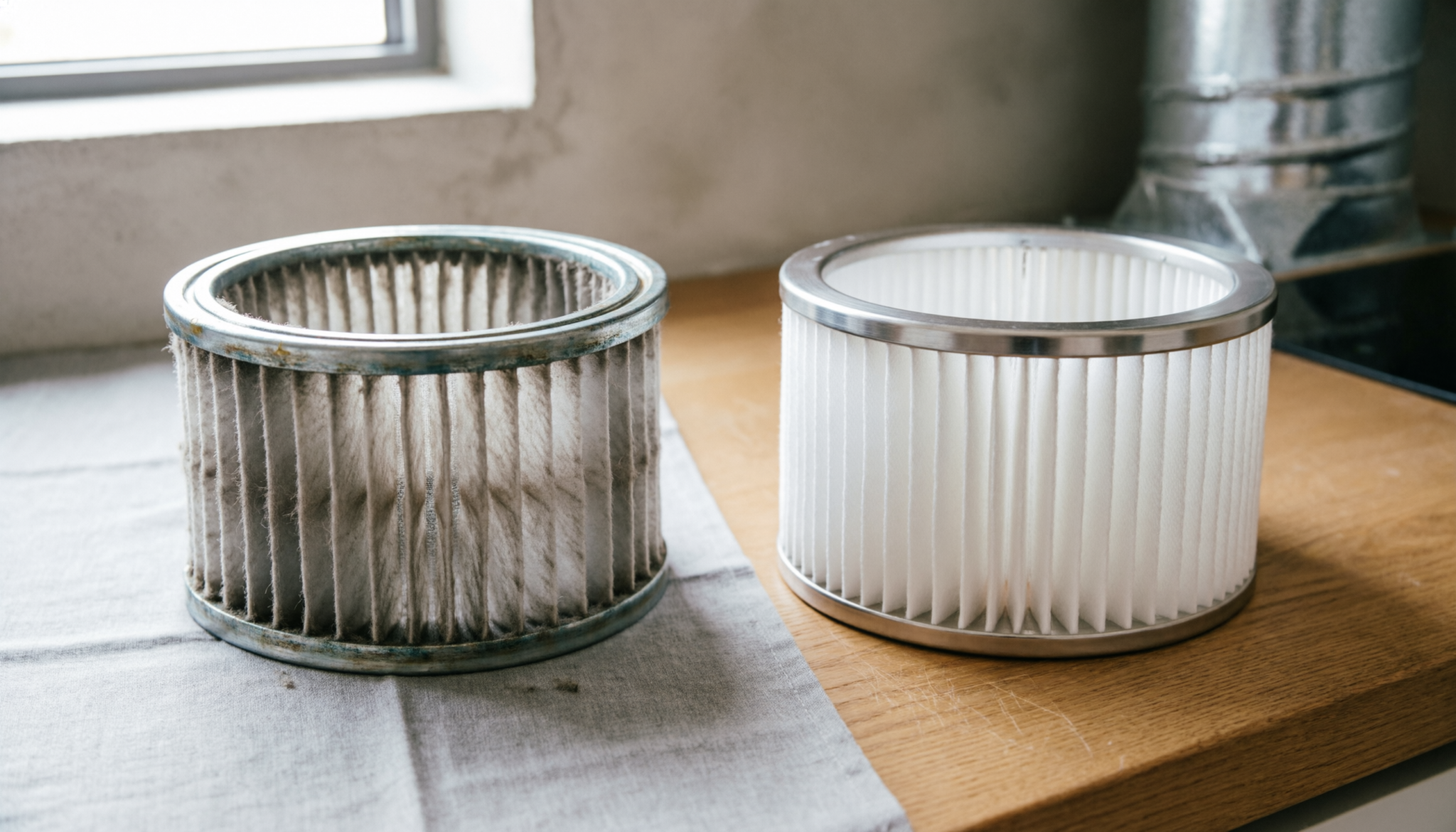
Expert Fix-It Verdict: Permanent vacuum filters reach end-of-life when fiber matting collapses, odor retention persists after washing, and airflow drops below manufacturer CFM ratings.
Washing restores surface debris only. Structural degradation requires replacement to restore suction performance and maintain motor protection integrity.
Threshold requires decisive component replacement action protocol standard.
Warning: Hidden Risk Inside “Washable” Filters
Permanent filters fail silently when fiber structure breaks down below visible inspection levels. Washing damaged filter media can release embedded dust clusters back into airflow channels.
Moisture retention inside compressed fibers accelerates microbial growth and creates persistent odor loops.
Continued use under degraded conditions increases motor strain, reduces suction stability, and compromises thermal protection systems inside compact vacuum units.
Filter Condition vs Functional Reality
| Filter Grade | Particle Size Outcome | Capture Efficiency | Medical Application |
|---|---|---|---|
| New HEPA H13 | 0.3 micron and above | 99.95% | Allergy control environments |
| Washed but intact | 0.3–1 micron leakage | 70–90% | Light household dust control |
| Structurally degraded | Above 1 micron bypass | Below 60% | No safe respiratory application |
How to tell if your foam filter is chemically clogged
A foam filter can look “clean enough” after a rinse yet still fail at its job. The issue is not always visible dirt.
Over time, fine dust mixes with household oils from cooking fumes, candles, and skin particles. That mixture bonds deep inside the foam.
Here is a simple check that works in any home:
- Hold the dry filter under bright light
- Look for uneven grey shading instead of a uniform color
- Press gently and release
- Notice if the foam feels stiff or slow to spring back
A healthy foam filter stays flexible and evenly colored. A chemically clogged one feels slightly sticky or dense, even when dry.
Another clue comes from water behavior. During rinsing, clean foam releases dirt quickly. A clogged filter pushes out cloudy water again and again, even after several rinses. That is not surface dust. That is embedded residue.
At this stage, washing buys only a little more time. Airflow remains restricted, and filtration quality drops. Keeping such a filter too long risks sending fine dust toward the motor.
Expert Insight
Technician’s Insight: If dust accumulates on external filter housing despite recent cleaning, internal fiber channels have collapsed.
Filtration function no longer occurs at designed efficiency levels; airflow bypass replaces particle capture, creating continuous contamination loop inside vacuum exhaust system under operational load conditions.
Why “Permanent” is a Marketing Term, Not a Technical Reality
“Permanent” sounds reassuring, but no filter material can handle endless cycles of dirt, airflow, and cleaning without change.
Every filter works by trapping particles inside a structure of tiny gaps. Over time, those gaps change.
Three things happen with repeated use and washing:
1. Fiber fatigue
Foam and felt filters rely on a network of tiny strands. Each rinse and squeeze stresses that structure. Gradually, strands thin out or break, reducing the ability to trap fine dust.
2. Pore expansion
When fibers loosen, the microscopic openings widen. Air still flows, but filtration weakens. Dust that once stayed trapped now passes through.
3. Residue buildup
Not all dirt washes away. Oils and ultra-fine particles cling stubbornly. That buildup blocks airflow, forcing the motor to work harder.
HEPA filters face a different problem. These filters use tightly packed fibers arranged to catch extremely fine particles.
Water disrupts that arrangement. Even a careful rinse can collapse sections of the filter, creating channels where dust slips through.
A “washable” label simply means water will not immediately destroy the filter. It does not mean performance stays the same after months or years.
The 3 Signs Your Filter is Dead (Odors, Suction Loss, Motor Heat)
Waiting for visible damage is a mistake. Filters often fail quietly. These three signals tell the real story.
1. Odors that return quickly
A vacuum should not leave a smell behind. If a sour or dusty odor comes back soon after cleaning the filter, trapped residue is breaking down inside the material.
Common causes include:
- Cooking oils embedded in foam
- Pet dander mixed with moisture
- Fine dust that never fully rinses out
A fresh wash may mask the smell briefly, but it returns fast. That cycle means replacement time.
2. Noticeable suction loss
Weak suction is often blamed on a full dustbin or blocked hose. A tired filter is just as likely.
Signs to watch:
- Debris left behind on hard floors
- Carpet passes needing repetition
- A change in sound, often softer or strained
A clogged filter restricts airflow. Even a strong motor cannot compensate for blocked air pathways.
3. Motor running hotter than usual
Heat is the most overlooked warning. Restricted airflow forces the motor to work harder, raising internal temperature.
Clues include:
- Warm air from exhaust vents
- A hot casing after short use
- Automatic shut-off in some models
Ignoring this can shorten motor life. Replacing a filter costs far less than replacing a vacuum.
Practical Replacement Timing
Strict timelines printed in manuals rarely match real conditions. A home with pets, cooking oils, or heavy foot traffic loads filters faster than a low-activity space.
A more reliable approach:
- Foam or felt filters: Replace every 3–6 months with regular use
- HEPA filters: Replace every 6–12 months unless labeled washable
- High-dust homes: Cut those timelines in half
Washing should be treated as a short-term reset, not a permanent fix.
Drying also matters. A damp filter invites odor and mold. After washing, air-drying for at least 24 hours in a warm, ventilated area is essential.
Rushing this step causes more harm than skipping a wash.
Common Mistakes That Shorten Filter Life
A few habits quietly ruin filters faster than normal use:
- Scrubbing too hard
Aggressive cleaning breaks down fibers quickly. - Using detergents
Soap leaves residue that traps more dirt later. - Reinstalling while damp
Moisture weakens structure and encourages odor. - Skipping replacement for too long
Trying to stretch value ends up costing more in repairs.
Keeping care simple works best: gentle rinsing, thorough drying, and timely replacement.
FAQs
1. How many times can a washable filter be cleaned before replacement?
Most foam filters handle about 5 to 10 washes before performance drops noticeably. Heavy use shortens that range. If stiffness, discoloration, or odor remains after cleaning, replacement is overdue.
2. Can a HEPA filter ever be washed safely?
Only if labeled waterproof or washable by the manufacturer. Standard HEPA filters should stay dry. Water damages the internal structure and reduces filtration efficiency.
3. Why does a vacuum smell worse after cleaning the filter?
Residual oils and fine dust can loosen during washing and then settle deeper inside the filter. Once dry, that trapped material produces odor during use.
This usually signals the filter has reached the end of its life.
Final Thought
A “permanent” filter holds up only for a while. Washing helps, but each cycle chips away at performance. Paying attention to smell, airflow, and heat gives clearer answers than any label.
Replacing a tired filter at the right time keeps cleaning effective and protects the vacuum from unnecessary wear.