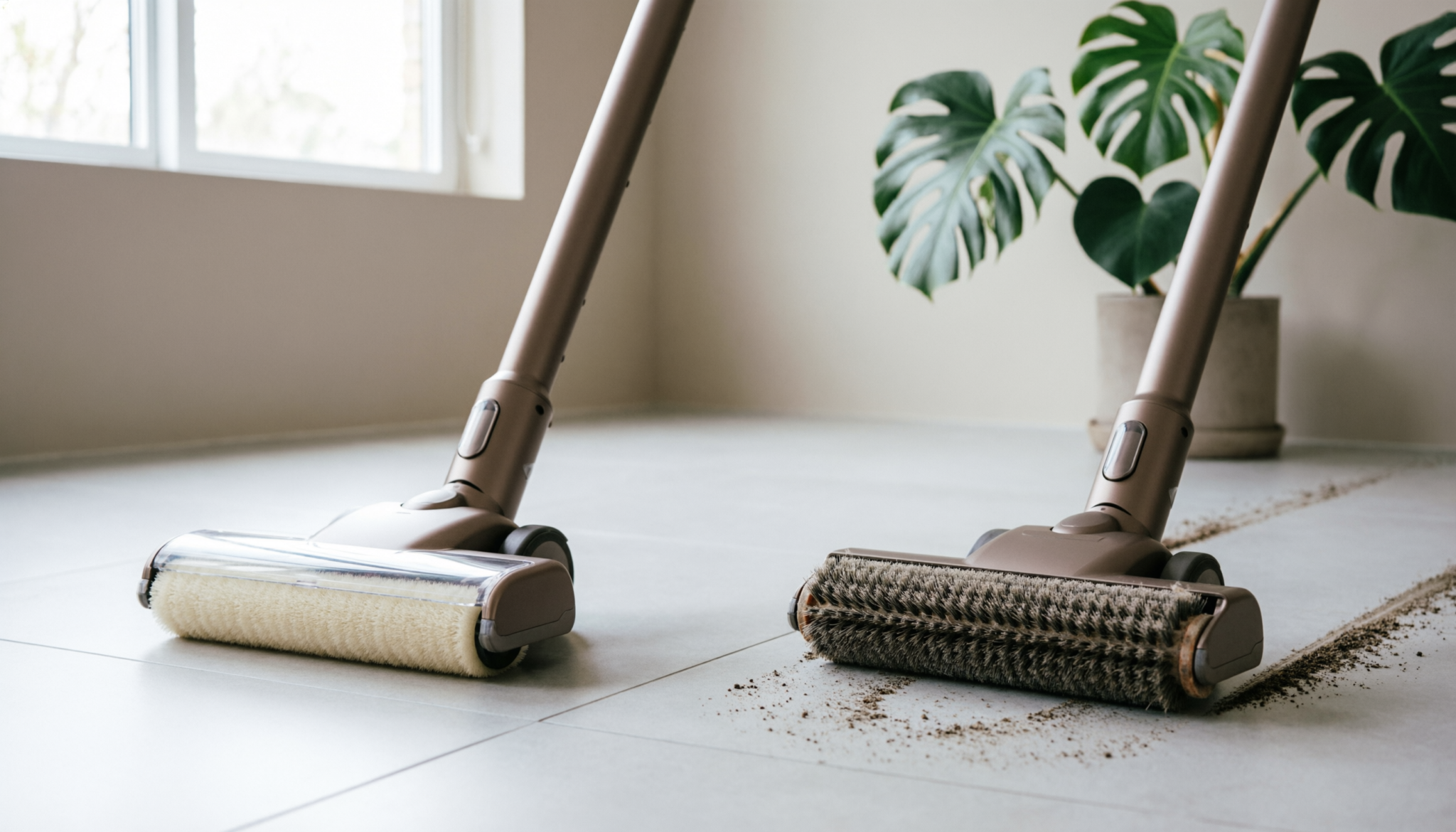
Diagnostic Summary: Vacuum snowplowing usually occurs when stiff bristles strike large debris faster than the intake airflow can capture it. Standard brushrolls often scatter particles across hard floors, while soft rollers maintain surface contact and guide debris directly into the suction channel without forward deflection.
WARNING
Using a stiff-bristle brushroll on delicate hardwood floors may scratch protective coatings over time. Aggressive brush agitation can also force grit into floor seams instead of removing it. Always match the brushroll type to the flooring surface before prolonged use.
The Filtration Hierarchy
| Filter Grade | Particle Size Outcome | Capture Efficiency | Medical Application |
|---|---|---|---|
| Standard Foam Filter | Captures visible dust and hair | Low to Moderate | General household cleaning |
| HEPA H13 | Captures particles down to 0.3 microns | 99.95% | Allergy-sensitive homes |
| ULPA Filter | Captures ultra-fine microscopic particles | 99.999% | Clean rooms and surgical environments |
The “Snowplow” Effect
Standard brushrolls were built for carpets, not hard floors. Stiff bristles spin fast and strike debris at an angle.
That impact sends larger particles forward instead of pulling them in.
Think of cereal, rice, or cat litter. A low-profile head meets resistance, then pushes debris across the floor. More passes follow. Frustration builds.
The failure comes down to three flaws:
- Wrong contact angle: Bristles hit debris instead of scooping it
- Air gaps: Poor sealing reduces suction at floor level
- Excess agitation: Spinning motion scatters instead of collects
Soft rollers solve this by staying in constant contact with the floor. The material bends, grips, and lifts instead of batting debris away.
Static Dissipation: Why Fine Dust Won’t Budge
Hard floors hold onto fine dust through static electricity. Standard brush heads ignore this completely.
Dust sticks, then settles back down after each pass, leaving faint streaks often called “ghost lines.”
Carbon fiber filaments inside soft rollers address this directly. These fibers reduce static charge at the surface, breaking the bond between dust and floor.
What actually changes:
- Dust releases instead of clinging
- Fewer repeat passes
- Cleaner finish without streaks
This is the difference between a floor that looks clean and one that actually is clean.
Why the Standard Brushroll Is Outdated
The classic brushroll made sense decades ago when most homes had wall-to-wall carpet. That design focused on digging dirt out of fibers.
Hard flooring has taken over many homes, but the default vacuum head has not caught up. Using a carpet tool on tile, hardwood, or laminate leads to poor pickup, scattered debris, and wasted time.
A soft roller is not an upgrade. It is the correct tool for the surface.
Why Standard Brushrolls Cause Snowplowing
Traditional brushrolls use stiff nylon bristles wrapped around a rotating cylinder. Carpet cleaning benefits from this aggressive agitation because bristles dig into fibers and lift embedded grit.
Hard floors create a different situation.
Instead of penetrating carpet fibers, stiff bristles strike directly against smooth surfaces. Large debris pieces bounce forward faster than suction airflow can pull them inward.
Common snowplowing symptoms include:
- Rice grains pushed ahead of the vacuum head
- Pet kibble scattering sideways
- Dust trails remaining behind the cleaner
- Fine powder collecting along wall edges
- Hair wrapping around the brushroll ends
The issue becomes worse when airflow drops due to dirty filters or partially clogged airways.
A standard brushroll depends heavily on strong suction because stiff bristles actively disturb debris. Weak airflow cannot recover scattered particles quickly enough.
Why Soft Rollers Behave Differently
Soft rollers use microfiber or plush fabric wrapped around a large drum. Instead of flicking debris forward, the roller creates controlled surface contact that channels particles directly toward the intake path.
The difference feels immediate on hardwood, tile, vinyl, and laminate flooring.
Soft rollers excel at:
- Fine dust pickup
- Large particle collection
- Flour and powder removal
- Pet hair control on hard floors
- Preventing debris scatter
The roller material also creates a sealing effect against the floor surface. Better contact improves suction efficiency across the entire cleaner head.
Large debris enters more smoothly because the roller compresses slightly during rotation instead of acting like a rigid spinning broom.
The “Sealed System” Requirement
Brushroll performance means little if airflow leaks exist inside the vacuum body.
A sealed vacuum system maintains consistent suction from floor head to exhaust filter. Air bypass weakens pickup performance and increases snowplowing because suction pressure drops before debris reaches the intake channel.
Common bypass points include:
- Loose dust-bin seals
- Cracked hose connections
- Worn brushhead gaskets
- Misaligned filter covers
- Split internal ducts
Testing for air leakage requires a simple inspection.
Run the vacuum over fine powder on a hard floor. If dust escapes from side vents or settles around the filter housing, internal leakage exists.
A properly sealed vacuum keeps airflow concentrated at the cleaner head where debris collection occurs.
Technician’s Insight
Technician’s Insight: Visible dust accumulation around the brushhead wheels usually indicates turbulent airflow beneath the cleaner head. Soft rollers reduce this turbulence by maintaining even floor contact.
Standard brushrolls create stronger directional air disruption, especially on smooth flooring where debris cannot anchor against carpet fibers.
Floor Type Changes Everything
Many vacuum owners assume higher brush speed automatically improves cleaning performance.
That assumption fails on hard flooring.
Hardwood Floors
Soft rollers usually perform better because debris cannot sink below the surface. Gentle contact prevents scattering while maintaining suction consistency.
Tile Floors
Grout lines create airflow gaps. Standard brushrolls may push debris into grout channels rather than lifting particles upward.
Low-Pile Carpet
Standard brushrolls typically clean deeper because bristles penetrate carpet fibers and loosen embedded grit.
High-Pile Carpet
Brushroll stiffness matters more than speed. Overly aggressive rollers reduce airflow by sealing too tightly against dense carpet surfaces.
Brush Height Matters More Than Most Owners Realize
Incorrect cleaner-head height creates major snowplowing issues.
If the nozzle sits too high:
- Airflow disperses outward
- Large debris escapes intake capture
- Fine dust remains behind
If the nozzle sits too low:
- Airflow becomes restricted
- Brush resistance increases
- Debris jams near the intake opening
Soft rollers generally tolerate height variation better because the material compresses against the surface.
Rigid bristle systems require more precise spacing.
Why Wheel Design Also Affects Snowplowing
Cleaner-head wheels change airflow angles more than most owners realize.
Cheap plastic wheels often lift the front nozzle unevenly during movement. That small height shift breaks the suction seal across smooth floors.
Results include:
- Dust streaks
- Crumb scattering
- Uneven pickup lanes
- Reduced edge cleaning
Soft rollers compensate better because the roller surface remains in contact even when wheel alignment shifts slightly.
FAQs
1. Why does a vacuum push cereal instead of sucking it up?
Stiff brushroll bristles often strike large debris faster than suction airflow can capture it. Hard floors make this worse because particles cannot settle into fibers.
2. Are soft rollers better than standard brushrolls?
Soft rollers usually perform better on hard floors. Standard brushrolls typically clean carpets more aggressively due to deeper fiber agitation.
3. Can weak suction cause snowplowing?
Yes. Dirty filters, hose blockages, or air leaks reduce intake pressure. Weak airflow allows debris to scatter forward instead of entering the suction channel.
Bottom Line
Vacuum snowplowing rarely comes from weak motors alone. Brushroll design, airflow sealing, floor type, and nozzle height all affect debris pickup behavior.
Soft rollers generally outperform standard brushrolls on hard flooring because they guide particles inward instead of scattering them forward.
Proper filtration maintenance and sealed airflow keep cleaning performance stable over time.