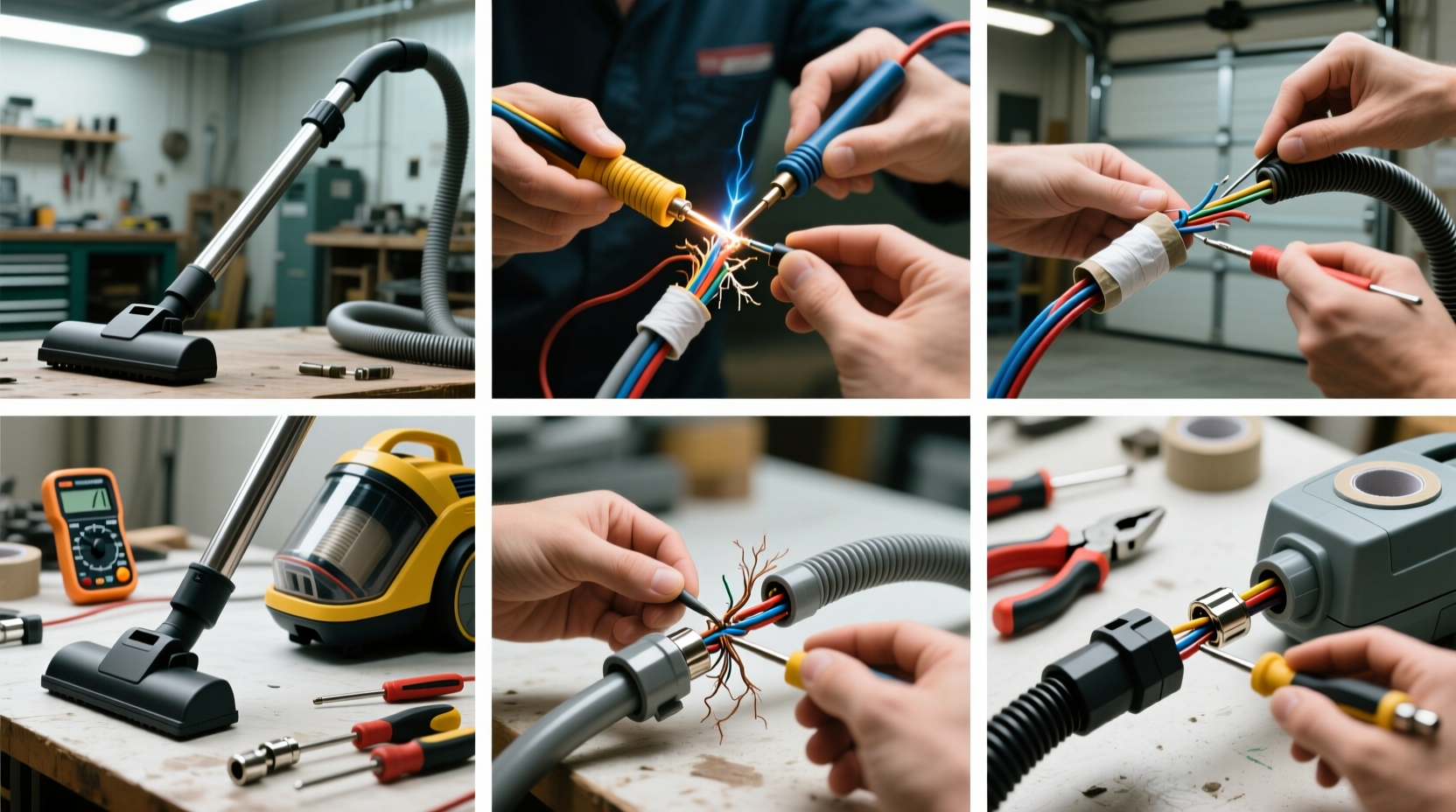
Vacuum power cords fail more often than vacuum motors because constant bending and tension slowly fracture internal copper wiring.
Repair makes sense only when the vacuum still delivers strong suction, runs cool, and shows no signs of motor fatigue.
Weak suction, overheating, or burning smells usually mean replacement makes more financial sense than electrical repair.
Vacuum cords absorb years of abuse.
Repeated bending near the plug, tight cord wrapping, and wheels rolling over the cable gradually weaken the internal wiring. Most failures begin inside the insulation long before visible damage appears.
Sometimes the repair takes less than an hour.
Other situations turn into wasted time on a vacuum already near the end of its usable life.
The smartest repair starts with safety and cost analysis before opening the machine.
Comparison Table
| Vacuum Condition | Repair Recommendation | Financial Value | Risk Level |
|---|---|---|---|
| Strong suction, newer vacuum | Repair cord | High | Low |
| Removable cord assembly | Repair cord | Very high | Low |
| Burning smell from motor | Replace vacuum | Poor | High |
| Weak suction after filter cleaning | Replace vacuum | Poor | Moderate |
| Loud grinding motor | Replace vacuum | Very poor | High |
| Older than 5–6 years | Usually replace | Moderate to poor | Moderate |
WARNING: Electrical Repair Ahead
This repair involves opening the motor housing and handling 120-volt wiring.
Incorrect wiring can damage the vacuum or cause electrical shock.
If tools such as a wire stripper, crimper, or multimeter are unfamiliar, skip the repair process and consider replacing the vacuum instead.
Cord damage is repairable, but electrical mistakes carry real risk.
Step 0: The Financial Reality Check
Before touching a screwdriver, do the math.
Typical repair cost:
- Replacement vacuum power cord: $15–$25
- Wire stripper or crimper: $10–$20
- Heat shrink tubing and connectors: $5–$10
- Time investment: 1–2 hours
Total: about $40 plus time
Now compare that to the vacuum itself.
When Repair Makes Sense
Repair is reasonable if the vacuum:
- Is under five years old
- Still has strong suction
- Has no burning smell from the motor
- Uses a removable cord assembly
When Repair Is a Waste of Time
Skip the repair if the vacuum already shows these signs:
- Motor overheating
- Weak suction even after cleaning filters
- Loud grinding or high-pitched whining
- Older than 5–6 years
Budget brands such as entry-level uprights often reach motor fatigue around that point. A new cord will not revive a tired motor.
Practical rule from decades of home repairs:
Never spend money repairing a vacuum that already struggles to clean.
Expert’s Insight: Most homeowners blame the cord because the vacuum cuts on and off during movement. In many cases, the real failure sits inside the motor switch where years of vibration loosen electrical connections.
The Essential Tool Kit
Cord repair is simple only when the right tools are on hand. Improvising with kitchen scissors or electrical tape usually creates future problems.
Core tools required
- Replacement 2-prong or 3-prong vacuum power cord
- Precision screwdriver set
- Wire stripper and crimping tool
- Heat shrink tubing kit
- Electrical wire nuts or crimp connectors
- Needle-nose pliers
- Optional but helpful: multimeter
Heat shrink tubing is especially valuable. Electrical tape dries out over time and loosens under motor heat.
Vacuum Power Cord Repair: 7 Professional Solutions
Cord replacement sounds intimidating, but the process is mechanical and predictable. Careful organization prevents mistakes.
Step 1: Accessing the Switch Housing
Unplug the vacuum completely.
Flip the machine over and remove the screws securing the handle housing or motor cover. Many vacuums hide screws under wheels or trim plates.
Once the housing opens, the power cord will lead directly to the power switch or a small wiring junction.
Take note of the strain relief clamp holding the cord in place.
Step 2: Mapping the Wiring (Take a Photo)
Before disconnecting anything, take a clear photo of the wiring.
This snapshot prevents confusion later.
Two key details matter:
- Wire polarity
- Connection order at the switch
Most cords contain:
- Black wire (hot)
- White wire (neutral)
Mixing these rarely damages a basic vacuum motor but can create switch problems.
Accuracy saves time.
Step 3: Removing the Old Strain Relief
The strain relief prevents tension from pulling wires loose when the cord gets yanked.
Use needle-nose pliers to compress the tabs and push the strain relief out of the housing.
Avoid cutting the cord until the clamp is removed. Leaving extra cord length makes rewiring easier.
Step 4: Disconnecting the Old Cord
Most vacuums use one of three connection styles:
- Wire nuts
- Crimp connectors
- Push terminals on the switch
Remove each connection carefully.
If the wires were crimped directly, cut them cleanly near the connector. Leave enough wire for stripping.
Step 5: Preparing the New Cord
Strip about ½ inch of insulation from each wire.
Slide heat shrink tubing over the wires before connecting. Forgetting this step means redoing the entire connection.
Twist copper strands tightly so the wire enters connectors cleanly.
Loose strands create weak connections and overheating.
Step 6: Reconnecting with Proper Polarity
Reconnect the wires exactly as the original layout showed.
Typical setup:
- Black (hot) wire → power switch terminal
- White (neutral) wire → motor connection
Secure the connection using:
- Wire nuts, or
- Crimp connectors
After tightening, slide heat shrink tubing over the joint and shrink it with gentle heat.
This seals the connection and prevents vibration damage.
Step 7: Installing the New Strain Relief
Insert the new cord through the housing opening.
Snap the strain relief clamp firmly into place.
This step matters more than most people realize. Without strain relief, daily cord pulls slowly rip wires off the switch.
Many failed repairs trace back to skipping this step.
Step 8: Reassemble the Housing
Before closing the vacuum:
- Check that wires are not pinched
- Confirm connectors are tight
- Verify the cord moves slightly without stressing the connections
Reinstall the housing screws and tighten evenly.
Plug the vacuum into a wall outlet and test the switch.
7 Professional Solutions for Damaged Vacuum Cords
Cord problems vary widely. Repair method depends on the damage location.
1. Plug Replacement
If damage occurs near the wall plug, replace only the plug head instead of the entire cord.
Fast and inexpensive.
2. Full Cord Replacement
Best option when:
- Cord insulation cracks
- Multiple internal breaks exist
- Vacuum frequently shuts off while moving
3. Internal Re-soldering
Sometimes the cord remains good but the switch connection loosens.
Re-soldering the terminal restores power quickly.
4. Heat Shrink Wire Splice
Useful for cords damaged in the middle.
Cut the damaged section, reconnect with crimp connectors, and seal with heat shrink tubing.
Durable when done correctly.
5. Switch Terminal Replacement
Occasionally the switch itself burns out.
Replacing the switch while installing a new cord solves both problems at once.
6. Strain Relief Upgrade
Many factory strain reliefs are thin plastic.
Upgrading to a heavy rubber strain relief reduces future cord failures.
7. Cord Reel Repair (For Canister Vacuums)
Cord reel systems fail when internal springs weaken.
Repair is possible but complicated. Replacing the entire reel assembly is often faster.
When It’s Time to Call It Quits
Even experienced repairers occasionally reach a point where replacement makes more sense.
Stop repairing when the vacuum shows:
- Motor overheating
- Burning electrical smell
- Weak suction after full cleaning
- Repeated electrical failures
Cord replacement cannot fix internal motor wear.
A vacuum with a failing motor usually lasts 6–12 months after repair before failing again.
Hard truth from long years of home maintenance:
Good money should not chase bad appliances.
Bottom Line
Vacuum cord repair is straightforward with the right tools and careful wiring. The real decision happens before the repair begins.
If the vacuum still cleans powerfully, replacing the cord makes sense.
If the motor already struggles, time and money are better spent on a replacement machine.