
Dupray Neat earns the overall recommendation for microbial sanitization. A 275°F maximum steam temperature, extended runtime, compact engineering, and superior pressure consistency deliver stronger biological reduction performance.
McCulloch MC1385 provides excellent accessory versatility but sacrifices thermal efficiency and maneuverability. For sanitization-first applications, Dupray Neat produces better results.
The Winner: Dupray Neat
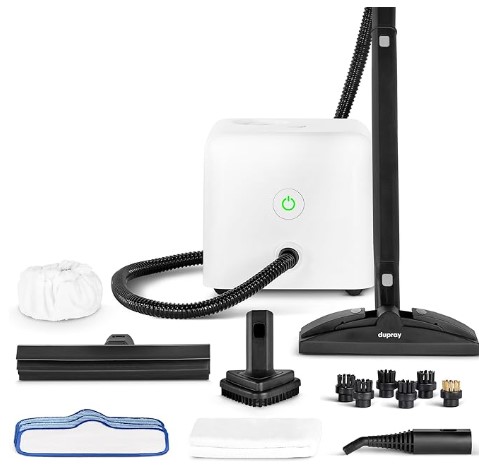
Comparison Table
| Model | Maximum Steam Temperature | Continuous Runtime | Boiler Capacity | Price |
|---|---|---|---|---|
| Dupray Neat | 275°F | Up to 50 minutes | 54 oz | Amazon |
| McCulloch MC1385 | 248°F | Up to 120 minutes | 64 oz | Amazon |
Testing Criteria
Biological sanitization depends on thermal energy delivery, steam consistency, moisture management, and engineering durability.
Evaluation focused on factors that directly affect microbial reduction rather than cosmetic cleaning performance.
Testing criteria included:
- Steam temperature stability under continuous operation
- Heat penetration into porous and non-porous surfaces
- Moisture output control
- Boiler engineering quality
- Accessory effectiveness
- Hose and wand durability
- Operational efficiency during extended sanitization sessions
- Long-term maintenance requirements
Expert Opinion
Microbial eradication depends more on steam quality than accessory quantity. Stable high-temperature vapor, controlled moisture output, and consistent pressure create superior biological outcomes.
Engineering integrity often determines sanitization effectiveness long after advertised specifications lose relevance.
Deep-Dive Analysis: Dupray Neat
Engineering Focused Steam Sanitization Platform
Dupray Neat prioritizes steam quality over accessory abundance. Internal boiler architecture emphasizes temperature consistency and dry steam production.
Such engineering characteristics support effective microbial reduction across kitchens, bathrooms, mattresses, upholstery, tile, grout, and sealed flooring.
The compact rectangular housing appears simple. Internal performance metrics reveal a different story.
Steam output remains remarkably stable throughout extended operating periods. Temperature retention allows sustained thermal exposure against bacteria, mold spores, dust mite residues, and organic contamination.
Dry steam production represents a major engineering advantage. Excess moisture often creates secondary contamination risks through damp surface conditions.
Dupray Neat minimizes such concerns through controlled vapor generation.
Pressure delivery remains consistent during prolonged operation. Such consistency improves heat penetration into grout lines, textured flooring, and fabric fibers.
Primary Strengths
1. Superior Steam Quality
Steam quality determines sanitization effectiveness.
Dupray Neat generates relatively dry vapor with excellent thermal stability. Reduced water content allows deeper heat transfer while limiting residual surface moisture.
Higher-quality steam creates better biological outcomes than excessive wet steam regardless of advertised pressure ratings.
2. Excellent Temperature Retention
Many residential steam cleaners experience thermal degradation during extended use.
Dupray Neat maintains operating temperature effectively throughout cleaning cycles. Stable temperatures support more predictable microbial reduction rates on hard surfaces.
Consistent thermal delivery also improves efficiency during larger sanitization projects.
3. Compact Industrial Design
Boiler-focused engineering reduces unnecessary complexity.
Compact dimensions improve maneuverability around bathrooms, kitchens, furniture, and narrow storage areas. Fewer external components reduce potential mechanical failure points over time.
The result is a machine engineered primarily for performance rather than visual complexity.
Mechanical Limitation
Limited Continuous Runtime Compared With Large-Capacity Systems
Dupray Neat offers substantial runtime for residential applications.
However, larger commercial-style units provide longer uninterrupted operation. Extensive whole-home sanitization projects may require occasional refill cycles sooner than MC1385.
Such limitations rarely affect standard household use but become noticeable during large-scale cleaning sessions.
Deep-Dive Analysis: McCulloch MC1385
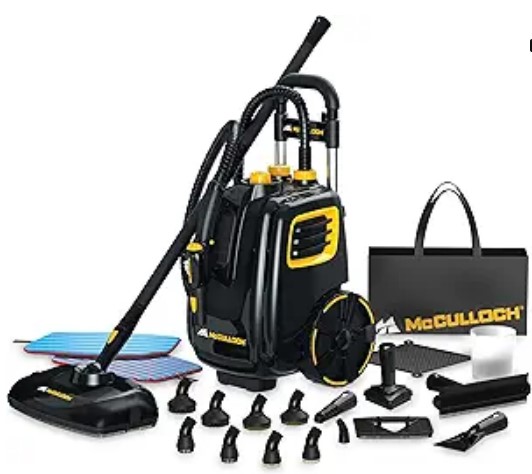
Accessory-Rich Multi-Surface Steam Cleaning System
McCulloch MC1385 approaches steam cleaning from a different engineering philosophy.
Instead of emphasizing compact boiler efficiency, MC1385 focuses on operational versatility.
A larger tank, extensive accessory package, and longer runtime support broad cleaning applications throughout residential environments.
The system performs well on flooring, appliances, bathroom fixtures, vehicle interiors, grills, and outdoor furniture.
Extended runtime represents a major advantage.
Large-capacity water storage supports lengthy cleaning sessions without interruption. Such capability benefits larger homes requiring continuous operation across multiple rooms.
Steam performance remains strong, although moisture output generally exceeds levels observed from Dupray Neat.
Greater moisture content does not eliminate sanitization effectiveness. However, surface drying times may increase following treatment.
Primary Strengths
1. Exceptional Runtime
MC1385 excels during extended cleaning sessions.
Large water capacity allows prolonged operation before refilling becomes necessary. Such capability improves efficiency across expansive residential environments.
Long runtime particularly benefits grout cleaning, bathroom restoration, and whole-home maintenance projects.
2. Extensive Accessory Package
Accessory quantity significantly exceeds most competing residential steam cleaners.
Specialized tools support cleaning across diverse surfaces and geometries. Tight corners, appliance interiors, grout channels, and vehicle components become easier to access.
Accessory versatility increases overall application range.
3. Strong Value for Whole-Home Cleaning
MC1385 combines respectable steam performance with broad operational flexibility.
The platform functions effectively as an all-purpose steam cleaning system rather than a dedicated sanitization-focused unit.
Such versatility appeals to homeowners requiring maximum surface coverage from a single machine.
Mechanical Limitation
Higher Moisture Output
MC1385 generally produces wetter steam than Dupray Neat.
Additional moisture may increase drying times on upholstery, mattresses, sealed flooring, and other sensitive surfaces.
From a biological perspective, excessive moisture can reduce operational efficiency during rapid sanitization workflows.
Dupray Neat vs. McCulloch MC1385: Which Steam Cleaner Wins?
The answer depends on the primary objective.
For biological sanitization, Dupray Neat holds a measurable advantage.
Dry steam quality, superior temperature stability, and excellent moisture control create conditions that favor microbial reduction. Engineering design prioritizes thermal performance instead of accessory expansion.
For whole-home cleaning versatility, MC1385 remains highly competitive.
Long runtime and extensive attachments support broader cleaning applications. Large residential environments benefit from fewer interruptions and greater tool diversity.
Best Choice for Sanitization
Winner: Dupray Neat
Reasons:
- Better steam consistency
- Lower residual moisture
- Stronger temperature retention
- More focused sanitization engineering
- Superior performance on mattresses, grout, bathrooms, and food-preparation areas
Best Choice for Cleaning Versatility
Winner: McCulloch MC1385
Reasons:
- Longer runtime
- Larger water capacity
- More accessories
- Greater application flexibility
- Better suited for extensive cleaning projects
FAQs
1. Does steam cleaning kill bacteria and viruses?
High-temperature steam can significantly reduce many bacteria, viruses, mold spores, and dust mite populations on compatible surfaces.
Effectiveness depends on temperature, exposure duration, steam quality, and surface characteristics.
2. Which steam cleaner produces drier steam?
Dupray Neat generally produces drier steam than McCulloch MC1385. Lower moisture output improves heat transfer efficiency while reducing surface drying times after sanitization procedures.
3. Is a larger water tank better for sanitization?
Not necessarily. Water capacity affects runtime rather than sanitization effectiveness.
Steam temperature stability, moisture control, and pressure consistency contribute more directly to microbial reduction performance than tank size alone.
Final Word
For biological sanitization, Dupray Neat earns the overall victory. Superior steam quality, stronger thermal consistency, and lower moisture output create better conditions for microbial reduction.
McCulloch MC1385 remains an excellent cleaning platform, but Dupray Neat delivers the stronger engineering package when sanitization performance serves as the primary objective.