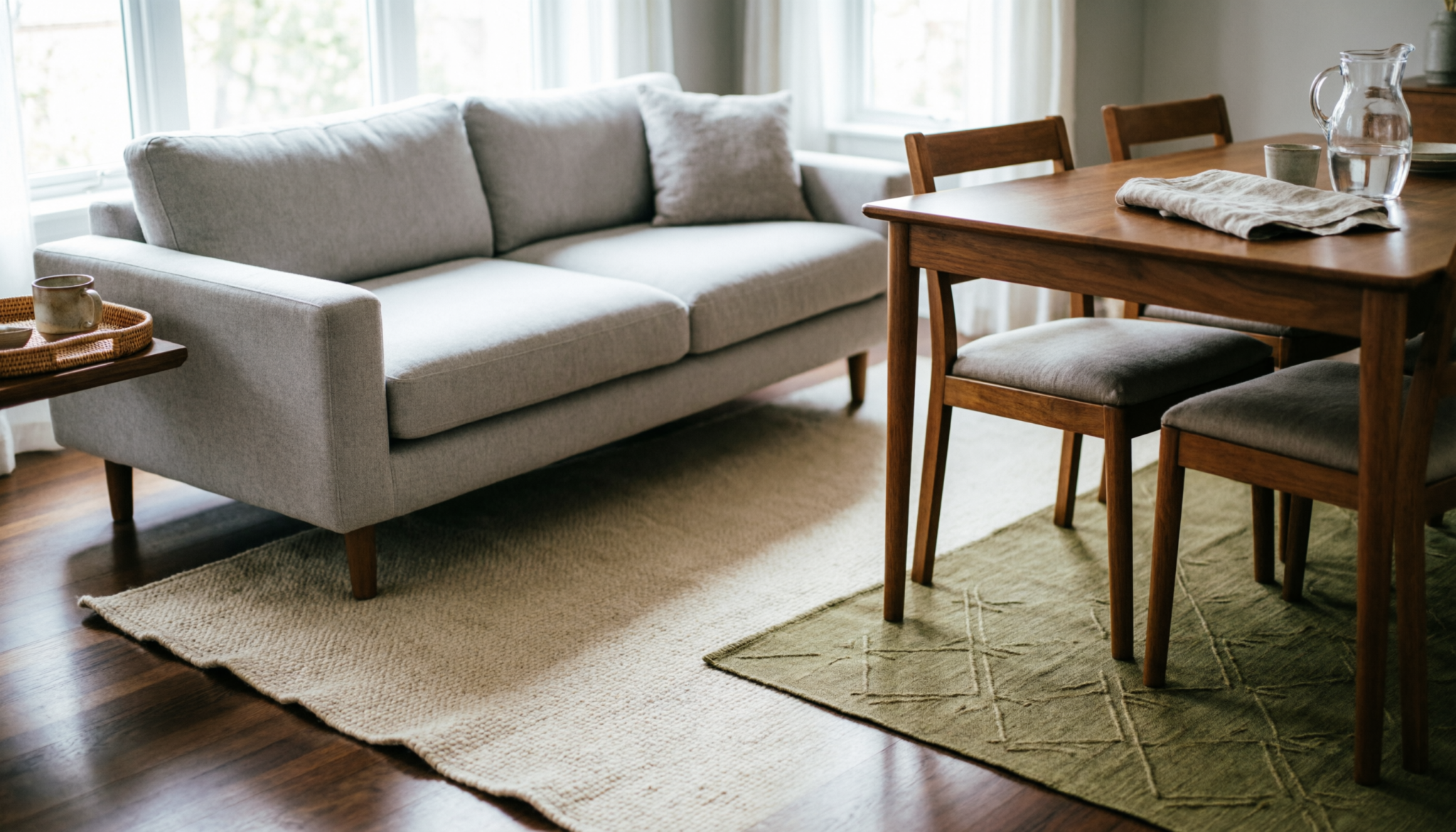
A rug can correct a room’s proportions or quietly ruin them. Most sizing mistakes come from rugs that sit too small under furniture, leaving seating areas visually disconnected.
The “front legs on the carpet” rule fixes that problem by anchoring furniture without overwhelming the floor plan.
Rug Size Spatial Logic Summary
Visual imbalance in seating areas usually comes from undersized rugs that fail to anchor furniture placement.
The correct rug size must extend beneath at least the front legs of sofas and chairs while maintaining 12 to 18 inches of exposed flooring around the perimeter.
Narrow walkways, uneven furniture spacing, and floating accent chairs create fragmented visual flow and make rooms appear smaller and disorganized.
Rug Pad Comparison Table
| Pad Material | Grip Outcome | Floor Safety | Longevity |
|---|---|---|---|
| Felt Pad | Moderate grip with soft cushioning | Safe for hardwood and laminate | 5 to 7 years |
| Rubber Pad | Strong grip for high-traffic areas | Prevents sliding but may mark delicate finishes if low quality | 3 to 5 years |
| Felt and Rubber Hybrid | Strong grip with added cushioning and sound absorption | Best protection for hardwood and tile | 7 to 10 years |
The Living Room Layout: All Legs On vs. Front Legs Only
Two workable layouts exist. Choice depends on room size, budget, and furniture scale.
All Legs On the Rug (Best for Larger Rooms)
- Sofa, chairs, and tables sit fully on the rug
- Creates a unified zone with strong visual weight
- Works well in open-plan spaces where seating needs clear boundaries
Reality check: This setup demands a large rug, often 9×12 or bigger. Anything smaller forces awkward furniture placement or cramped spacing.
Front Legs Only (Best for Most Homes)
- Front legs of sofa and chairs sit on the rug
- Back legs remain off
- Maintains connection without crowding the room
Why this works: Visual anchoring happens at the front edge. That single line ties the layout together without needing oversized rugs.
Common Mistake: The “Postage Stamp” Rug
- Small rug floats in the middle
- Furniture sits completely off
- Room feels disjointed and smaller than actual size
Fix: Step up at least one size. A slightly oversized rug always looks intentional. A too-small rug always looks like a mistake.
The Bedroom Layout: The “Rule of Thirds” for Rug Placement Under a Bed
Bedroom rugs follow a different logic. Comfort and proportion matter more than full coverage.
The Rule of Thirds
- Place the rug under the lower two-thirds of the bed
- Leave the headboard and nightstands off the rug
- Extend rug far enough on each side for feet to land on softness
Ideal Rug Sizes by Bed Type
- Queen bed: 8×10 rug
- King bed: 9×12 rug
Why This Works
- Keeps focus on the bed without swallowing the room
- Provides softness where needed most
- Avoids bulky layering near the headboard
Common Bedroom Mistake
- Small rug placed under only the foot of the bed
- Looks disconnected and offers little comfort
Fix: Increase size so the rug reaches at least halfway under the bed, preferably two-thirds.
Why the “Front Legs on the Carpet” Rule Works
Furniture needs visual connection. When sofas and chairs sit completely off the rug, the room feels scattered. The rug appears disconnected from the seating arrangement rather than integrated into it.
The “front legs on the carpet” rule creates structure without requiring an oversized rug that fills the entire room. At minimum, the front legs of large furniture pieces should rest securely on the rug surface.
This rule works because it:
- Creates a unified seating zone
- Prevents a floating furniture layout
- Adds balanced proportions
- Makes small rooms appear wider
- Improves visual flow between furniture pieces
For living rooms, this layout often provides the best balance between comfort, scale, and budget.
Standard Rug Sizes and Where They Actually Work
Many rug-buying mistakes happen because standard sizes get used in the wrong room dimensions.
5×7 Rugs
A 5×7 rug rarely works in a full living room unless placed beneath a coffee table only. In most seating layouts, it appears undersized and disconnected.
Best use cases:
- Small reading corners
- Compact apartments
- Home offices
- Under twin beds
8×10 Rugs
An 8×10 rug fits most average living rooms using the “front legs” approach. Front sofa legs and chair legs sit comfortably on the rug while maintaining visible flooring around the edges.
Best use cases:
- Standard three-seat sofas
- Sectionals in medium rooms
- Open-concept seating zones
9×12 Rugs
A 9×12 rug works best in larger living rooms where all furniture legs may rest on the rug without crowding the walls.
Best use cases:
- Large sectionals
- Open floor plans
- Wide seating arrangements
- Formal living rooms
A rug should never touch every wall edge. Maintain roughly 12 to 18 inches of visible flooring around the perimeter whenever possible.
Common Rug Sizing Mistakes That Make Rooms Feel Off
Choosing Rugs Based on Coffee Table Size
The rug should anchor the seating arrangement, not match the coffee table dimensions. A large sofa paired with a tiny rug creates visual imbalance immediately.
Ignoring Walkway Clearance
Rugs placed too close to hallways or door swings interrupt movement. Maintain at least 18 inches of walking clearance in major pathways.
Using Different Rug Sizes in Connected Spaces
Open-concept rooms require proportional consistency. A massive dining room rug beside a tiny living room rug creates uneven visual weight.
Placing Only the Coffee Table on the Rug
This remains one of the most common layout problems. The room feels temporary and unfinished because furniture lacks connection to the floor anchor.
Rug Placement Rules for Different Rooms
Living Room
The front legs of sofas and accent chairs should rest on the rug. Coffee tables should sit fully centered.
For large layouts:
- All furniture legs may sit on the rug
- Leave border flooring visible
- Keep rug centered to the seating area, not the room itself
Dining Room
Dining rugs require enough surface area for chairs to remain on the rug even when pulled out.
Standard guideline:
- Extend rug at least 24 inches beyond the table edges
Too-small dining rugs create unstable chair movement and damaged rug edges.
Bedroom
Bedroom rugs should extend beyond the bed frame to provide soft landing space.
Typical sizing:
- Queen beds pair well with 8×10 rugs
- King beds often require 9×12 rugs
Avoid narrow rugs that stop abruptly beside nightstands. The layout feels visually cramped.
Rug Shape Matters More Than Most Layouts Realize
Shape changes the room’s perceived proportions.
Rectangular Rugs
Best for:
- Standard seating layouts
- Long living rooms
- Dining tables
- Bedrooms
Round Rugs
Useful for:
- Small conversation areas
- Entryways
- Round dining tables
- Rooms needing softer visual lines
Runner Rugs
Ideal for:
- Hallways
- Kitchens
- Narrow bedrooms
- Laundry spaces
A poorly chosen shape creates more imbalance than slightly incorrect sizing.
Expert Opinion
Expert’s Tip: Rug size mistakes usually come from measuring furniture instead of measuring the seating zone.
The rug should extend at least 6 to 8 inches beyond the sofa edges to prevent a cramped appearance.
A quality felt-and-rubber pad prevents shifting, reduces corner curling, and protects hardwood finishes from uneven wear patterns.
How Rug Color and Pattern Affect Perceived Size
Color influences spatial perception almost as much as dimensions.
Light Rugs
Light tones visually expand smaller rooms. Soft beige, muted gray, ivory, and warm sand shades create openness.
Dark Rugs
Dark rugs ground large rooms effectively but may visually shrink compact spaces if oversized patterns dominate the floor.
Large Patterns
Bold oversized patterns work best in spacious rooms with minimal furniture clutter.
Small Patterns
Smaller repeating patterns help maintain balance in tighter layouts.
Busy rugs paired with busy upholstery often create visual competition instead of cohesion.
Measuring a Room Properly Before Buying a Rug
Accurate measuring prevents expensive sizing mistakes.
Step 1: Measure the Seating Area
Measure the full furniture arrangement, not just the open floor space.
Step 2: Mark Rug Boundaries
Painter’s tape helps visualize the rug footprint directly on the floor.
Step 3: Check Door Clearance
Verify that doors swing freely without catching rug edges.
Step 4: Account for Expansion
Future furniture changes matter. A rug that barely fits today may feel undersized after layout updates.
Skipping this process usually leads to buying one size too small.
FAQs
1. How much larger should a rug be than a sofa?
A rug should generally extend 6 to 12 inches beyond each side of the sofa. This creates balanced proportions and prevents the seating area from feeling visually compressed.
2. Should all furniture legs sit on the rug?
Not always. In many living rooms, only the front legs need to sit on the rug. Larger rooms may accommodate all furniture legs comfortably.
3. What size rug works best for small living rooms?
An 8×10 rug often works better than smaller options because it anchors furniture properly and visually expands the room. Tiny rugs usually make compact spaces feel even smaller.
Final Take
Correct rug sizing creates structure, balance, and visual comfort without requiring expensive redesigns. The “front legs on the carpet” rule solves most layout problems by anchoring furniture into a unified zone.
Small rugs fragment a room. Properly scaled rugs create cohesion, improve flow, and make furniture arrangements feel intentional rather than temporary.