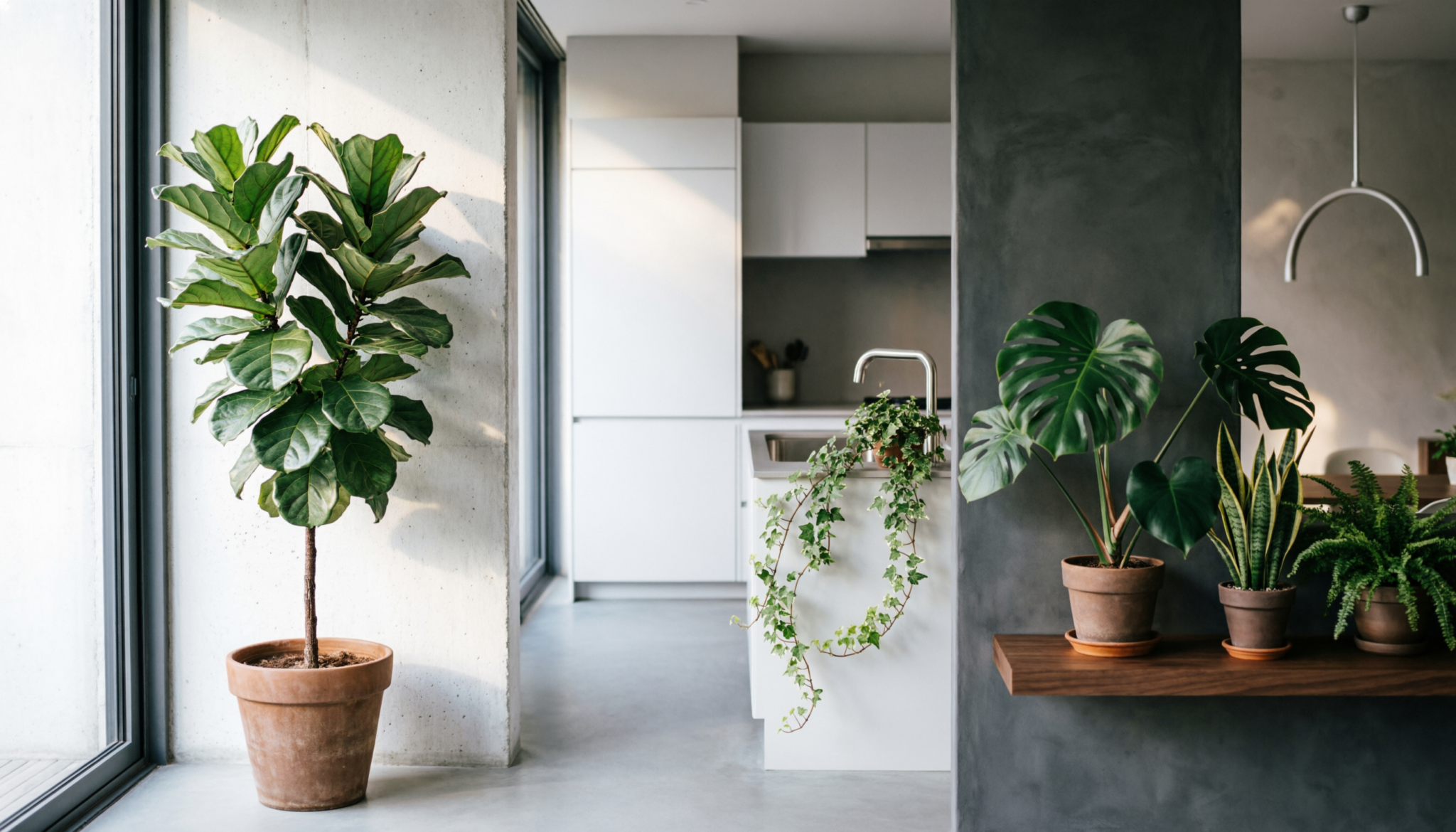
Minimalist architecture often delivers clean sightlines, smooth surfaces, and sharp geometry. The problem starts when those same qualities remove warmth, texture, and visual rhythm from daily living spaces.
Greenery corrects that imbalance. Proper plant placement softens hard edges, absorbs visual harshness, and restores movement without cluttering the architecture itself.
Spatial Logic Summary: Minimalist interiors feel cold when smooth materials dominate every visual layer at the same height. Greenery restores balance by adding organic texture, irregular shapes, and vertical variation.
The most effective layouts combine tall structural plants, trailing greenery, and low sculptural foliage to interrupt rigid architectural lines without overcrowding open space.
Comparison Table
| Placement Strategy | Visual Warmth | Architectural Balance | Maintenance Level | Best Minimalist Feature |
|---|---|---|---|---|
| Tall Floor Plants | High | Softens vertical lines | Moderate | Concrete walls |
| Trailing Greenery | Medium-High | Reduces visual rigidity | Low-Moderate | Floating shelves |
| Sculptural Tabletop Plants | Medium | Adds texture without clutter | Low | Stone surfaces |
| Indoor Trees | Very High | Anchors oversized spaces | Moderate-High | Double-height ceilings |
Where to Place Plants in a Modern Room
Start with the problem areas. Corners, long blank walls, and spaces beside furniture often feel stiff because nothing interrupts the geometry.
A tall plant tucked into a corner immediately softens a hard angle. Low plants placed near seating reduce the “floating furniture” effect common in minimalist layouts.
Avoid symmetry that feels forced. A slightly off-center plant placement creates a more natural rhythm, closer to how greenery appears outdoors.
Window edges also matter. Instead of leaving them bare, frame them with plants to soften incoming light.
Harsh daylight bouncing off glass and concrete becomes gentler when filtered through leaves.
Why Minimalist Homes Often Feel “Cold”
Minimalist architecture relies heavily on repetition. Flat white walls, black metal framing, polished concrete, oversized windows, and uninterrupted flooring create visual discipline.
That discipline looks refined in photographs but often feels emotionally distant in lived spaces.
Three issues usually create the problem:
- Excessive hard surfaces
- Lack of organic texture
- Weak visual layering
A room with concrete floors, matte cabinetry, and exposed steel may technically feel balanced, yet still appear sterile because every surface reflects the same emotional tone.
Greenery interrupts that pattern naturally.
Leaf variation introduces asymmetry. Organic movement offsets straight architectural lines.
Deep greens absorb visual harshness more effectively than decorative accessories because plants add shape and texture simultaneously.
The key is restraint. Minimalist architecture collapses under random plant clutter. One oversized olive tree often works better than ten scattered succulents.
Use Large Plants as Architectural Counterweights
Small plants rarely soften large-scale minimalist spaces effectively. Minimalist rooms often feature high ceilings, expansive walls, and oversized windows. Tiny greenery disappears visually against that scale.
Larger plants create proportional balance.
Best options for minimalist homes include:
- Olive trees
- Fiddle leaf figs
- Rubber plants
- Bird of paradise
- Kentia palms
Tall greenery works because it mirrors architectural height while softening rigid geometry.
Placement matters more than quantity.
Position larger plants:
- Near sharp corners
- Beside floating staircases
- Adjacent to floor-to-ceiling windows
- Next to oversized sectionals
- Along blank concrete walls
Avoid symmetrical placement unless the architecture already leans heavily structured. Slight asymmetry creates warmth without disrupting the minimalist aesthetic.
Container selection matters too. Busy ceramic patterns compete with minimalist interiors. Use:
- Matte stone planters
- Textured concrete vessels
- Limewash finishes
- Soft black ceramic
- Warm sand-colored containers
Glossy plastic immediately weakens the effect.
Layer Greenery Instead of Scattering It
Random plant placement creates visual noise. Minimalist architecture depends on intentional spacing.
Effective greenery layouts rely on layered height variation instead.
Use three visual levels:
- Floor level
- Mid-height surfaces
- Elevated trailing greenery
For example:
- A tall olive tree near a window
- A medium rubber plant beside a console
- Trailing pothos from a floating shelf
This layering technique builds softness gradually without making the room feel crowded.
The strongest minimalist interiors often use fewer plant varieties repeated consistently throughout the home. Repetition creates cohesion.
Good combinations include:
- Olive tree + pothos
- Rubber plant + philodendron
- Snake plant + trailing ivy
Avoid mixing too many leaf shapes, colors, or planter finishes. Excess variation weakens architectural clarity.
Expert Opinion
Expert’s Tip: Minimalist interiors need negative space around greenery to preserve architectural clarity. Maintain at least 18 inches of visible breathing room around large planters.
Tight clustering creates visual heaviness and weakens the clean structural lines that make minimalist spaces feel intentional.
Match Plant Shapes to Architectural Lines
Plant shape changes the emotional tone of a room.
Rounded foliage softens aggressive architecture faster than sharp foliage.
For example:
- Olive trees create softness through irregular branching
- Ferns reduce visual hardness with layered movement
- Cascading ivy relaxes rigid shelving systems
Meanwhile:
- Snake plants reinforce vertical rigidity
- Spiky succulents echo sharp architecture
- Cacti intensify minimalist severity
That does not make angular plants wrong. They simply work better in warmer minimalist spaces already balanced with wood, textiles, or softer lighting.
For heavily industrial interiors with concrete and steel, softer greenery usually performs better.
Minimalist homes also benefit from movement. Plants with gentle leaf motion near airflow prevent rooms from feeling static.
Good movement plants include:
- Bamboo palms
- Ferns
- Areca palms
- Hanging pothos
Stillness creates elegance. Excess stillness creates lifelessness.
Use Natural Imperfection to Offset Precision
Minimalist architecture often feels emotionally distant because every line appears controlled.
Greenery introduces natural imperfection:
- Slight leaf variation
- Organic branching
- Irregular silhouettes
- Seasonal growth changes
These imperfections humanize rigid interiors.
Natural wood, linen, and greenery work together because all three contain subtle unpredictability. That contrast matters.
A polished concrete room with zero organic elements often feels unfinished emotionally, even when technically complete.
Greenery fixes this without requiring excessive decor.
The most effective minimalist homes usually pair plants with:
- Soft linen drapery
- Warm oak tones
- Natural woven textures
- Limewash walls
- Matte finishes
Plants alone cannot compensate for an entirely hard-material interior. They work best as part of a broader texture strategy.
Avoid the Most Common Greenery Mistakes
Minimalist interiors expose mistakes quickly because fewer objects exist to hide imbalance.
Common problems include:
Too Many Small Plants
Small scattered pots create visual fragmentation. Fewer larger plants maintain cleaner architectural flow.
Fake Plants with Plastic Sheen
Artificial greenery with glossy surfaces weakens premium minimalist interiors immediately. High-quality preserved branches or realistic silk olive trees perform better if maintenance remains a concern.
Overdecorated Planters
Minimalism depends on restraint. Busy planter patterns compete with the architecture itself.
Ignoring Light Conditions
A struggling plant damages the room visually faster than no plant at all. Match greenery to actual light levels instead of aspirational styling photos.
Blocking Natural Circulation
Plants should soften pathways, not interrupt them. Maintain clear movement lines through open-concept spaces.
FAQs
1. Which plants work best in minimalist interiors?
Olive trees, rubber plants, pothos, fiddle leaf figs, and kentia palms work especially well because they provide sculptural shapes without excessive visual clutter.
Consistent leaf color and restrained forms support minimalist architecture better than highly colorful flowering plants.
2. How many plants should a minimalist living room contain?
Most minimalist living rooms need only three to five intentional greenery placements. Oversaturation creates visual chaos.
One large focal plant paired with smaller supporting greenery usually creates stronger architectural balance than numerous small pots.
3. Do minimalist interiors require real plants?
Real greenery provides natural movement, texture variation, and organic aging that artificial plants rarely replicate convincingly.
High-quality preserved branches or premium faux olive trees can work in low-light spaces, but cheap artificial greenery weakens minimalist interiors immediately.
Final Take
Minimalist architecture succeeds through restraint, proportion, and clarity. Greenery works best when supporting those principles instead of competing with them.
Large sculptural plants, layered placement, natural textures, and controlled spacing soften rigid interiors without sacrificing architectural precision. Warmth comes from balance, not decoration overload.