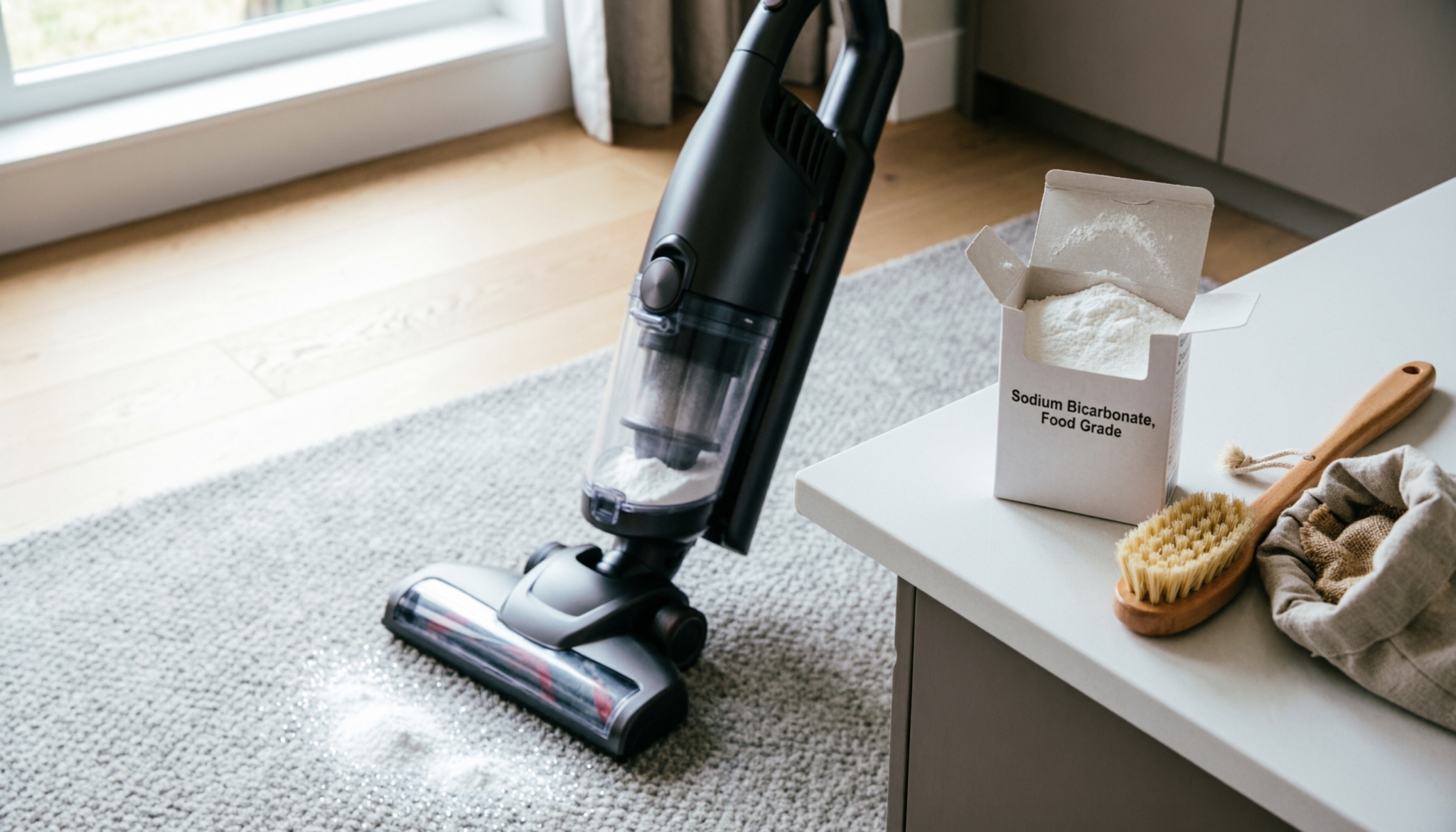
Maintenance Quick-Start: Vacuuming small amounts of baking soda is usually safe for sealed vacuums with strong filtration systems.
Problems start when fine powder clogs filters, coats motor fans, or bypasses weak seals.
Bagless vacuums and older units face the highest risk because microscopic particles circulate directly through internal airflow channels.
Warning:
Baking soda absorbs moisture and odors, but heavy use inside carpets creates dense powder buildup. Excess powder can clog cyclones, reduce suction, overheat motors, and shorten filter lifespan. Fine particles also escape through low-grade filtration systems and recirculate into indoor air.
Comparison Table
| Filter Grade | Particle Size Outcome | Capture Efficiency | Medical Application |
|---|---|---|---|
| Standard Foam Filter | Captures visible dust only | Low | Basic household debris |
| HEPA H13 | Captures particles as small as 0.3 microns | 99.95% | Allergy-sensitive environments |
| HEPA H14 | Captures ultra-fine airborne contaminants | 99.995% | Hospital-grade isolation rooms |
Why Baking Soda Creates Problems Inside Vacuums
Baking soda looks harmless because texture feels soft and lightweight. Vacuum motors disagree.
Fine sodium bicarbonate particles behave differently from normal household dirt. Carpet dust contains mixed particle sizes, but baking soda remains extremely uniform and powdery.
That consistency allows particles to pass through weak filters and settle inside motor housings.
Common symptoms after frequent baking soda vacuuming include:
- Reduced suction
- Burning smells
- Loud motor pitch
- Filter clogging
- Dust leaking from exhaust vents
- Premature motor wear
Bagless cyclonic systems face the biggest challenge.
Cyclones separate larger debris through centrifugal force, but ultra-fine powders often bypass separation chambers entirely.
Repeated exposure gradually coats motor fans and internal sensors.
Which Vacuums Handle Baking Soda Best?
Not every vacuum reacts the same way.
Sealed HEPA vacuums tolerate baking soda better because airflow systems prevent powder leakage.
Disposable bag systems also help because bags act as secondary filters before particles reach the motor.
Higher-risk vacuum types include:
- Cheap bagless uprights
- Stick vacuums with small dust bins
- Robot vacuums
- Older canisters with worn seals
- Vacuums using washable mesh filters only
Robot vacuums struggle especially hard because fine powder interferes with cliff sensors, wheel assemblies, and charging contacts.
Cordless stick vacuums also face airflow restrictions faster due to compact motor pathways and smaller filters.
Heavy baking soda use often causes overheating in these smaller systems.
Technician’s Insight
Technician’s Insight: White powder buildup around exhaust vents signals filtration bypass inside the vacuum body. Internal motor contamination has already started.
Continued operation increases bearing wear, weakens cooling airflow, and shortens brushless motor lifespan significantly. Sealed HEPA systems tolerate limited baking soda exposure better than open cyclone designs.
Safe Ways to Use Baking Soda on Carpet
Controlled use matters more than brand names.
Safe application starts with moderation. Thick carpet coatings create dense residue layers deep in fibers. Vacuum airflow struggles to lift compacted powder completely.
Safer process:
- Sprinkle a light dusting only
- Wait 15 to 30 minutes
- Vacuum slowly using overlapping passes
- Empty dust containers immediately
- Clean filters afterward
Large piles of baking soda create unnecessary strain.
Moisture also changes the equation completely.
Damp baking soda hardens into paste-like residue that clogs hoses and internal air channels. Wet powder often sticks to cyclone chambers permanently.
Pet owners commonly overuse baking soda for odor control. Repeated weekly applications gradually create residue buildup beneath carpet backing.
At that point, odors usually come from padding contamination rather than surface fibers.
Better Alternatives for Odor Removal
Baking soda works for mild odors, but stronger smells usually need source removal instead of masking.
Better long-term odor control methods include:
- Hot water extraction
- Enzyme treatment for pet accidents
- Carpet shampooing
- Activated charcoal absorbers
- HEPA air purification
- Moisture reduction
Vacuuming alone cannot remove deeply absorbed biological contamination.
Pet urine especially crystallizes beneath carpet padding. Baking soda temporarily dulls the smell while bacteria continue spreading underneath.
Repeated powder treatments often delay proper cleaning.
For allergy-sensitive homes, excessive baking soda use may worsen airborne particulate levels during vacuuming. Fine powder easily becomes airborne during carpet agitation.
HEPA filtration helps, but limited airflow systems still release some microscopic particles during heavy cleaning sessions.
FAQs
1. Can baking soda ruin a vacuum cleaner?
Yes. Excessive baking soda use can clog filters, restrict airflow, contaminate motors, and damage internal seals. Bagless vacuums face higher risk because ultra-fine powder bypasses cyclone systems more easily.
2. Is vacuuming baking soda bad for carpets?
Light use is usually safe. Heavy applications leave residue deep inside carpet fibers and backing. Residual powder attracts dirt and may create stiff or dull carpet texture over time.
3. How often should baking soda be used on carpet?
Occasional use works best. Frequent applications create buildup inside both carpets and vacuums. Persistent odors usually require deep cleaning or moisture correction instead of repeated powder treatments.
Bottom Line
Vacuuming baking soda is safe in small amounts when using sealed HEPA vacuums with strong filtration.
Heavy or repeated use creates airflow restrictions, filter clogging, and long-term motor contamination.
Controlled application matters. Proper carpet cleaning removes odors more effectively than relying on powder treatments alone.