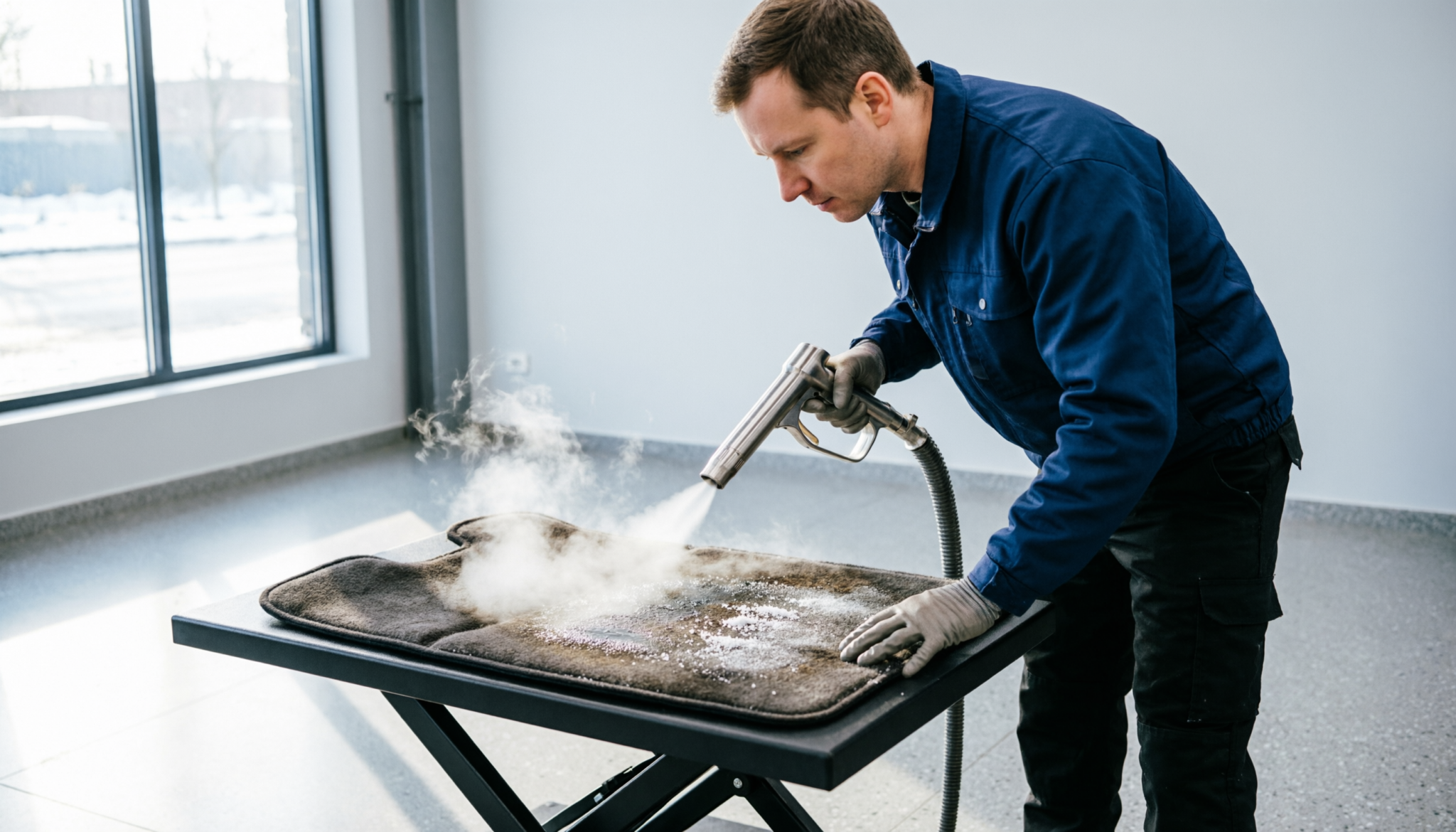
Steam-assisted extraction removes winter road salt effectively when condensed water dissolves salt and controlled agitation loosens deposits.
Effective cleaning combines vacuuming, short steam passes, and immediate moisture extraction. Steam alone can redistribute dissolved salt, while incomplete drying can worsen residue migration.
Complete extraction supports clean mats and fresher vehicle-cabin air.
Comparison Table: Winter Salt Extraction Methods
| Method | Salt Dissolution | Residue Removal | Cabin-Air Relevance |
|---|---|---|---|
| Dry vacuuming | Minimal | Loose crystals only | Reduces tracked dust |
| Warm-water extraction | High | High with vacuum recovery | Reduces residue and moisture when drying succeeds |
| Steam-assisted extraction | High after condensation | High with immediate extraction | Supports low-residue, low-moisture surfaces |
Why Road Salt Creates Persistent Mat Stains
Winter road salt reaches vehicle mats through boots, tires, slush, and roadside spray. Carpet fibers capture salt, grit, organic soil, and de-icing residues.
Evaporation leaves crystalline deposits along fiber surfaces and backing layers. Repeated wetting and drying produces white halos, stiff fibers, and recurring residue.
Salt does not behave like an oily stain. Water dissolves salt deposits, allowing dissolved material to move through porous fibers. Dry vacuuming removes loose crystals but cannot remove dissolved salt within damp residue.
Vehicle cabins represent enclosed microenvironments with measurable air-quality concerns. U.S.
Environmental Protection Agency research identifies particulate matter, volatile organic compounds, carbonyls, semi-volatile compounds, and microbes among pollutants measured inside motor-vehicle cabins.
Source control and filtration remain central air-quality measures.
Salt residue does not automatically represent a major airborne pollutant. Accumulated road dust, grit, organic debris, and dried residues can contribute to surface particulate loading.
Routine source removal supports cleaner cabin surfaces and reduces material available for resuspension.
How Condensed Steam Dissolves Salt Deposits
Steam requires careful explanation. Dry vapor does not directly dissolve a solid salt crystal. Dissolution occurs after steam contacts a cooler mat surface and condenses into liquid water.
Liquid water then hydrates and separates soluble salt ions, allowing saline residue to move away from carpet fibers.
Heat adds a mechanical advantage. Elevated surface temperature can soften compacted grime and improve water movement through contaminated fibers.
Steam delivers localized moisture, reducing large-volume cleaning solution use.
Salt dissolution depends primarily on water contact. A high-temperature steam pass without moisture recovery can relocate dissolved salt rather than remove salt. White residue may reappear after evaporation.
Short passes therefore outperform prolonged saturation. Steam nozzle movement should remain controlled, with overlapping strokes rather than stationary heating. Immediate extraction removes dissolved saline water before evaporation can return salt to the fiber surface.
Material compatibility remains essential. Carpet-backed mats can contain adhesives, dyes, foam, rubber, or layered synthetic materials.
Excessive heat or prolonged moisture exposure can affect backing stability, dye appearance, and drying performance. Manufacturer care guidance should determine temperature and moisture limits.
Steam Extraction Requires Complete Moisture Recovery
Effective salt removal follows a simple sequence: remove solids, dissolve residue, agitate gently, extract moisture, then dry completely.
First, remove the mat from the vehicle whenever practical. Shake or vacuum loose sand, salt crystals, gravel, and debris. Dry soil removal prevents abrasive particles from becoming slurry during steam treatment.
Second, inspect mat construction. Rubber, thermoplastic, carpet, and fabric-backed mats require different moisture strategies. Heat limits still apply.
Third, apply brief steam passes to localized salt deposits. A towel or microfiber cover can collect loosened residue at the nozzle interface. Excessive dwell time increases moisture loading.
Fourth, use extraction equipment capable of recovering liquid from carpet fibers. Vacuum recovery represents the critical stage because dissolved salt remains in cleaning water until physical removal.
Fifth, inspect after drying. Returning white residue indicates residual saline solution inside the fiber matrix. A second controlled rinse-and-extract cycle may outperform heavier chemical treatment.
Drying requires airflow, moderate warmth, and sufficient time. A damp mat returned to an enclosed vehicle creates an unfavorable moisture environment.
EPA guidance identifies moisture and humidity as important indoor-air-quality factors and recommends moisture control.
Expert’s Insight: Control Salt Before Drying
Road salt responds to water. Steam supplies heat and condensed water, but extraction determines removal. A mat requires dissolved salt to leave the fiber matrix.
Repeated steaming without vacuum recovery can create temporary visual improvement followed by recrystallized residue. Short treatment cycles, thorough extraction, and complete drying provide superior control.
Why Salt Returns After Steam Cleaning
Salt recurrence usually signals incomplete extraction rather than failed dissolution. Dissolved material can migrate through capillary spaces during cleaning.
Evaporation then concentrates saline material near the surface, producing a second white deposit.
Fiber architecture strongly influences recurrence. Dense automotive carpet can hold liquid below the visible pile. Backing layers can also retain contaminated moisture.
Surface-only steam treatment may therefore produce a clean appearance without removing the complete dissolved load.
After drying, inspect high-contact zones under bright light. White crystalline outlines, stiff fiber patches, or powdery deposits indicate residual material.
A microfiber wipe can reveal loose residue. Persistent recurrence warrants another controlled extraction cycle rather than stronger chemical concentration.
Vinegar sometimes appears in household salt-stain advice because mild acidity can help with mineral residues and mixed road grime. Pure sodium chloride already dissolves readily in water.
Acidic chemistry does not replace physical extraction. Mixed de-icing compounds and oily road film may require different chemistry, guided by material compatibility and soil identification.
The least aggressive effective method remains preferable. Excess cleaner can leave surfactant residue, while excess water can increase drying time.
EPA guidance emphasizes source control and careful management of cleaning-related pollutants.
Protecting Cabin Air After Winter Cleaning
Car mats sit close to the passenger breathing zone. Surface cleanliness therefore contributes to cabin hygiene, although mat cleaning alone cannot control total vehicle-cabin air quality.
Ventilation, cabin filtration, outdoor pollution, interior materials, and combustion-related pollutants can affect cabin exposure.
A vehicle-cabin air-quality review found multiple pollutant categories inside motor vehicles and identified ventilation and filtration as important exposure-control measures.
Mat maintenance should therefore complement, rather than replace, cabin-filter replacement and sensible ventilation practices.
Salt removal also protects flooring materials. Crystalline deposits can increase stiffness and abrasion when mixed with grit. Moisture cycles can transport residues into seams and backing layers.
Preventive maintenance works better than seasonal rescue cleaning. Frequent shaking, vacuuming, and prompt slush removal reduce salt entering carpet fibers.
Washable rubber or polymer mats can simplify routine rinsing where vehicle design permits.
For carpet mats, extraction remains the central principle: dissolve, agitate, recover, dry. Steam can improve the dissolution and agitation stages, but no steam process substitutes for liquid recovery.
FAQs
1. Can steam alone remove road salt from car mats?
Steam alone can dissolve and mobilize salt after condensation, but evaporation can leave dissolved salt behind. Vacuum extraction or thorough liquid recovery provides the necessary removal stage.
Short steam passes followed by extraction offer stronger residue control than repeated steaming without moisture recovery.
2. Why does white salt residue return after cleaning?
White residue returns when dissolved salt remains inside fibers, backing, or seams. During drying, water migrates toward the surface and evaporates, leaving recrystallized salt.
Incomplete extraction, excessive saturation, and deep backing contamination increase recurrence. Another controlled rinse-and-extract cycle can remove residual saline solution.
3. Does steam cleaning improve vehicle indoor air quality?
Mat cleaning can reduce surface soil and residue available for disturbance, but steam cleaning cannot control every cabin pollutant.
Vehicle-cabin air quality also depends on ventilation, filtration, outdoor pollution, interior emissions, and moisture management. EPA guidance places source control, ventilation, and filtration among core air-quality strategies.
Final Word
Steam provides useful heat and condensed water for winter salt removal, but extraction determines success. Thorough vacuum recovery prevents dissolved salt from returning during drying.
Complete drying protects carpet backing and cabin moisture conditions. Routine vacuuming, prompt slush removal, and appropriate mat care reduce seasonal residue before heavy deposits develop.