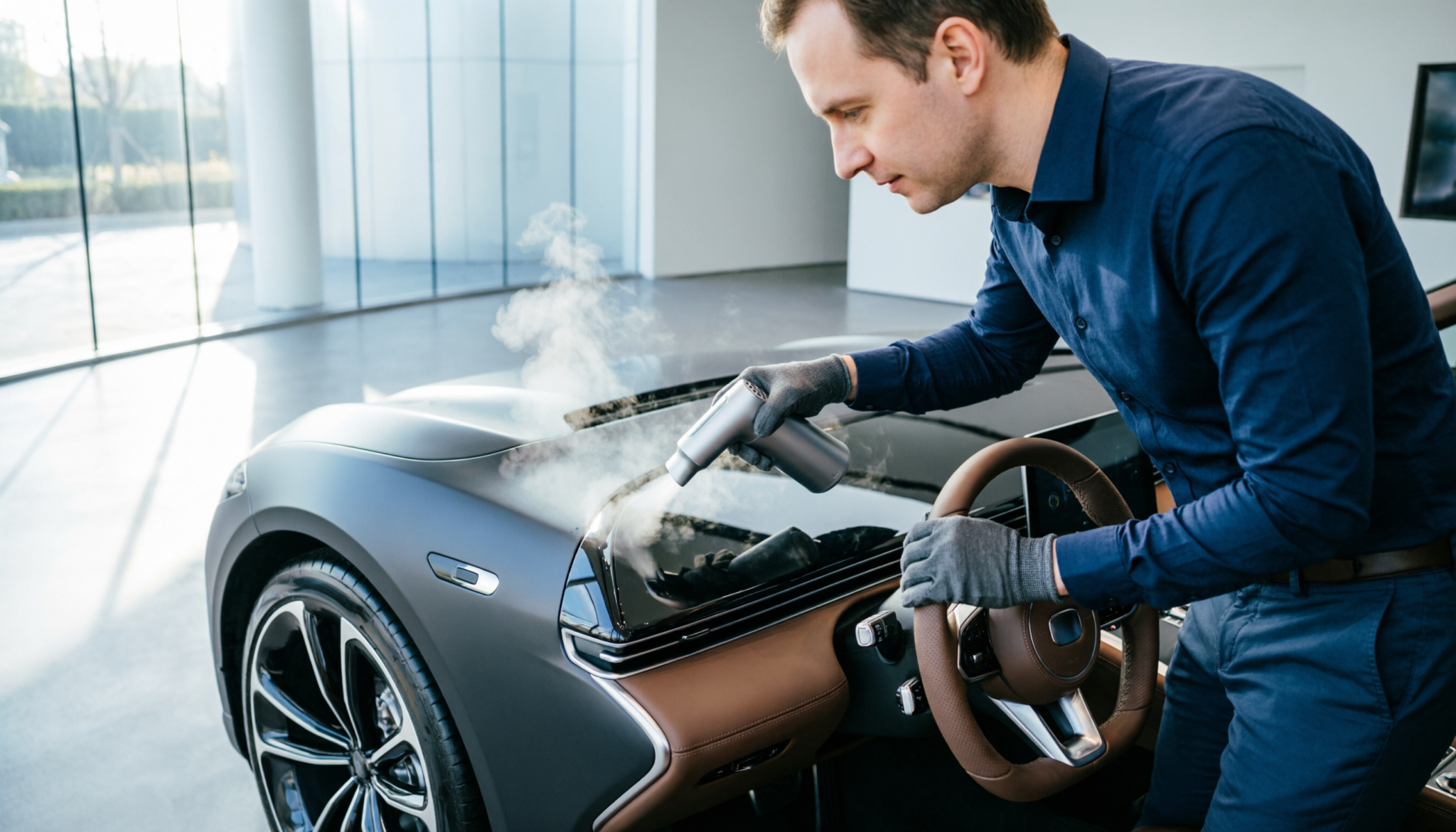
Dashboard surfaces accumulate dust, skin oils, food residues, road particles, and airborne contaminants. Steam cleaning can reduce dependence on chemical formulations.
VERDICT
Controlled steam offers a lower-chemical cleaning method for dashboard surfaces, but direct steam exposure can damage electronic components.
The safest protocol uses steam on a microfiber cloth, followed by immediate drying. Chemical sprays can release volatile compounds and leave residues.
Steam requires distance, control, and manufacturer-compatible surfaces for dashboard cleaning.
Steam Versus Sprays For Dashboard Sanitation
| Cleaning factor | Controlled steam | Chemical spray |
|---|---|---|
| Airborne chemical load | Minimal added chemical load | Potential VOC and fragrance exposure |
| Electronic risk | Moisture and heat require strict control | Liquid ingress and solvent exposure |
| Residue | Generally low with proper technique | Surfactant, fragrance, or solvent residue possible |
Controlled Steam Reduces Chemical Airborne Load
Indoor air quality inside a vehicle depends partly on material emissions and cleaning practices. A dashboard cleaner does not remain exclusively on the dashboard.
Spray droplets can enter cabin air, settle on adjacent surfaces, or reach ventilation pathways.
Fragranced products deserve particular caution. Fragrance compounds can contribute to perceived freshness without improving actual sanitation. Strong odor also does not indicate microbial reduction.
Controlled steam avoids many formulation-related emissions. Water provides the principal cleaning medium, while thermal energy assists residue removal.
A cloth captures loosened contamination rather than dispersing material through the cabin.
Steam cleaning therefore supports a lower-chemical sanitation strategy.
However, steam cannot remove every indoor-air contaminant.
Carbon monoxide, nitrogen dioxide, fine particulate matter, and volatile organic compounds require source control and ventilation rather than surface steaming.
Dashboard cleaning should complement, not replace, cabin ventilation, filter maintenance, and prompt removal of contamination sources.
Electronic Components Require Moisture Discipline
Electronic dashboards contain sensitive assemblies behind apparently solid surfaces.
Touchscreens, capacitive controls, display modules, switches, circuit boards, microphones, sensors, and connectors can occupy small spaces behind dashboard panels.
Direct steam application creates two hazards: condensation and thermal stress.
Condensed water can enter seams or openings. Heat can also affect adhesives, coatings, plastics, laminates, and display components. Repeated exposure can accelerate material degradation.
Safe steam sanitation therefore requires separation between steam output and electronic openings.
A practical protocol uses a microfiber cloth as the primary contact surface. Steam can condition the cloth rather than saturating the dashboard.
The cloth should remain damp rather than wet. Small sections should receive short cleaning passes, followed by immediate drying.
Particular caution applies to:
- Touchscreen edges
- Physical buttons
- Instrument clusters
- USB ports
- Speaker grilles
- Air vents
- Steering-wheel controls
- Seams around display panels
- Sensor openings
- Electrical switches
Manufacturer instructions remain the controlling authority. Some dashboard materials, coatings, displays, and synthetic leather surfaces may prohibit steam entirely.
Surface Heat Improves Residue Removal
Dashboard grime frequently contains a mixture of skin oils, sunscreen, food residues, dust, and environmental particles. Cold wiping can smear oily residues across textured plastic.
Heat softens many organic residues. Steam-assisted microfiber cleaning can therefore improve mechanical removal without relying on aggressive solvents.
The sanitation mechanism remains important. Cleaning and disinfection are not identical processes.
Steam can loosen and remove contamination, while sufficiently high temperatures under controlled conditions can reduce viable microorganisms.
Actual microbial reduction depends on temperature, contact duration, surface characteristics, soil load, and application technique.
A quick pass across a dashboard does not guarantee sterilization or complete pathogen elimination.
For routine automotive sanitation, the practical objective should remain removal of organic residue and reduction of contamination while preserving surface and electronic integrity.
A chemical disinfectant may remain appropriate when a manufacturer specifically permits the formulation and when genuine disinfection is required. Product label directions and surface compatibility should govern chemical use.
Safer Dashboard Sanitation Needs Precision
Expert’s Insight: Steam provides a valuable lower-chemical cleaning method for compatible dashboard materials, but electronics demand strict moisture control.
A microfiber barrier, short cleaning passes, immediate drying, and avoidance of openings reduce risk.
Chemical sprays also require restraint because aerosolized compounds and liquid overspray can affect cabin air quality and electronics.
The most important correction involves the word safer.
Steam is not universally safer than chemical spray. Direct steam can cause greater damage than a properly selected automotive cleaner applied to a compatible surface.
The stronger argument concerns controlled steam versus uncontrolled chemical overspray.
A spray bottle can create droplets beyond the intended cleaning area. A careless application can saturate buttons, penetrate seams, or leave residues on touch-sensitive surfaces.
Steam applied through a cloth can reduce chemical exposure while maintaining precise physical contact.
Application technique determines the outcome.
A suitable steam protocol follows several controls:
- Check surface compatibility. Manufacturer guidance takes priority.
- Use a clean microfiber cloth. Cloth contact improves moisture control.
- Avoid direct steam injection. Electronic openings require complete protection.
- Use short passes. Excessive heat or moisture provides no sanitation advantage.
- Dry immediately. Residual moisture should not remain around controls.
- Ventilate the cabin. Fresh-air exchange supports better indoor air quality.
- Clean the cloth frequently. A contaminated cloth can redistribute soil.
A dedicated detailing brush can remove dry particles before steam-assisted wiping. Removing loose particulate matter first reduces smearing and improves final surface cleanliness.
Indoor Air Quality Depends On More Than Cleaning
Dashboard sanitation represents only one part of vehicle indoor air quality.
Cabin air can accumulate pollutants from exterior traffic, road dust, combustion emissions, tobacco smoke, fragrances, adhesives, plastics, and interior materials.
Recirculation can increase pollutant concentration when an external source enters the cabin.
A clean dashboard cannot compensate for a saturated cabin air filter or persistent pollution source.
Effective cabin hygiene therefore combines several controls:
- Regular cabin-filter replacement according to vehicle requirements
- Exterior-air ventilation when outdoor conditions permit
- Removal of food and organic residues
- Reduced use of heavily fragranced products
- Periodic dust removal from vents and dashboard recesses
- Prompt cleaning of spills
- Appropriate surface sanitation
- Careful chemical selection when disinfectants are necessary
Steam contributes primarily through controlled surface cleaning and reduced dependence on volatile cleaning formulations.
The strongest sanitation strategy uses the least aggressive method capable of achieving the required cleaning result.
FAQs
1. Is steam safe for dashboard electronics?
Steam requires caution around electronics. Direct steam can force moisture into seams, switches, vents, ports, displays, and electrical assemblies.
A safer approach uses steam on a microfiber cloth for compatible surfaces, followed by immediate drying. Manufacturer instructions should determine whether steam is appropriate for specific dashboard materials.
2. Does steam improve vehicle indoor air quality?
Steam can reduce reliance on aerosolized cleaners, fragrances, and solvent-containing sprays during compatible surface cleaning. Steam does not remove all airborne pollutants.
Cabin filtration, ventilation, particulate control, and elimination of pollution sources remain essential for meaningful indoor-air-quality improvement.
3. Can steam disinfect a car dashboard?
Steam can reduce microorganisms under appropriate temperature and contact conditions, but a brief wipe does not guarantee disinfection. Soil removal remains the primary benefit of routine steam-assisted cleaning.
For regulated disinfection requirements, a compatible disinfectant and label-directed contact time provide a more defensible procedure.
Final Word
Controlled steam can support cleaner dashboard surfaces and lower chemical exposure, provided electronic components remain protected from direct heat and moisture.
Microfiber application, short passes, immediate drying, ventilation, and manufacturer compatibility create the safest protocol.
Chemical sprays remain useful when properly selected, but indiscriminate overspray creates unnecessary residue and airborne exposure.