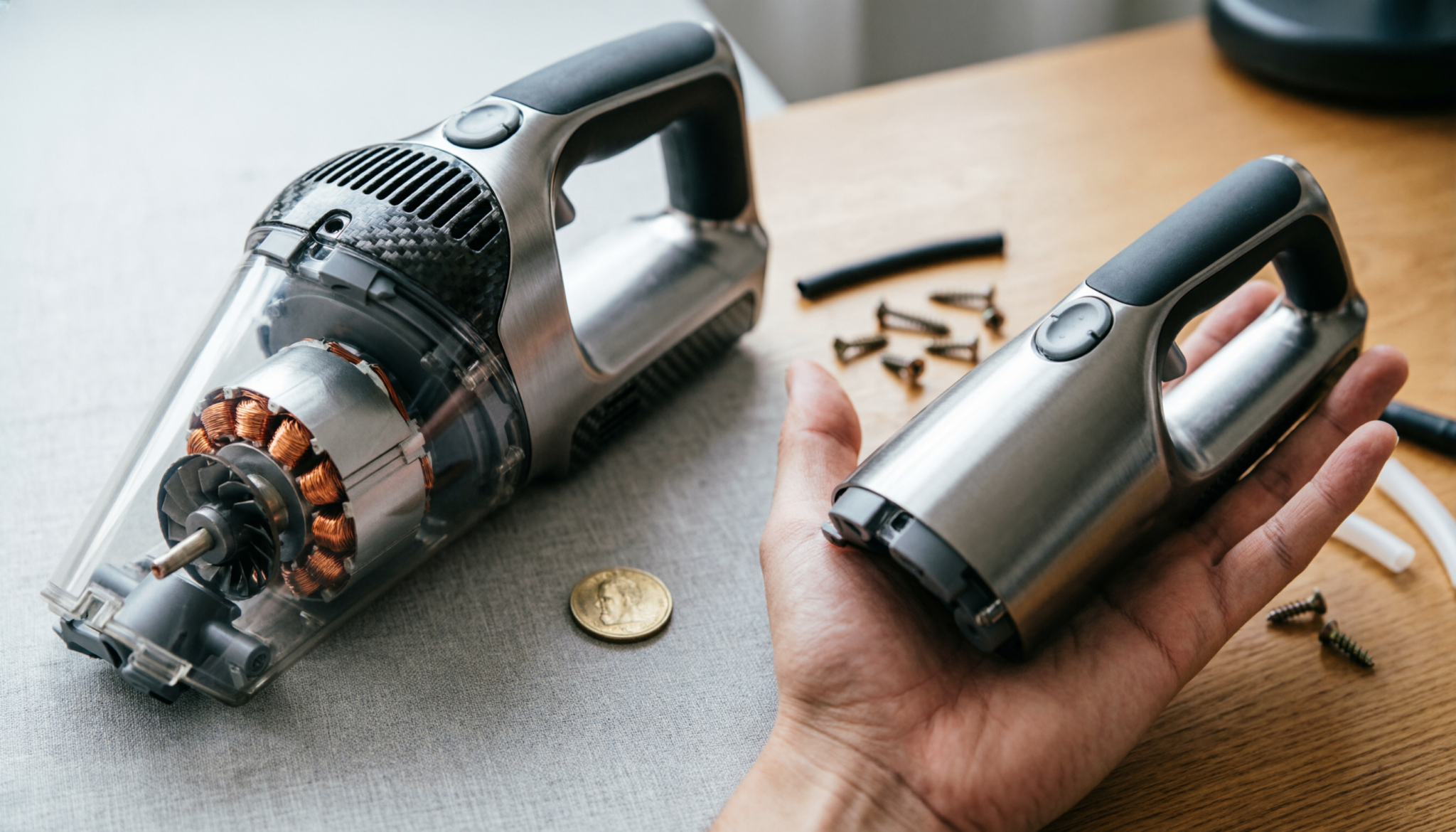
Rapid Repair Protocol: Miniature vacuum motors fail most often from restricted airflow and overheating. Fine dust coats cooling channels, raises winding temperatures, and weakens motor bearings.
Cleaning internal filters every two weeks and preventing intake blockages protects suction stability, battery longevity, and turbine efficiency in compact cordless and handheld vacuum systems.
Warning: High-speed compact motors can exceed 100,000 RPM. Disassembling sealed turbine housings without proper tools may damage impeller alignment, compromise electrical insulation, or create unsafe overheating conditions during reassembly.
Comparison Table
| Engineering Factor | Airflow-Focused Design | Portability-Focused Design | Balanced Compact Design |
|---|---|---|---|
| Motor Size | Larger turbine chamber | Ultra-compact motor housing | Mid-sized digital motor |
| Weight Outcome | Heavier hand fatigue | Lightweight handling | Moderate handling comfort |
| Suction Efficiency | Strong deep-clean airflow | Reduced sustained airflow | Stable mixed-surface suction |
| Runtime Application | Longer debris extraction | Quick spot cleaning | Whole-home convenience |
Suction vs. Portability: The Core Trade-off
Weight reduction is not just about trimming plastic. It forces a full redesign of the motor, battery, and airflow system.
A heavier vacuum uses a larger motor that generates strong airflow at lower speeds. That delivers deep carpet agitation without excessive strain.
A lightweight model shrinks that motor.
To compensate, engineers push RPM higher, which increases noise and heat while still falling short on deep debris removal.
This is where expectations break. A 5-pound vacuum handles surface dirt well but struggles with embedded dust, especially in thick carpets or high-traffic areas.
What this means in real use:
- Great for daily maintenance
- Weak for deep weekly cleaning
- Noticeable drop in performance on rugs and pet hair buildup
Why Strong Suction Requires Larger Motor Architecture
Vacuum suction depends on pressure differential. Stronger suction requires faster impeller rotation, larger fan geometry, or increased wattage. All three create engineering consequences.
Miniaturized motors face severe thermal stress. Small housings trap heat around copper windings and electronic control boards. Excess heat reduces efficiency and shortens motor lifespan.
Engineers counter this problem with advanced airflow channels, lightweight aluminum heat sinks, and high-speed digital brushless motors.
Compact motors also reduce airflow stability under resistance. Thick carpet, clogged filters, and narrow attachments create pressure loss.
Larger upright vacuums compensate with bigger cyclonic chambers and wider airflow pathways.
Handheld and slim cordless designs cannot maintain the same pressure consistency because internal air tunnels remain physically restricted.
Battery-powered units add another limitation. Strong suction drains lithium-ion packs rapidly. Increasing battery capacity raises total weight, which directly reduces portability.
Lightweight vacuums therefore operate in carefully controlled power windows to preserve runtime and prevent overheating.
This engineering compromise explains why many ultra-light vacuums perform well during quick debris pickup yet struggle with embedded sand, pet hair, or dense carpet fibers.
The Hidden Role of Airflow Efficiency
Consumers often focus only on suction power numbers. Airflow efficiency matters more in real homes.
A poorly designed motor can generate strong peak suction while moving limited air volume. Effective cleaning depends on maintaining airflow velocity across floor surfaces and through the dust-separation system.
Engineers improve airflow efficiency through:
- Cyclonic chamber shaping
- Reduced turbulence inside air tunnels
- Sealed filtration systems
- Low-resistance exhaust routing
- Precision impeller balancing
Miniaturized designs complicate all these tasks. Smaller chambers increase turbulence. Tight airflow bends create pressure loss. Thin filters clog faster because surface area shrinks.
Noise control becomes another challenge. High-speed compact motors create sharp-frequency sound waves that feel louder than traditional low-RPM motors.
Manufacturers compensate with acoustic foam, insulated housings, and vibration dampening mounts. Those additions increase weight and reduce available internal space.
The result becomes a constant engineering balancing act:
- More suction creates more heat
- More cooling requires larger airflow paths
- Larger airflow paths increase body size
- Larger bodies reduce portability
No compact vacuum escapes these physics limitations.
Battery Density vs. Cleaning Performance
Cordless vacuum popularity pushed miniaturized motor engineering into a new phase. Battery density now shapes vacuum performance as much as motor design.
Strong suction requires sustained electrical current. Small battery packs struggle under high-load cleaning modes.
Engineers compensate with smart power-management systems that automatically reduce suction when resistance decreases.
This explains why many cordless vacuums pulse between power levels during use.
Battery placement also affects portability. Large battery packs mounted near the handle improve balance but increase wrist fatigue.
Rear-mounted batteries reduce hand strain but create awkward maneuvering around furniture.
Heat management becomes even more critical in cordless systems because batteries and motors share confined internal space.
Excess motor heat can accelerate battery degradation and reduce charging efficiency over time.
Modern brushless digital motors help reduce these problems because they produce less friction and waste less energy than traditional brushed motors. Even so, compact high-speed motors remain vulnerable to:
- Thermal saturation
- Dust contamination
- Bearing wear
- Voltage instability
- Reduced airflow under clogging conditions
Lightweight convenience always extracts a performance cost somewhere within the system.
Technician’s Insight
Technician’s Insight: Compact vacuum motors often fail from microscopic dust intrusion rather than mechanical burnout. Fine particles bypass worn seals, contaminate bearings, and disrupt impeller balance.
Rising motor pitch, reduced airflow consistency, and sudden battery drain usually signal internal airflow leakage long before complete motor failure becomes visible to users.
Why Filtration Systems Become Smaller Engineering Compromises
Strong suction means little without effective filtration.
Miniaturized vacuums struggle because compact housings limit filter surface area. Small filters clog faster, reduce airflow sooner, and force motors to work harder under resistance.
Engineers must choose between:
- Larger filters with heavier housings
- Smaller filters with reduced airflow lifespan
- Thin filter materials with shorter durability
- Dense HEPA filtration with increased motor strain
High-efficiency filtration creates measurable airflow resistance.
Powerful full-sized vacuums compensate with stronger motors and wider airflow chambers. Compact units lack that reserve capacity.
This explains why many lightweight vacuums lose suction rapidly during heavy cleaning sessions.
The motor itself may still function properly, but restricted filtration reduces total airflow efficiency.
Sealed-system engineering becomes critical in compact vacuums. Any leakage around gaskets, dust bins, or filter frames weakens pressure consistency and releases fine particles back into indoor air.
Poor seal integrity creates another hidden trade-off. Lightweight plastic housings flex more during operation.
Flexing weakens long-term seal performance, especially near motor exhaust channels and removable dust bins.
The Future of Miniaturized Vacuum Motor Design
Vacuum engineering continues moving toward lighter materials, smarter airflow management, and higher motor efficiency rather than raw wattage increases.
Several developments already improve compact vacuum performance:
Advanced Brushless Motors
Digital brushless motors reduce friction, improve RPM precision, and lower electrical waste. Smaller housings now achieve stronger airflow than older bulky motor systems.
Improved Battery Chemistry
Silicon-enhanced lithium cells increase energy density while reducing weight. Future cordless vacuums may sustain stronger suction without dramatically increasing mass.
AI-Based Power Adjustment
Sensor-controlled suction systems automatically respond to debris density and floor resistance. This preserves runtime while reducing unnecessary motor stress.
Lightweight Structural Materials
Carbon-fiber composites and reinforced polymers reduce housing weight without sacrificing rigidity or seal stability.
Even with these advances, physics still governs vacuum performance. Strong sustained suction requires airflow volume, cooling capacity, and electrical power.
Shrinking motor systems too aggressively always creates trade-offs somewhere else in the machine.
FAQs
1. Why do lightweight vacuums lose suction faster?
Small motors and compact filters clog more quickly under heavy debris loads. Restricted airflow forces the motor into higher thermal stress, reducing sustained cleaning efficiency.
2. Why are compact vacuums louder than larger models?
Miniaturized motors operate at extremely high RPM levels. High-frequency turbine noise becomes sharper and more noticeable because compact housings contain less acoustic insulation.
3. Does stronger suction always mean better cleaning?
No. Balanced airflow, brush-roll design, filtration quality, and seal integrity matter just as much. Strong suction without stable airflow often produces uneven debris pickup.
Bottom Line
Miniaturized vacuum motors represent a constant engineering compromise between suction strength, runtime, cooling, filtration, and portability.
Lightweight convenience improves handling and storage but limits airflow stability and thermal capacity.
The best compact vacuum systems balance motor efficiency, airflow management, and ergonomic design rather than chasing maximum suction numbers alone.