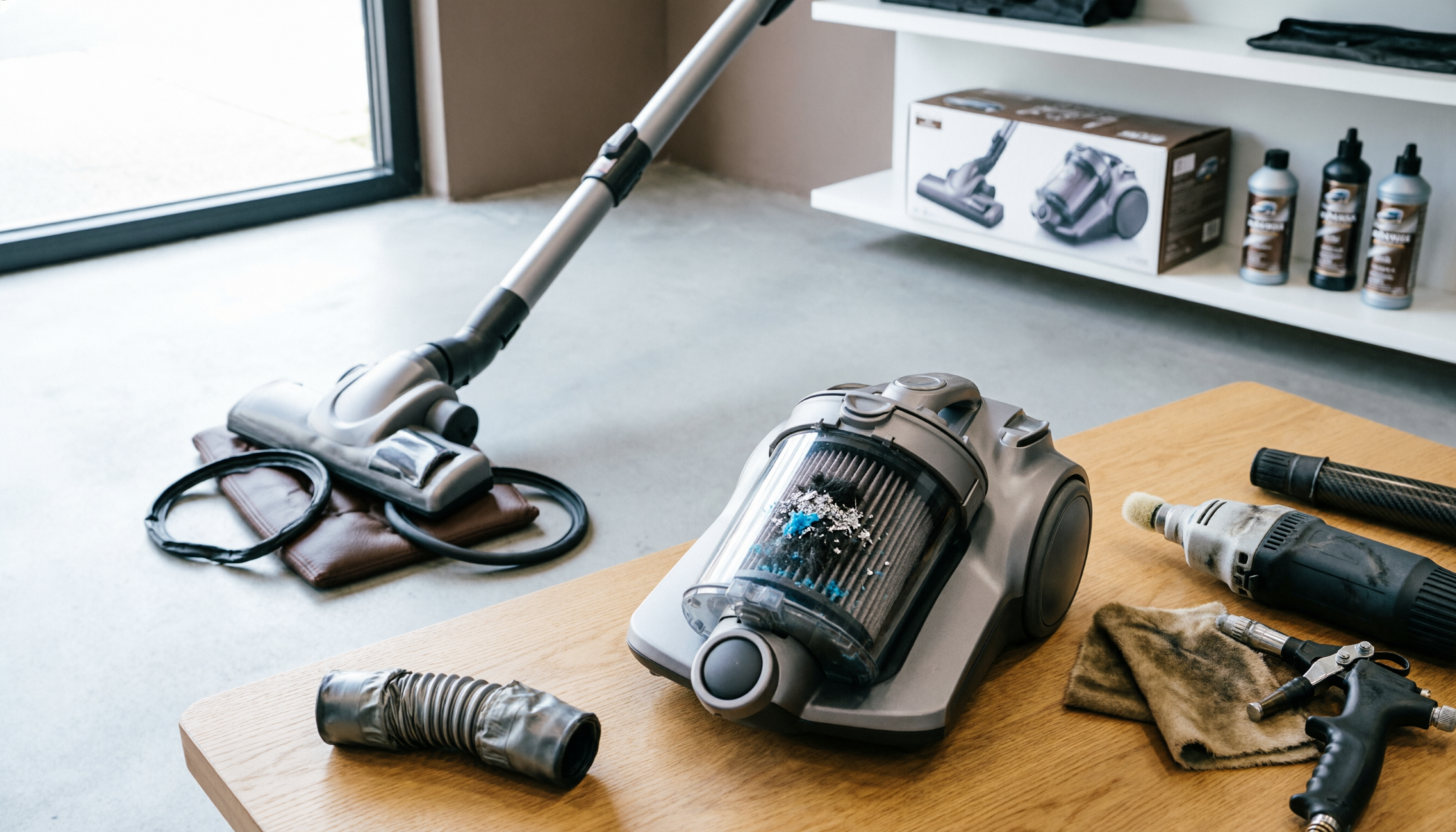
Car detailing feels harmless, but fine dust tells a different story. Ash, drywall powder, and brake dust behave nothing like crumbs or hair.
These particles slip past standard filters, circulate through the motor, and quietly grind it down.
Many vacuums fail not from age, but from the wrong kind of dirt.
The Short Answer
The Warning: Standard household vacuums are built for large debris like hair and crumbs.
Car detailing creates micro-dust such as ash, drywall residue, and brake dust.
Without a certified HEPA filter, these particles bypass filtration and enter the motor, where they wear down internal bearings and shorten the vacuum’s lifespan.
The “Bearing Sandblast” Effect
Fine dust does not just pass through a vacuum. It behaves like an abrasive.
Inside every vacuum motor sits a set of bearings.
These bearings rely on a thin layer of lubrication to reduce friction as the motor spins at high speed.
When micro-dust enters the system, it mixes with that lubricant and turns it into a gritty paste. That paste acts like sandpaper.
At first, the damage is subtle. A slight change in sound. A faint burning smell. Then performance drops.
Suction weakens. Heat builds up faster than usual. Eventually, the motor fails completely.
Drywall dust is one of the worst offenders. It is extremely fine, almost powder-like, and designed to spread evenly.
That same property makes it easy to slip through basic foam or cloth filters.
Ash behaves similarly, especially from fireplaces or burnt debris, carrying ultra-light particles straight into the motor housing.
This is not a clogging problem. It is internal wear.
Why Standard Filters Fail
Most household vacuums rely on basic filtration systems that trap visible debris.
These filters work well for everyday cleaning but struggle with particles smaller than 10 microns.
Fine dust often measures below 2.5 microns.
At that size, particles move with airflow rather than settling.
Instead of getting trapped, they pass straight through the filter media and continue circulating inside the vacuum.
Once inside, the motor becomes the next stopping point. That is where the real damage begins.
What HEPA Actually Changes
A certified HEPA filter is not just “better.” It is built to capture at least 99.97% of particles as small as 0.3 microns.
That difference matters.
Instead of allowing fine dust to pass through, HEPA filtration traps it before it reaches the motor. This keeps the internal components clean, preserves lubrication, and prevents abrasive wear.
Without HEPA, a vacuum used for detailing becomes a short-term tool. With HEPA, it becomes a durable machine that can handle repeated exposure to fine dust.
Where Most People Get It Wrong
The biggest mistake is assuming suction power equals durability. Strong suction does not protect the motor.
In fact, it can make things worse by pulling more fine dust into the system faster.
Another weak assumption is that shaking out filters or washing them solves the issue.
Cleaning a filter restores airflow but does nothing to improve its ability to trap micro-particles.
A final blind spot is mixing cleaning jobs. Using the same vacuum for carpets and drywall dust spreads fine particles throughout the machine, even after switching tasks.
Practical Fix That Actually Works
- Use a certified HEPA filter, not a “HEPA-style” label
- Pair it with high-efficiency filter bags when possible
- Keep one vacuum dedicated to fine dust tasks
- Replace filters on schedule, not when performance drops
- Avoid using bagless systems for heavy dust work
Skipping any of these steps weakens the entire setup.
Bottom Line
Fine dust does not look dangerous, but it destroys from the inside out.
Standard vacuums are not built for it, and the damage builds quietly until failure hits.
Proper filtration is not an upgrade. It is basic protection against a slow, expensive breakdown.