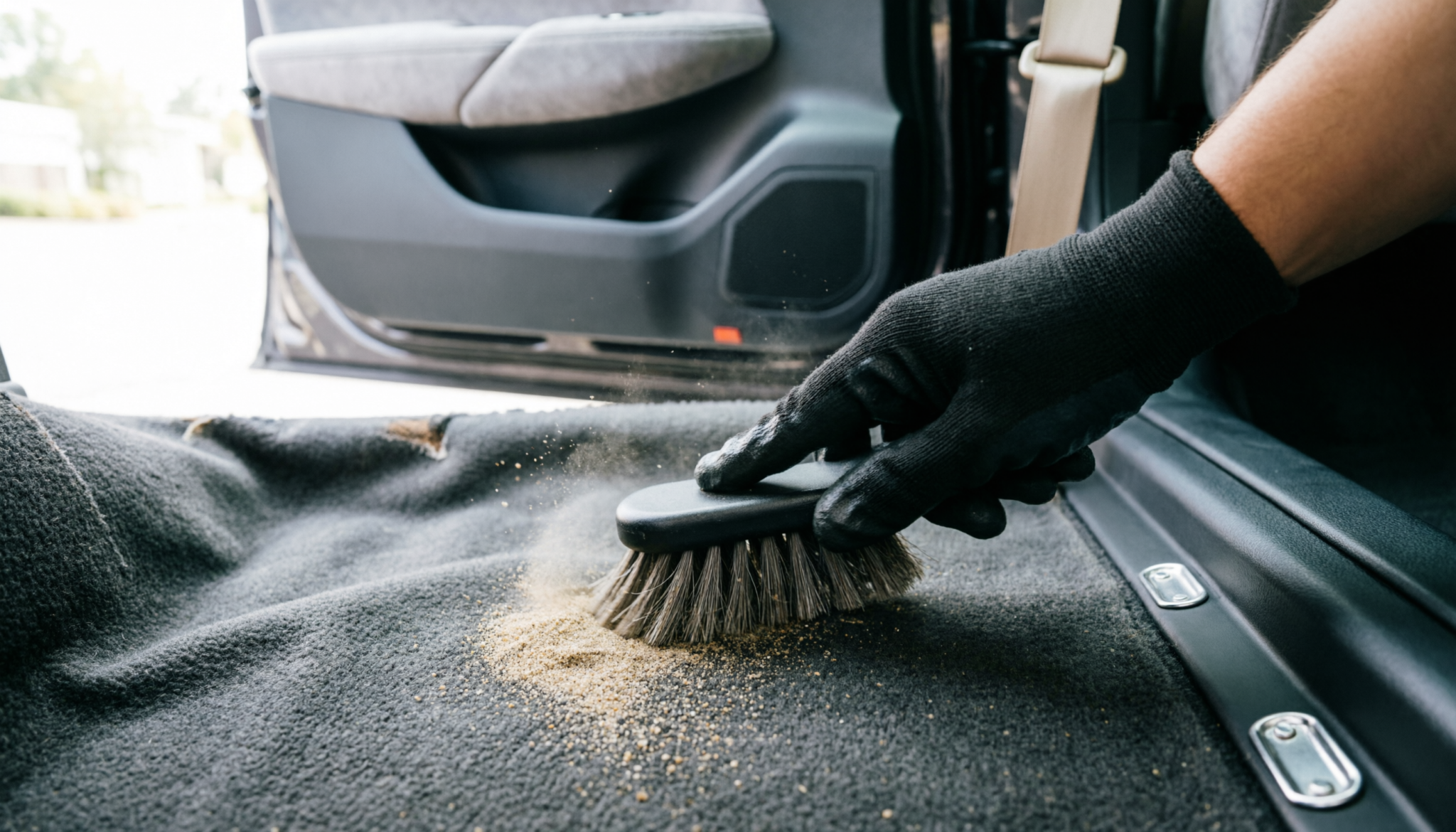
Maintenance Quick-Start: Deep-seated sand removal requires stiff-bristle agitation, dry carpet conditions, and repeated vacuum passes from multiple directions.
Agitation breaks compacted sand loose from carpet backing, allowing airflow to lift particles instead of dragging them deeper into the fibers.
Warning
Heavy scrubbing with metal brushes can damage carpet loops, fray automotive fibers, and weaken glued carpet backing.
Rotary drill brushes also generate friction heat on delicate carpets. Always test agitation tools on a hidden section before aggressive cleaning.
Sand Removal Comparison Table
| Cleaning Method | Sand Removal Depth | Carpet Risk | Efficiency |
|---|---|---|---|
| Vacuum Only | Surface Level | Low | Poor |
| Rubber Brush Agitation + Vacuum | Mid-to-Deep Layer | Low | High |
| Drill Brush Agitation + Vacuum | Deep Layer | Moderate | Very High |
Why Standard Vacuuming Fails
Most people run a vacuum head over the surface and assume the job is done. That only removes loose debris.
Deep sand behaves differently:
- It wedges into the carpet backing
- It resists suction alone
- It compacts tighter with every step
High suction without movement just pulls air around the sand, not through it. That’s the core mistake.
The Agitation Hack That Actually Works
Three steps. Skip one, and results drop fast.
Step-by-Step Extraction Guide
1. Vibrate (Mechanical Agitation)
Use a drill brush attachment or a massage gun with a soft head. The goal is vibration, not brute force scrubbing.
- Hold the tool lightly against the carpet
- Let the motion shake the fibers, not crush them
- Work in small sections
This breaks the bond between sand and fiber. Without this step, sand stays buried.
Common mistake: pressing too hard. That pushes sand deeper instead of loosening it.
2. Loosen (Stiff Bristle Brush)
After vibration, follow with a stiff detailing brush.
- Short, quick strokes
- Brush in multiple directions
- Focus on seams and edges where sand collects
This step pulls sand closer to the surface where airflow can reach it.
Weak approach: soft brushes. They glide over the surface and leave heavy grit behind.
3. Capture (Vacuum with High CFM)
Now vacuum immediately while particles are loose.
- Use a narrow nozzle for better airflow concentration
- Slow, overlapping passes
- Work against the carpet grain
CFM (cubic feet per minute) matters more here than raw suction numbers. Strong airflow carries loosened sand out instead of letting it fall back in.
For a deeper breakdown of airflow vs suction, see the guide on CFM vs. Air Watts.
Why Sand Becomes “Permanent” in Car Carpets
Sand behaves differently from ordinary dust.
Pet hair tangles around carpet fibers. Food crumbs stay near the surface. Sand sinks downward because of size, weight, and vibration from driving.
Every footstep pushes particles deeper into the carpet base. Heat inside parked vehicles also softens carpet fibers slightly, allowing grains to wedge tightly into the pile.
Several conditions make removal harder:
- Wet shoes compact particles
- Thick floor mats trap fine silica
- Long-pile carpets hide embedded grit
- Cheap vacuums lack airflow consistency
- Straight suction cannot separate bonded particles
This explains why many vehicle owners vacuum repeatedly without results.
The problem is not effort. The problem is technique.
The “Agitation Hack” Professional Detailers Use
Professional carpet extraction begins before vacuuming.
Agitation loosens sand from carpet fibers mechanically. Once disturbed, the vacuum captures particles far more effectively.
Three tools work especially well:
Rubber Carpet Brushes
Rubber bristles create friction against carpet fibers without cutting them. Short pulling motions drag sand upward.
Best for:
- Daily maintenance
- Delicate carpets
- Moderate sand buildup
Stiff Nylon Detailing Brushes
Nylon bristles reach deeper into dense carpet piles. Cross-brushing from several angles loosens compacted grit.
Best for:
- SUV cargo areas
- Thick floor mats
- Heavy beach sand
Drill Brush Attachments
Rotating drill brushes rapidly shake embedded particles loose. Professional detailers often combine drill agitation with immediate vacuum extraction.
Best for:
- Severe sand contamination
- Construction debris
- Deep carpet restoration
Poor technique ruins carpets quickly. Excessive drill speed damages loops and weakens fibers.
Moderate pressure works better than aggressive scrubbing.
Technician’s Insight
Technician’s Insight: “Most failed sand-cleaning attempts happen because vacuuming starts before agitation. Sand settles beneath the visible carpet surface.
Agitation lifts particles upward where airflow can capture them. Without mechanical disturbance, suction alone skims the top while deep grit remains trapped underneath.”
The Best Vacuum Technique After Agitation
Agitation alone does not finish the job. Extraction technique matters equally.
Many vehicle owners vacuum too quickly.
Fast passes create weak airflow contact time, allowing heavier particles to remain behind.
Professional detailing methods follow a slower pattern:
Step 1: Vacuum Slowly
Move the nozzle slowly across the carpet. High airflow requires time to lift dense particles.
Step 2: Change Direction
Vacuum from four directions:
- Front to back
- Side to side
- Diagonal left
- Diagonal right
Different angles expose hidden sand trapped beneath carpet loops.
Step 3: Use Narrow Attachments
Wide floor heads reduce concentrated suction. Crevice tools and narrow nozzles increase airflow intensity directly over embedded debris.
Step 4: Compress Carpet Fibers
Pressing the nozzle downward slightly increases airflow contact near the carpet base where sand accumulates.
This technique removes substantially more grit than casual surface vacuuming.
Common Mistakes That Make Sand Removal Worse
Several popular cleaning habits actually force sand deeper into the carpet.
Wet Cleaning Too Early
Water locks fine sand into carpet backing like concrete. Dry extraction must happen first.
Using Soft Household Brushes
Soft upholstery brushes glide across the surface without disturbing compacted particles.
Vacuuming Dirty Mats Inside the Vehicle
Loose sand immediately re-contaminates clean carpet sections.
Always clean mats outside the vehicle.
Ignoring Carpet Edges
Door sills and seat rails collect the heaviest buildup because airflow weakens near tight corners.
Overfilling the Vacuum Bin
Reduced airflow lowers particle lift dramatically. Sand-heavy cleaning fills bins faster than normal household debris.
Practical Add-Ons That Help
- Drill brush attachments for consistent vibration
- Stiff interior detailing brushes for fiber separation
- Crevice tools to increase airflow precision
These aren’t upgrades for comfort. They directly improve extraction efficiency.
FAQs
1. Why does sand remain after multiple vacuum passes?
Sand settles below the carpet surface where airflow cannot reach effectively. Agitation loosens embedded particles so suction can remove them.
2. Are drill brushes safe for automotive carpets?
Moderate-speed nylon drill brushes are generally safe on durable carpets. Excessive speed or stiff bristles can fray fibers and damage backing material.
3. Does stronger suction always remove more sand?
Not always. Agitation matters more than raw suction power. Mechanical loosening allows airflow to capture particles efficiently.
Bottom Line
Deep-seated sand removal depends more on agitation than vacuum strength. Mechanical brushing breaks compacted particles loose from carpet backing, allowing proper airflow extraction.
Slow vacuum passes, directional cleaning, and dry carpet conditions produce the best results. Professional-level cleaning comes from technique, not expensive equipment alone.