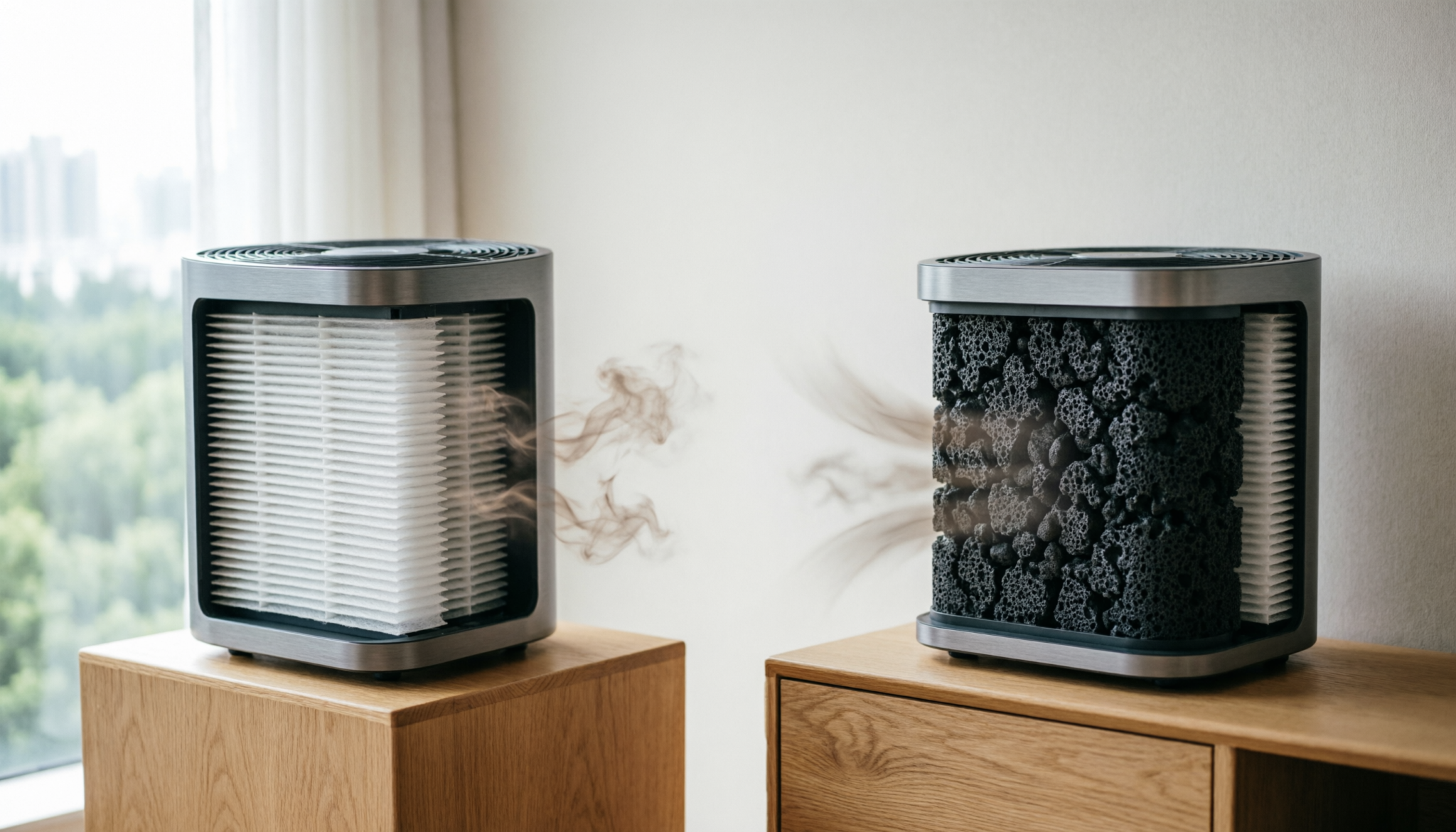
Pet hair removal and odor removal require different filtration strategies. HEPA captures airborne particles such as dander and fur, but odor gases pass through standard filters.
Activated carbon pellets absorb volatile organic compounds, ammonia, and sulfur compounds responsible for persistent pet smells inside enclosed living spaces.
Verdict
HEPA filtration handles pet dander, fur, and allergen particles with high efficiency, yet odor molecules remain airborne because gaseous contaminants bypass mechanical filtration layers.Activated carbon pellets solve this limitation through adsorption.
Combined HEPA and carbon systems create balanced indoor air treatment for homes with litter boxes, wet fur, and persistent animal odors.
Comparison Table
| Filtration Component | Primary Function | Weakness | Best Indoor Use |
|---|---|---|---|
| HEPA Filter | Captures pet hair, dander, dust | Cannot trap odor gases | Allergy reduction |
| Carbon Pellets | Absorbs odor molecules and VOCs | Limited particle removal | Pet odor control |
| Combined Filtration | Handles particles and odors simultaneously | Higher maintenance demand | Multi-pet households |
HEPA filtration particle capture limits
HEPA media relies on mechanical interception, impaction, and diffusion mechanisms.
Performance peaks at particulate matter down to 0.3 microns, leaving molecular gases unaffected.
Pet odor compounds exist primarily as volatile organic molecules, bypassing fiber capture pathways entirely. Air remains chemically active despite visually clean conditions.
Odor chemistry inside enclosed rooms
Pet odors originate from nitrogen-based compounds, fatty acids, and microbial byproducts.
These molecules remain airborne long after visible cleaning. Air circulation redistributes compounds rather than eliminating them.
Odor persistence correlates with humidity, surface porosity, and ventilation rate, creating continuous re-emission cycles from soft furnishings and flooring.
Pet Odors Require Gas Filtration
Pet odors originate from gaseous compounds, not visible particles alone. Urine ammonia, litter box sulfur compounds, saliva residue, damp fur, and microbial activity release volatile organic compounds into indoor air.
Standard HEPA media relies on dense fiber interception designed for solids. Gas molecules move directly through those microscopic gaps.
Many homeowners assume persistent odor indicates weak airflow or poor cleaning habits. Incorrect assumption. Odor persistence often reflects filtration mismatch.
Mechanical filtration captures particulate contamination, while gaseous contamination requires adsorption technology.
Activated carbon pellets contain millions of microscopic pores. Large internal surface area attracts odor molecules through adsorption rather than absorption.
Critical distinction. Absorption pulls substances inside a material structure. Adsorption bonds contaminants onto surface areas. Carbon pellets function like molecular parking spaces for odor compounds.
Pellet structure matters significantly. Thin carbon sheets saturate rapidly inside pet-heavy environments.
Pelletized carbon contains greater mass, deeper pore networks, and longer service life. Multi-pet homes require high carbon weight rather than decorative carbon coatings marketed as odor filters.
Carbon Pellet Density Determines Performance
Carbon quantity directly affects odor removal capacity. Weak filtration designs often contain lightweight carbon pads with minimal adsorption surface.
Short operational lifespan follows quickly. Persistent pet odor usually returns within weeks because saturated carbon loses effectiveness.
Dense pellet beds increase dwell time. Longer contact between contaminated air and carbon surfaces improves odor adsorption efficiency.
Fast-moving airflow through shallow carbon layers weakens performance dramatically.
Three environmental factors accelerate carbon saturation:
- High indoor humidity
- Multiple pets
- Poor ventilation rates
Humidity creates major filtration complications. Water vapor occupies carbon pore spaces before odor gases reach adsorption sites.
Humid homes therefore require heavier carbon filtration systems and more frequent replacement intervals.
Litter box zones present extreme filtration stress. Ammonia concentration near enclosed litter spaces rises rapidly without dedicated odor adsorption capacity.
Standard HEPA-only purifiers fail repeatedly in these locations because ammonia remains gaseous.
Pet bedding creates another overlooked contamination source. Fabric surfaces accumulate oils, saliva proteins, microbial growth, and moisture.
Vacuum cleaning removes hair but leaves odor chemistry embedded inside fibers. Carbon filtration reduces airborne emissions released continuously from soft materials.
Expert Opinion: Expert’s Insight
Persistent pet odor rarely signals cleaning failure. Filtration imbalance causes most long-term odor complaints. HEPA captures visible contamination, while activated carbon pellets target invisible gaseous pollutants.
Balanced indoor air management requires simultaneous particle control and molecular adsorption, especially inside sealed modern homes with limited natural ventilation and multiple indoor animals.
Common HEPA Misconceptions Affect Air Quality
Marketing language often confuses consumers. “Medical-grade HEPA” sounds comprehensive, yet HEPA standards measure particulate capture efficiency only. Odor removal falls outside HEPA certification requirements.
Another misconception involves fragrance masking. Scented sprays temporarily overpower pet odors without removing gaseous pollutants.
Combined chemical fragrances and pet emissions may worsen indoor air irritation for sensitive occupants.
Air fresheners also create false cleanliness perception. Indoor odor intensity may decrease temporarily while volatile organic compound levels remain elevated.
Carbon adsorption addresses source contaminants rather than covering odors with competing scents.
Placement mistakes reduce purification effectiveness. Air purifiers positioned behind furniture or inside obstructed corners struggle with airflow circulation.
Odor-heavy zones require direct airflow paths between contamination source and filtration system.
Oversized rooms create another limitation. Small filtration units operating inside large open-concept living areas rarely maintain adequate air exchange rates.
Pet odor control depends heavily on repeated air cycling through carbon media.
Mechanical ventilation also matters. Sealed indoor environments trap moisture and odor compounds. Carbon filtration improves air chemistry, but stagnant airflow still increases pollutant accumulation.
Balanced ventilation alongside adsorption filtration creates better long-term odor stability.
Balanced Filtration Improves Indoor Comfort
Effective pet air management combines several environmental controls simultaneously:
- HEPA particle filtration
- Activated carbon adsorption
- Humidity management
- Surface cleaning
- Ventilation support
Single-solution expectations create disappointment. No filtration technology compensates fully for neglected cleaning or moisture problems.
Urine residue inside carpets, subfloors, or upholstery continuously releases odor compounds into indoor air regardless of filtration quality.
Humidity control remains particularly important. Elevated indoor moisture accelerates bacterial growth and odor persistence.
Relative humidity between 40% and 50% generally supports better odor management and filtration efficiency.
Carbon replacement timing also matters. Saturated carbon loses adsorption capacity gradually rather than suddenly. Slow decline often masks performance loss until odor intensity becomes severe again.
Warning signs of exhausted carbon include:
- Faster odor return after cleaning
- Lingering litter box smell
- Damp animal odor persistence
- Reduced freshness despite normal airflow
Pet households with multiple animals often underestimate filtration workload.
Large dogs, senior pets, indoor cats, and enclosed apartments generate concentrated indoor contamination loads requiring heavier-duty carbon capacity.
Airflow design deserves equal attention. Strong airflow without adequate carbon contact time weakens odor adsorption.
Balanced engineering prioritizes both circulation and exposure duration inside the carbon chamber.
FAQs
Why does HEPA fail against pet odors?
HEPA filtration targets solid particulates. Odor compounds exist as gases that bypass mechanical fiber capture entirely, remaining active in enclosed environments.
What role do carbon pellets play?
Carbon pellets provide high-surface-area adsorption sites that bind volatile organic compounds, reducing airborne odor concentration through molecular retention rather than physical filtration.
How long does carbon remain effective?
Effectiveness depends on contaminant load, humidity, and airflow rate. Saturation reduces adsorption capacity, requiring periodic replacement for consistent performance.
Final Take
Indoor odor control requires chemical adsorption beyond particulate filtration. HEPA systems address visible airborne matter but leave molecular contaminants active.
Carbon pellet integration closes this gap through surface adsorption chemistry.
Balanced system design delivers measurable reduction in odor persistence, restoring stable indoor atmospheric composition across enclosed pet environments.