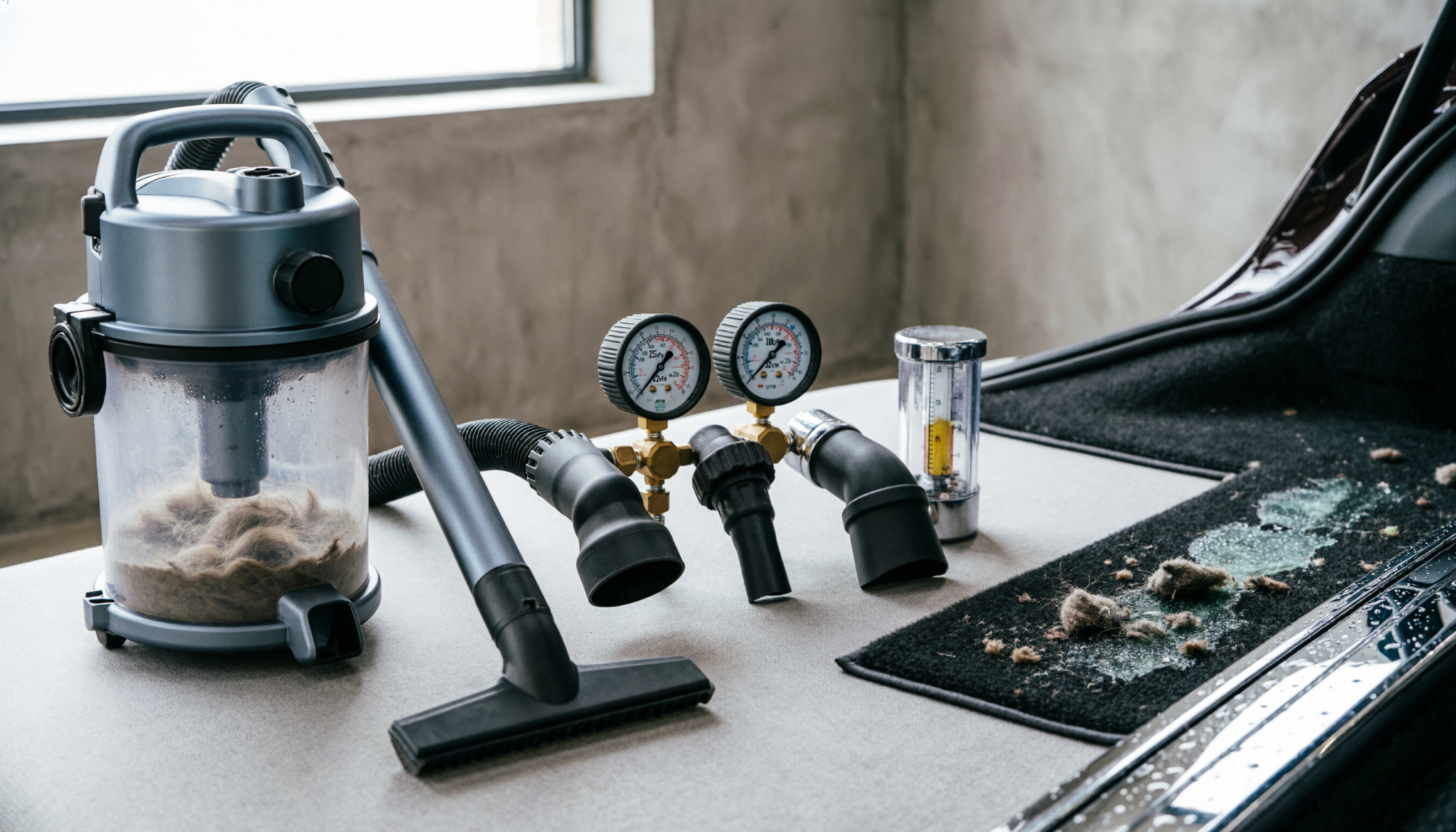
Car interiors trap grit in tight spaces where weak airflow fails fast. Marketing pushes horsepower, but airflow does the real work.
Understanding how suction actually moves debris changes buying decisions and cleaning results.
Focus on airflow, system design, and filtration instead of flashy labels that don’t translate into performance.
The Short Answer
The Truth: Many car vacuums advertise “Peak Horsepower,” but this is a momentary electrical spike, not usable cleaning power.
For car interiors, CFM (Cubic Feet per Minute) is what matters.
Higher CFM moves heavy debris like sand through narrow tools. For serious results, target 60+ CFM.
What Actually Creates Suction
Suction is not magic. It’s airflow plus resistance.
Two numbers matter:
- CFM (Cubic Feet per Minute): How much air moves through the system
- Static Lift (Water Lift): How strongly the vacuum pulls against resistance
Car detailing leans heavily on airflow, not just pull strength. Sand, crumbs, and dust sit deep in fabric and seams.
Without enough airflow, debris stays put even if the motor sounds strong.
Horsepower doesn’t measure either of these directly. It measures electrical input, not cleaning output.
Why “Peak Horsepower” is a Lie: The Real Suction Metrics for Car Detailing
Why “Peak Horsepower” Falls Apart Under Scrutiny
“Peak HP” is a best-case electrical spike recorded under ideal lab conditions. It does not reflect:
- Real-world airflow through a hose
- Losses from filters and attachments
- Performance over time
In practice, a vacuum claiming high horsepower can still choke when pushing air through a narrow crevice tool.
Where it breaks down:
- Tight car interiors increase airflow resistance
- Long hoses reduce effective suction
- Cheap filters clog quickly, killing airflow
Better benchmark: Ignore horsepower claims. Check rated CFM under load, not in open air.
The 12V Trap: Why Cigarette Lighter Vacuums Fail
Plug-in car vacuums seem convenient, but the physics works against them.
A standard 12V outlet delivers limited power. That caps both airflow and suction strength.
What that means in real use:
- Weak airflow can’t lift sand from carpets
- Floor mats hold onto grit
- Fine dust gets stirred but not removed
Many of these units produce very low CFM and almost no static lift. The motor simply can’t generate enough airflow through even a short nozzle.
Bottom line: Convenience wins, cleaning loses.
Better alternative:
- Battery-powered units with high-output motors
- Compact shop vacs with proper airflow ratings
The “Sealed System” Problem in Cars
A car cabin is small, enclosed, and easy to contaminate.
Poorly designed vacuums leak fine dust back into the air. In a house, that spreads out. In a car, it lingers.
Common failure points:
- Loose seals around dust bins
- Cheap filters that don’t trap fine particles
- Exhaust ports blowing directly into the cabin
Why this matters:
- Dust gets recirculated onto surfaces just cleaned
- Allergens build up in a confined space
- Air quality drops quickly during cleaning
What to check instead:
- Tight sealing from nozzle to exhaust
- Multi-stage filtration (not just a basic mesh)
- Exhaust direction that doesn’t blow debris back into the cabin
CFM vs. HP: The Practical Difference
| Metric | What It Claims | What It Actually Tells |
|---|---|---|
| Peak Horsepower | Electrical spike | Almost nothing useful |
| CFM | Airflow volume | Real cleaning ability |
| Static Lift | Pull strength | Helps with dense debris |
For car detailing:
- CFM does the heavy lifting
- Static lift supports, but doesn’t replace airflow
- Horsepower is mostly noise
What Works in Real Car Cleaning
Technical benchmarks prove which machines perform under pressure.
Minimum baseline for solid results:
- 60+ CFM
- Stable airflow under load
- Sealed filtration system
Where better tools show their value:
- Pulling sand from carpet fibers
- Cleaning seat seams without clogging
- Maintaining airflow as the bin fills
What to Prioritize When Choosing
Skip brand hype and focus on measurable performance.
Look for:
- Published CFM or Air Watts (not just HP)
- Short, wide hoses to reduce airflow loss
- Crevice tools designed for airflow, not just reach
- Washable or high-efficiency filters
Avoid:
- 12V-only units for anything beyond light dust
- “High HP” with no airflow data
- Loose-fitting bins and cheap seals
Final Take
Horsepower sells, airflow cleans. That’s the whole story.
Any vacuum can sound powerful in open air. Car interiors expose weak systems fast. Tight spaces, dense fabrics, and fine debris demand strong, sustained airflow.
Focus on CFM, sealed design, and real-world performance. Everything else is just packaging.