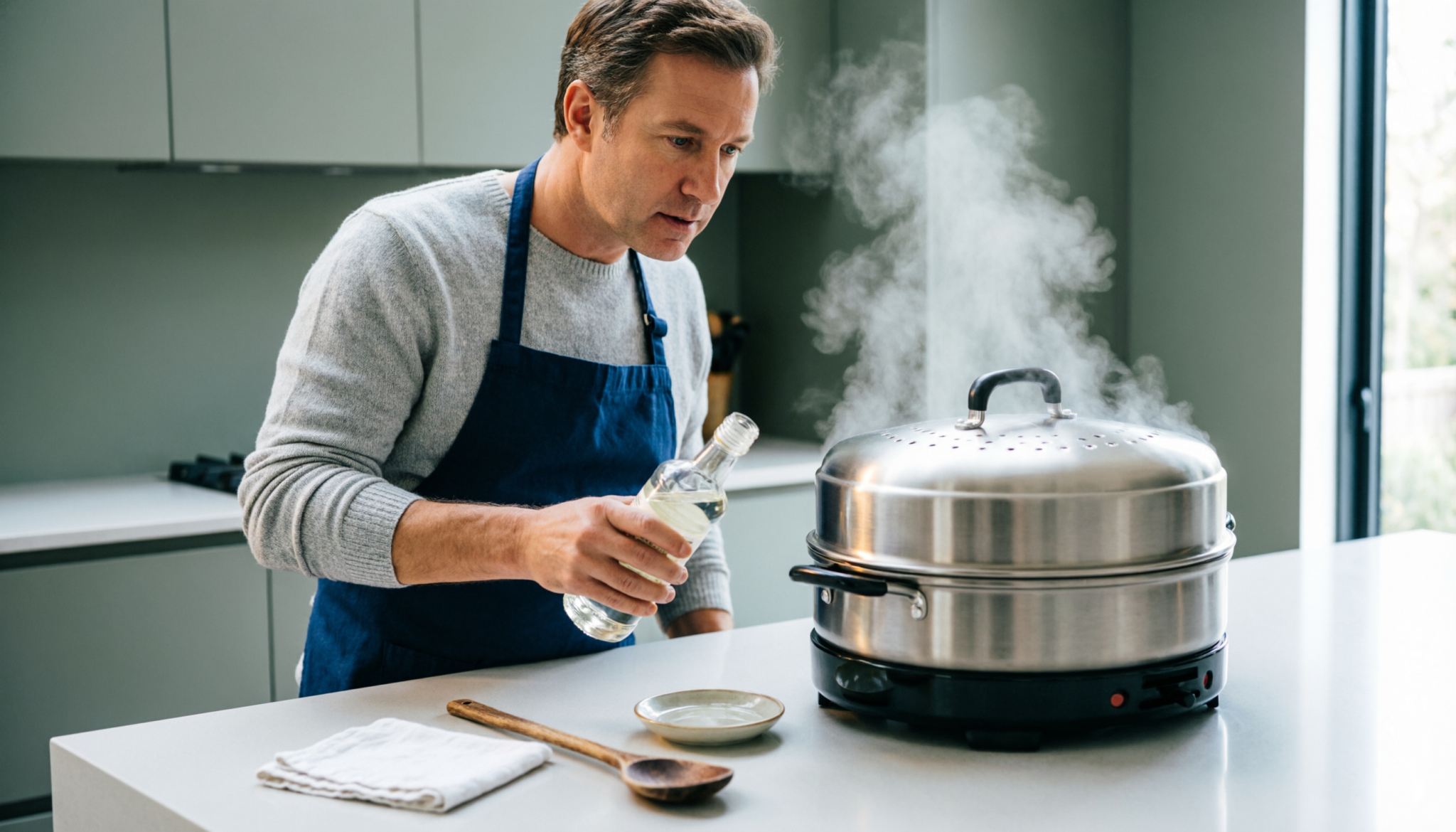
Verdict: Vinegar belongs in appropriate surface-cleaning applications, not inside a steam cleaner unless the manufacturer specifically approves vinegar use. Acetic acid can attack sensitive metals, seals, coatings, and internal components.
Distilled water provides the safer operating medium for steam generation while reducing mineral accumulation and protecting heating-system longevity.
Steam cleaning depends on a surprisingly simple internal system: water enters a heated chamber, electrical energy raises water temperature, vapor pressure develops, and steam exits through a nozzle.
The apparent simplicity creates a common maintenance mistake.
Household vinegar often appears to offer an inexpensive answer for mineral deposits, yet internal steam-cleaner use can introduce chemical exposure where manufacturers expect water alone.
Vinegar contains acetic acid. Acidic chemistry can interact with metals, protective coatings, elastomers, adhesives, and other materials used around heating chambers, valves, pumps, tubing, and seals.
Damage may remain invisible until heating performance declines, water leakage develops, odor appears, or component failure occurs.
The safest principle remains straightforward: keep vinegar out of the water tank unless the specific steam-cleaner manufacturer explicitly permits vinegar.
Comparison Table
| Maintenance factor | Distilled water | Vinegar solution |
|---|---|---|
| Internal chemistry | Low mineral load; generally suitable for approved steam systems | Acidic; material compatibility varies |
| Heating-element risk | Lower scale-related stress | Potential corrosion or material degradation |
| Routine recommendation | Preferred where manufacturer guidance permits | Use only with explicit manufacturer approval |
Why acidic liquids threaten heating components
A steam cleaner operates under repeated cycles of heating, cooling, pressure development, and condensation.
Internal materials experience thermal stress alongside chemical exposure. Adding an acidic liquid introduces another stress pathway.
Acetic acid does not function as a neutral descaling agent. Vinegar remains chemically active, even at household concentrations. Contact with susceptible metals can accelerate corrosion.
Copper, aluminum, zinc-containing alloys, plated surfaces, and certain protective finishes can respond differently to acidic exposure.
Heating elements deserve particular caution. Many heating systems contain metal sheathing around an electrical resistance element.
Additional internal components may include thermostatic controls, sensors, fittings, valves, seals, and connectors. Material compatibility depends heavily on construction.
Corrosion rarely produces an immediate dramatic failure. Gradual surface attack, deposits, pitting, seal deterioration, or residue accumulation can reduce reliability over repeated cleaning cycles.
A heating chamber also creates a concentrated environment. Water evaporates into steam while dissolved substances remain behind.
Vinegar chemistry therefore does not simply disappear during heating. Residual liquid and concentrated dissolved material can remain inside the system.
Mineral scale requires a safer maintenance strategy
Hard-water scale presents a legitimate steam-cleaner problem. Calcium and magnesium deposits can accumulate inside boilers, heating chambers, valves, and steam pathways.
Scale acts as thermal insulation around heated surfaces, reducing heat-transfer efficiency and potentially increasing heating-system stress.
Vinegar appears attractive because acidic chemistry can dissolve carbonate-based mineral deposits. Surface descaling and internal steam-cleaner descaling, however, represent different maintenance situations.
A kettle, showerhead, or removable metal component may tolerate an approved acidic descaling treatment. A sealed steam-cleaner boiler may contain multiple materials with different chemical tolerances.
A cleaning method suitable for one object does not automatically become suitable for another.
Manufacturer instructions therefore matter more than generic vinegar advice.
Distilled water can reduce mineral input substantially compared with hard tap water.
Some manufacturers permit distilled water, while others specify tap water or another approved water type because internal sensors or operating characteristics can differ. Manufacturer documentation remains the controlling authority.
A steam cleaner without approved vinegar compatibility should receive only the water type specified in operating instructions.
Heating-element protection starts with water quality
Water quality represents the first line of internal steam-system maintenance. Excess mineral content contributes to scale.
Chemical additives introduce compatibility concerns. Correct water selection addresses both concerns without unnecessary chemistry.
Distilled water contains very low concentrations of dissolved minerals. Reduced mineral content means reduced raw material for calcium carbonate and magnesium deposits.
Lower scale accumulation can support consistent heat transfer and steam production.
Filtered water requires more caution. Household filtration systems differ substantially. Carbon filtration can improve taste and remove selected contaminants without producing genuinely low-mineral water.
Reverse-osmosis systems can provide substantially lower dissolved-solids levels, but manufacturer approval still matters.
Water additives deserve similar caution. Fragrance oils, detergents, disinfectants, essential oils, and homemade cleaning mixtures can introduce residues, foaming, chemical reactions, or material incompatibility.
Steam cleaners generally function as water-to-vapor appliances, not chemical-injection systems.
Routine emptying also matters. Standing water can leave mineral residue after evaporation.
Complete drainage after cooling can reduce prolonged internal contact with residual water. Storage with an empty tank can also reduce stagnant-water problems.
Safe descaling depends on manufacturer instructions
Descaling should follow equipment-specific instructions rather than household cleaning folklore.
Manufacturer documentation may specify a commercial descaling solution, a particular dilution, a cleaning frequency, or a prohibition against acidic cleaners.
A steam cleaner without a stated descaling procedure should not receive improvised vinegar treatment.
Warning signs of scale include slower heating, reduced steam output, inconsistent steam pressure, sputtering, unusual operating noise, visible mineral particles, or increasing maintenance frequency.
Such symptoms can indicate internal deposits, but diagnosis requires caution because blocked accessories, water-level problems, worn seals, electrical faults, and thermostat issues can produce similar symptoms.
External cleaning remains different. Vinegar may have legitimate applications on compatible, non-sensitive surfaces, provided surface-care instructions permit acidic cleaning.
A distinction between surface chemistry and internal-appliance chemistry prevents many avoidable maintenance failures.
No vinegar inside the reservoir means no vinegar reaching the boiler through normal operation.
Expert Opinion: Expert’s Insight
Expert’s Insight: Steam-cleaner longevity depends more on material compatibility and water management than aggressive internal cleaning.
Vinegar offers useful household descaling chemistry, but acidic exposure inside a sealed heating system introduces unnecessary component risk without universal compatibility.
Manufacturer-approved water and descaling procedures provide the strongest protection for boilers, seals, valves, sensors, and heating elements.
FAQs
1. Can vinegar damage a steam cleaner?
Yes, vinegar can damage certain internal components when manufacturer approval does not exist. Acetic acid can contribute to corrosion or deterioration involving susceptible metals, coatings, seals, and other materials.
Damage risk varies according to boiler construction, concentration, exposure duration, temperature, and component materials.
2. Can vinegar remove scale inside steam cleaners?
Vinegar can dissolve certain mineral deposits chemically, especially carbonate-based scale. Chemical effectiveness does not establish appliance compatibility.
Internal steam-cleaner components may contain materials unsuitable for acidic exposure. An approved descaling product or manufacturer-specified procedure provides a more defensible maintenance approach.
3. What water protects steam-cleaner heating systems?
The correct water depends on manufacturer specifications. Distilled water often minimizes mineral loading and therefore reduces scale formation, but universal use cannot be assumed.
Some steam cleaners require tap water or specify particular water conditions. Operating instructions should determine water selection, descaling frequency, and internal maintenance.
Final Word
Vinegar offers useful household cleaning chemistry, but steam-cleaner boilers demand stricter material compatibility. Acidic liquid inside an unapproved heating system can introduce corrosion, seal deterioration, residue, and premature component failure.
Manufacturer-approved water, routine drainage, controlled descaling, and proper storage provide a safer maintenance strategy for long-term steam performance.