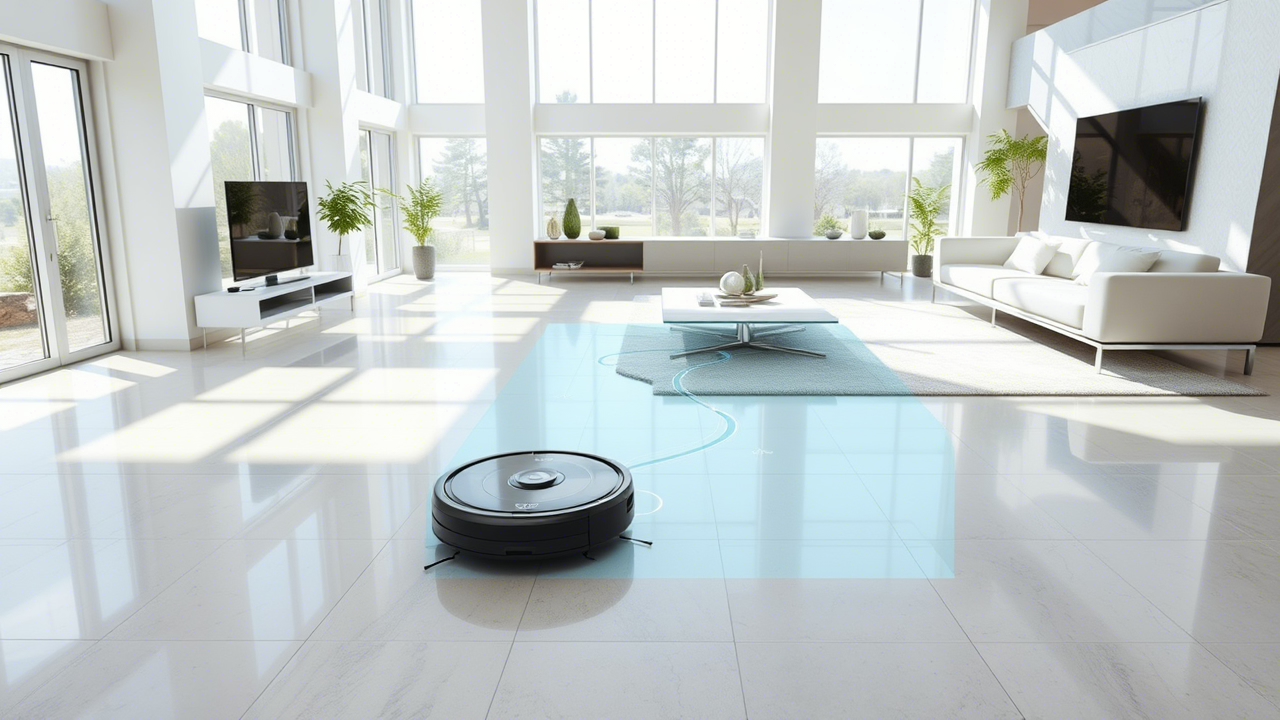
Robot vacuums often freeze or turn away from black rugs, leaving entire areas untouched. This isn’t a defect. It’s a safety feature doing its job too well.
The same system that prevents falls down stairs can misread dark flooring, creating a frustrating cleaning blind spot in otherwise tidy homes.
The Short Answer
The Scientific Reason:
Robot vacuums rely on Infrared (IR) cliff sensors to detect drops like stairs. Dark surfaces, especially black rugs, absorb IR light instead of reflecting it.
The sensor receives little to no signal, which mimics the reading of an empty drop. The system reacts by stopping or reversing to avoid a fall.
What’s Actually Happening Underneath
Cliff sensors sit underneath the vacuum, constantly firing infrared light toward the floor.
Light reflects back on lighter surfaces, confirming safe ground. Black rugs interrupt this feedback loop.
This creates three common behaviors:
- Sudden stops at the rug edge
- Repeated backing away
- Entire zones skipped during cleaning
Homes with patterned rugs face an even bigger issue.
Dark patches within lighter designs can trigger inconsistent movement, making cleaning look erratic and incomplete.
The “Tape Hack” Warning
A popular DIY fix involves covering the cliff sensors with tape or paper to force the vacuum to ignore false drop signals.
Yes, it works. But it solves one problem by creating a bigger one.
The real risk:
- Stairs, ledges, and split-level flooring become invisible
- The vacuum can drive straight off an edge
- Damage to the machine is likely, especially with heavier models
This workaround only makes sense in single-level homes with zero drop risks. Even then, it’s a compromise, not a solution.
A safer approach is to block off risky areas physically or use virtual boundaries if supported.
The Evolution of Dual-Sensors
Newer high-end robot vacuums don’t rely on infrared alone. They combine multiple sensing methods to reduce false readings.
What’s changed:
1. Ultrasonic sensors added
Ultrasonic waves measure distance differently from infrared. Dark colors don’t interfere the same way, so black rugs no longer appear as cliffs.
2. Sensor fusion systems
Modern units combine IR, ultrasonic, and camera-based mapping. This cross-checking reduces errors and improves decision-making.
3. Smarter navigation software
Algorithms now learn surface types over time. Once a black rug is mapped safely, future cleaning runs become smoother and more confident.
What still falls short:
Budget models still rely heavily on basic infrared sensors. That means the black rug problem isn’t going away at the lower end anytime soon.
When Upgrading Actually Makes Sense
Upgrading isn’t always the right call. But in this case, it can fix a very specific frustration.
Consider a newer model if:
- Large black or dark-patterned rugs cover key areas
- Cleaning gaps are consistent and noticeable
- Home layout includes mixed flooring that confuses navigation
Technical benchmarks show that flagship models with multi-sensor arrays handle these conditions far better.
Not perfectly, but reliably enough to eliminate daily frustration.
Practical Workarounds That Don’t Backfire
Before replacing anything, a few grounded fixes can help:
- Add lighting: Bright ambient light can slightly improve IR reflection on some surfaces
- Reposition rugs: Shift dark rugs away from stair edges to reduce false triggers
- Use no-go zones: Block stairs digitally instead of disabling sensors
- Run spot cleaning manually: Force coverage in problem areas when needed
These aren’t perfect, but they reduce friction without risking damage.
The Bottom Line
The “cliff sensor crisis” isn’t poor design. It’s a safety system reacting exactly as built. The real issue is a mismatch between sensor technology and modern home décor.
Infrared alone struggles with dark surfaces. Multi-sensor systems fix most of it. Until then, workarounds help, but each comes with trade-offs that need to be taken seriously.