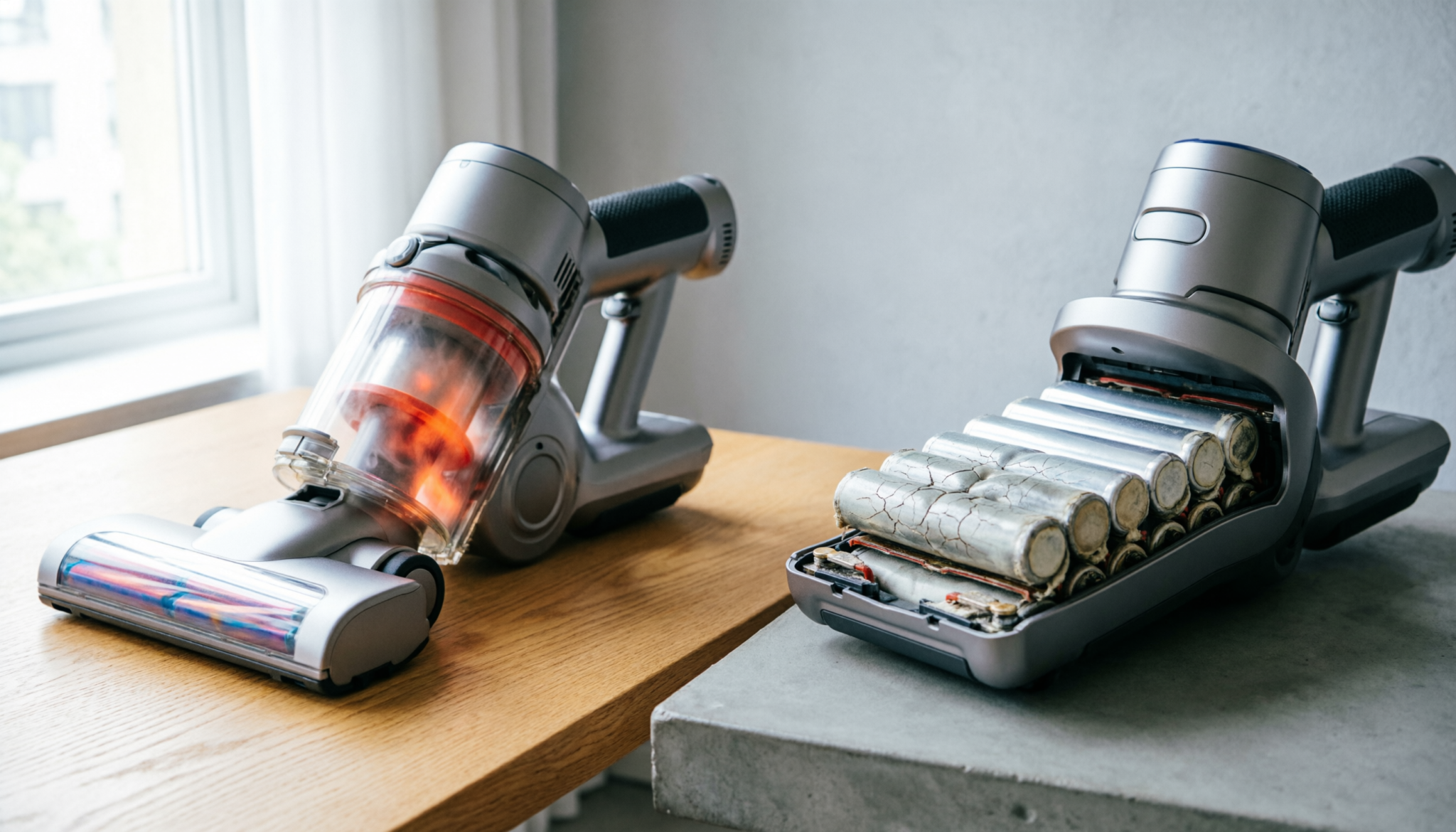
Cordless vacuums fail early for two simple reasons: heat and overuse cycles. Most homes unknowingly push batteries past safe limits every week.
High suction and poor charging habits quietly wear cells down until runtime drops fast and charging becomes unreliable.
The Short Answer
Vacuum batteries die prematurely due to Thermal Degradation and Cycle Exhaustion. Using Max Mode continuously generates heat exceeding 140°F, which causes internal chemical plating, permanently reducing capacity.
To double battery life, keep charge between 20% and 80% and avoid using the vacuum immediately after a full charge.
Comparison Table
| Model | Battery Stability | Heat Handling | Real-World Longevity | Best Fit |
|---|---|---|---|---|
| Dyson V7 Battery Replacement | High | Strong | 2–3 years with care | Heavy weekly cleaning |
| Hoover ONEPWR Lithium Battery | Very High | Excellent | 3+ years | Multi-room homes |
| Shark ION Power Pack Battery | Moderate | Good | 1.5–2 years | Light daily use |
Straight truth: Even the best battery fails early under constant max mode and poor charging habits. Build better habits before replacing parts.
How high-suction settings destroy Li-Ion cells
Max mode feels satisfying, but it is the fastest way to age a battery. High current draw creates heat inside the cells.
Heat speeds up chemical breakdown and causes lithium plating, which permanently blocks capacity.
In real homes, this shows up as shorter runtime after a few months. Daily max mode use can cut battery life in half. Use it only for deep dirt, not routine cleaning.
The secret to extending battery life to 3+ years
Lithium-ion batteries last longer when they avoid extremes. Charging to 100% and draining to zero stresses the chemistry.
A practical routine:
- Start cleaning at 80–90% instead of full charge
- Recharge when battery drops near 20–30%
- Avoid overnight charging every day
This simple habit reduces internal strain and keeps capacity stable over time.
Why the garage is the worst place for your vacuum charger
Heat does not only come from usage. Storage matters just as much.
Garages often trap heat during the day and drop too cold at night. Both extremes damage battery cells. Charging in these conditions worsens the problem.
Better placement:
- Indoors, away from direct sunlight
- Stable room temperature
- Good airflow around the charger
Consistent conditions protect the battery even when the vacuum is not in use.
The Technical Life-Span Table
| Usage Habit | Est. Life (Cycles) | Impact on Capacity | Mentors Verdict |
|---|---|---|---|
| 100% Max Mode | 150 – 200 | Rapid Drop | The Battery Killer |
| Mixed (Auto) Mode | 300 – 400 | Gradual | Standard |
| Eco Mode (20-80%) | 600+ | Minimal | Pro Maintenance |
FAQs
1. Why does a new vacuum battery lose power so quickly?
High heat during early use often causes irreversible damage. Frequent full charges and full drains speed up wear within the first few months.
2. Is it safe to leave the vacuum on the charger all the time?
Occasional overnight charging is fine. Daily constant charging keeps the battery at 100%, which increases long-term stress and reduces lifespan.
3. Can a weak battery be restored?
Capacity loss from chemical damage cannot be reversed. Runtime may improve slightly with better habits, but full performance will not return.
Final Thought
Battery failure is rarely a defect. Daily habits quietly decide lifespan. Heat, full charges, and constant max mode shorten life far more than most realize.
Small changes in usage and storage make a bigger difference than upgrading brands. Treat the battery with care, and it will return the favor for years.