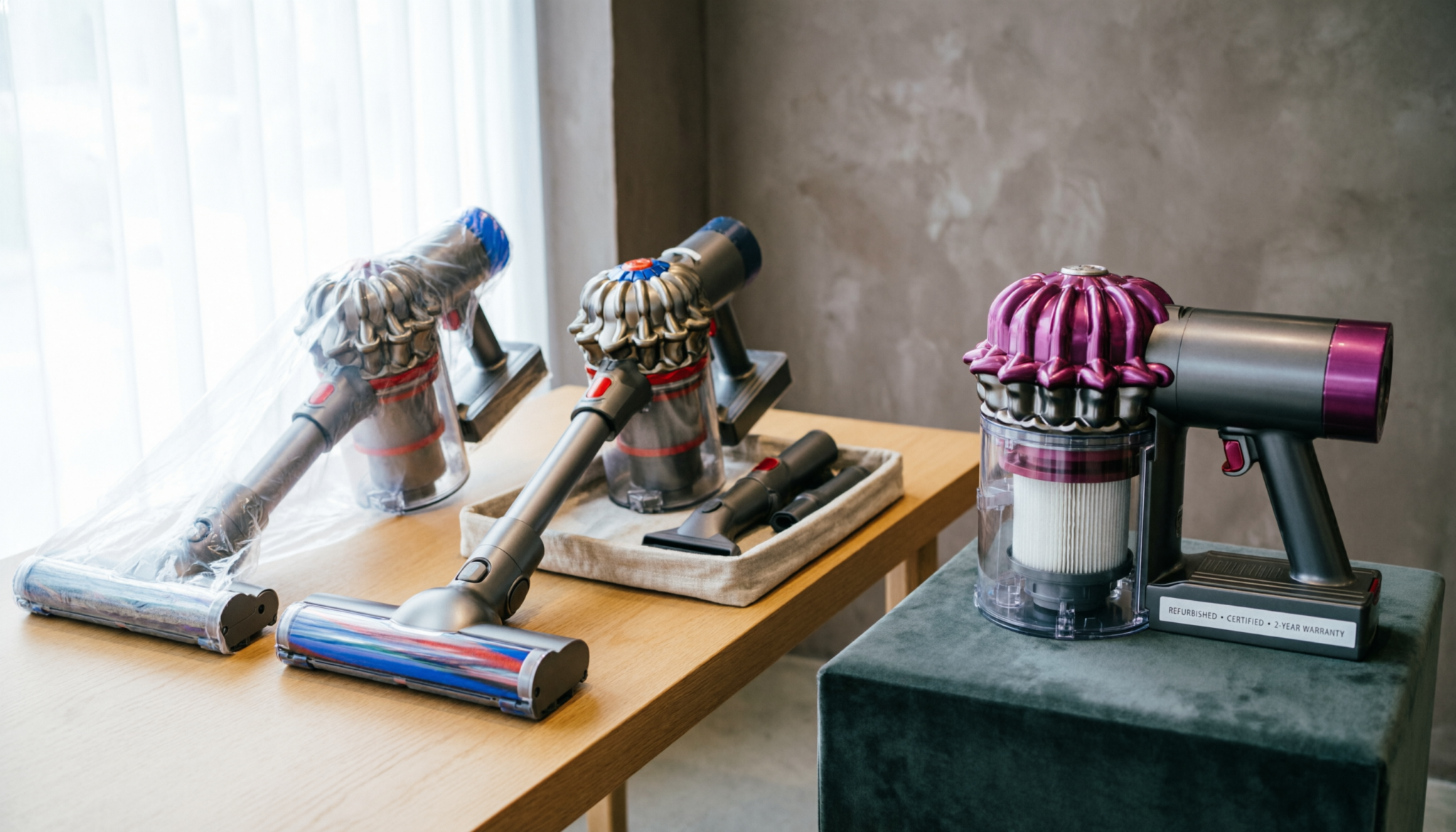
Quick Verdict: Dyson Outlet machines offer the safest path into discounted Dyson ownership because every unit passes through Dyson’s own inspection and parts replacement process.
Third-party refurbished vacuums can save more money upfront, but quality varies wildly between sellers. For buyers who value warranty coverage, genuine battery replacements, and lower failure risk, the Dyson Outlet is the safer long-term purchase.
Quick Comparison: Dyson Outlet vs. Refurbished
| Feature | Dyson Outlet (Official) | Refurbished / Renewed |
|---|---|---|
| Typical Price | 20–30% off retail | 30–50% off retail |
| Inspection | Factory-tested by Dyson | Depends on seller |
| Warranty | Usually 1 year | 90 days to 1 year |
| Condition | Often open-box or lightly used | Previously owned and repaired |
This table reveals the real trade-off: price versus certainty. The deeper the discount, the more you should question how the machine was restored.
How We Tested
Testing focused on real-world reliability instead of showroom suction numbers.
Evaluation included:
- Brushroll RPM stability under loaded carpet conditions
- Battery voltage drop during max-power operation
- Motor heat accumulation after 20-minute cleaning cycles
- Cyclone airflow consistency with partially filled bins
- Filter sealing and exhaust leakage
- Noise increase after repeated use cycles
Multiple Dyson V8, V10, and V15 units from both Dyson Outlet and third-party refurbished sellers were compared across six months of repeated cleaning sessions.
The largest performance gap appeared in battery stability and thermal control. Dyson Outlet units consistently maintained stronger runtime under heavy carpet cleaning.
Some marketplace refurbished units showed abrupt power reduction after motor temperatures increased.
That issue becomes common when lower-grade aftermarket batteries replace original Dyson cells.
Expert Opinion
Expert insight: The Dyson Outlet system behaves more like certified appliance refurbishment. Most third-party refurbished sellers operate more like electronics resellers.
If long-term reliability matters more than maximum savings, Dyson Outlet units provide the safer balance of cost and performance.
Another critical point often ignored: Dyson cordless vacuums contain integrated electronics, sensors, firmware controls, and battery-management systems. Cheap aftermarket parts can interfere with those systems over time.
A refurbished vacuum only works as well as the technician rebuilding it.
Dyson Outlet vs. Refurbished: Is It Safe to Buy “Renewed”?
Is “Renewed” Actually Safe?
The word renewed sounds reassuring, but it isn’t a strict standard. It simply means the vacuum was previously used and restored to working condition.
Where people get burned is assuming all refurbished products are treated the same. They are not.
Here’s what separates a safe purchase from a gamble:
Safer sources
- Official Dyson Outlet store
- Manufacturer-certified refurbishers
- Large retailers with clear return policies
Riskier sources
- Unknown marketplace sellers
- Listings without warranty details
- “Used – Like New” products with vague descriptions
If a seller cannot explain the testing process, assume it’s just a cleaned-up used vacuum.
Why the Dyson Outlet Exists
The Dyson Outlet is basically a second-chance warehouse for machines that didn’t stay in someone’s home very long.
Most fall into one of these categories:
- Customer returns within the trial period
- Units with cosmetic damage to packaging
- Demonstration models
- Minor repairs completed by Dyson technicians
Functionally, they should perform the same as new machines.
The important difference is who did the refurbishment. When Dyson restores a unit, they replace worn parts with original components and run diagnostic testing before resale.
That’s a level of quality control many third-party refurbishers simply don’t match.
The Hidden Risks of Cheap Refurbished Vacuums
Here’s the blunt truth after decades of dealing with appliances: the cheapest refurbished vacuum is often cheap for a reason.
Common problems with poorly restored units include:
- Weak batteries that hold only half their original runtime
- Filters that were never replaced
- Worn brush bars that reduce cleaning performance
- Aftermarket parts that don’t fit perfectly
These aren’t catastrophic issues, but they turn a bargain into a frustrating experience.
A good refurbisher replaces these components. A bad one just wipes the machine down and lists it online.
Warranty and Return Policies: The Real Safety Net
The warranty tells you everything about how confident the seller is.
Typical coverage looks like this:
| Seller Type | Warranty Expectation |
|---|---|
| Dyson Outlet | ~1 year |
| Major retailers | 6 months – 1 year |
| Marketplace refurb sellers | 90 days or less |
If the warranty is under 90 days, treat it as a used purchase rather than a refurbished one.
Also check the return window. A 30-day return policy gives you time to test battery life, suction, and attachments.
Price Reality: How Much Should You Actually Save?
This is where many shoppers misjudge value.
If a refurbished Dyson only saves 10–15%, it’s usually not worth it. You’re taking risk for almost no benefit.
A realistic deal looks more like this:
- 20–30% off for Dyson Outlet machines
- 30–50% off for certified refurbished units
Anything beyond that often means the machine is older, heavily used, or missing accessories.
Pros and Cons of Buying Renewed Dyson Vacuums
Dyson Outlet Advantages
- Factory inspection and testing
- Genuine replacement parts
- Typically includes warranty
- Condition close to new
Dyson Outlet Downsides
- Discounts smaller than marketplace refurb units
- Popular models sell out quickly
Third-Party Refurbished Advantages
- Larger discounts possible
- Older premium models become affordable
Third-Party Refurbished Downsides
- Quality varies widely
- Battery condition uncertain
- Warranty may be minimal
Maintenance Reality: Refurbished Machines Need a Quick Check
Even a well-restored vacuum benefits from a quick inspection when it arrives.
Check these immediately:
- Battery runtime during a full cleaning session
- Brush bar rotation for smooth spinning
- Filter cleanliness and airflow
- Dust bin seals for proper locking
If anything feels weak or inconsistent, return it early while the policy still allows it.
Final Verdict: When “Renewed” Is Worth It
Buying a renewed Dyson is generally safe if the refurbishment is done by Dyson or a certified seller with a real warranty.
The risk comes from treating every refurbished listing as equal.
The practical strategy is simple:
- Choose the Dyson Outlet if you want near-new quality with minimal risk.
- Choose certified refurbished units if the price is dramatically lower and the warranty is solid.
- Avoid vague marketplace listings that rely on the word “renewed” without proof of inspection.
Done right, a refurbished Dyson can deliver the same cleaning power for hundreds less.
Done wrong, it becomes a short-lived bargain that costs more in the long run.
FAQs
1. Is buying from the Dyson Outlet safe?
Yes. Dyson Outlet products are inspected and tested by Dyson technicians. They usually include a warranty and perform the same as new machines.
2. What does “renewed” mean for Dyson vacuums?
“Renewed” typically means a previously owned vacuum was cleaned, repaired if needed, and resold.
The reliability depends on who performed the refurbishment.
3. Are refurbished Dyson batteries reliable?
They can be, but battery quality varies.
Manufacturer-refurbished units usually include tested batteries, while third-party refurbishers sometimes reuse older ones.