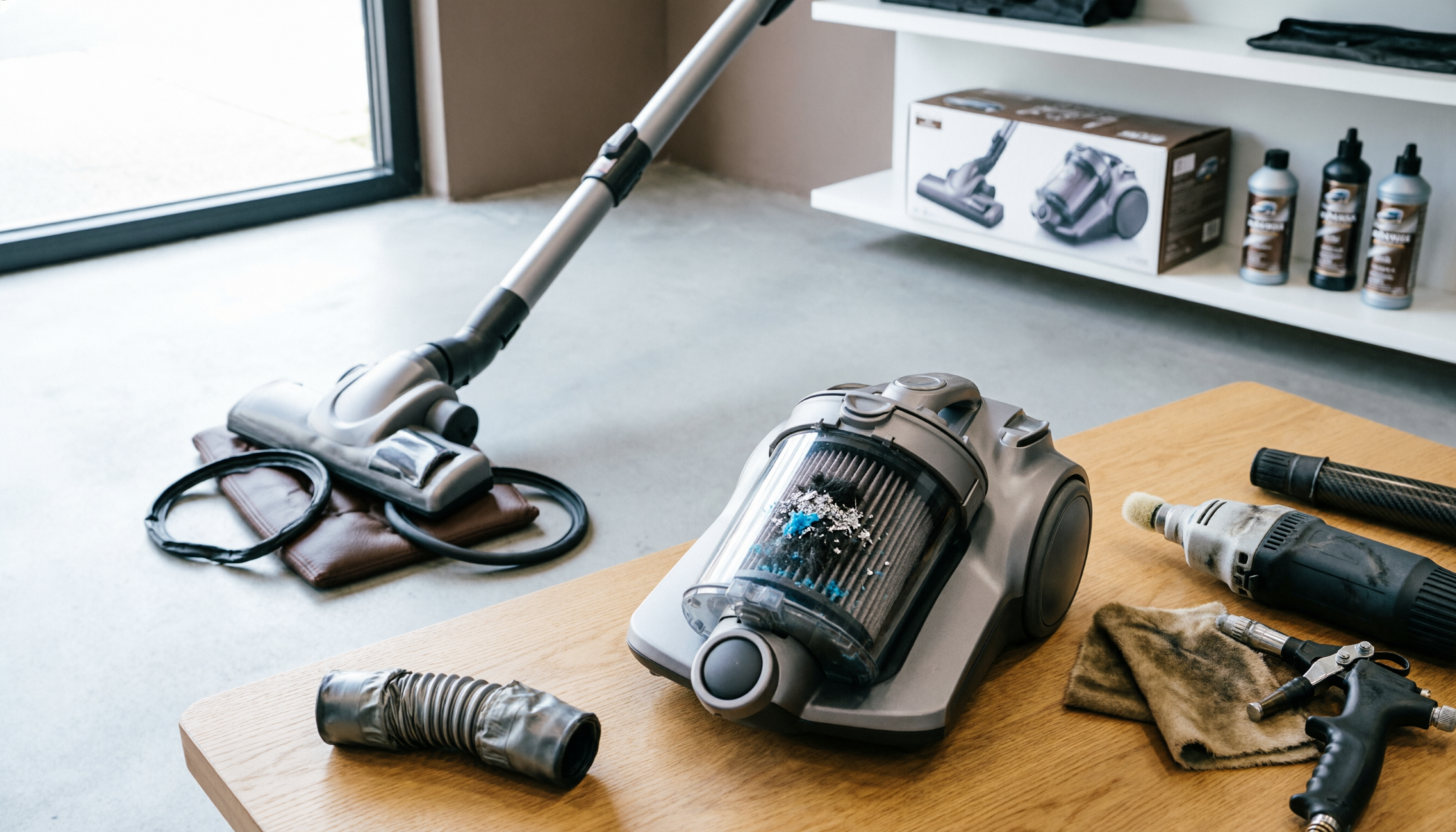
Maintenance Quick-Start: Fine dust destroys vacuum motors by bypassing weak filtration, packing into motor windings, blocking cooling airflow, and grinding internal bearings.
Standard foam and mesh filters cannot contain ultrafine particles from drywall, ash, cement, flour, and construction debris. Long-term exposure causes overheating, carbon-brush wear, electrical arcing, and permanent suction loss.
Warning
Drywall dust, fireplace ash, silica powder, and concrete dust should never enter a standard household vacuum unless the machine carries sealed filtration rated for ultrafine particles.
Fine particulate matter damages motors silently. Damage often appears weeks later as overheating, burning smells, reduced suction, or total motor failure.
Fine Dust Filtration Comparison Table
| Filter Grade | Particle Size Outcome | Capture Efficiency | Medical Application |
|---|---|---|---|
| Standard Foam Filter | Captures large debris only | Low against ultrafine dust | None |
| HEPA H13 | Captures particles down to 0.3 microns | 99.95% | Hospitals and laboratories |
| ULPA Filter | Captures particles below 0.12 microns | 99.999% | Clean rooms and surgical environments |
The “Bearing Sandblast” Effect
Fine dust does not just pass through a vacuum. It behaves like an abrasive.
Inside every vacuum motor sits a set of bearings.
These bearings rely on a thin layer of lubrication to reduce friction as the motor spins at high speed.
When micro-dust enters the system, it mixes with that lubricant and turns it into a gritty paste. That paste acts like sandpaper.
At first, the damage is subtle. A slight change in sound. A faint burning smell. Then performance drops.
Suction weakens. Heat builds up faster than usual. Eventually, the motor fails completely.
Drywall dust is one of the worst offenders. It is extremely fine, almost powder-like, and designed to spread evenly.
That same property makes it easy to slip through basic foam or cloth filters.
Ash behaves similarly, especially from fireplaces or burnt debris, carrying ultra-light particles straight into the motor housing.
This is not a clogging problem. It is internal wear.
Why Fine Dust Becomes a Motor Killer
Large debris behaves predictably inside a vacuum. Hair, crumbs, and pet fur move through the airflow path and settle inside the bin. Fine dust behaves differently.
Particles from drywall, plaster, fireplace ash, and concrete become airborne clouds. Many particles measure smaller than human hair by hundreds of times. Standard vacuum filters cannot trap material at that size.
Instead, dust travels straight through the filtration system and enters the motor housing.
Inside the motor, several destructive processes begin at once:
- Dust coats motor windings
- Cooling airflow becomes restricted
- Bearings lose lubrication protection
- Carbon brushes wear faster
- Electrical arcing increases heat levels
Most homeowners never notice the damage early because suction often remains strong during the first stages.
The motor slowly cooks from the inside.
Burning smells, loud whining, and excessive heat usually appear only after serious internal wear already exists.
The Biggest Fine Dust Mistakes Homeowners Make
Many vacuum failures come from jobs that seem harmless at first.
Drywall Renovation Cleanup
Drywall powder acts almost like smoke. Cheap filters cannot contain it. Fine gypsum particles spread into every internal cavity of the machine.
One renovation project can permanently shorten motor life.
Fireplace Ash Removal
Ash remains abrasive even after cooling. Tiny carbon particles scratch fan blades and bearings while clogging cooling channels.
Warm ash creates an even bigger risk because residual heat damages plastic housings and seals.
Garage and Workshop Cleanup
Wood dust, cement powder, and sawdust overload household filtration systems quickly. Workshop debris requires industrial airflow separation and sealed containment.
Standard upright vacuums lack both.
Emptying the Dust Bin Too Late
Overfilled bins reduce airflow velocity. Fine particles circulate longer inside the vacuum instead of reaching the filter system efficiently.
That extra circulation pushes more dust into the motor compartment.
Expert Insight
Technician’s Insight: If dust appears outside the HEPA exhaust housing, internal seals have already failed. Motor contamination is likely active inside the airflow chamber.
Continued operation spreads microscopic particles back into indoor air while accelerating bearing wear, fan imbalance, and electrical overheating inside the vacuum motor.
Why Cheap Filters Fail Against Fine Dust
Many vacuum advertisements focus on suction power while ignoring filtration engineering.
Strong suction without sealed filtration actually worsens motor contamination.
Cheap filters fail for three main reasons.
Poor Particle Retention
Basic foam filters catch visible debris but allow microscopic particles to pass directly through.
The vacuum appears clean while the motor slowly fills with dust.
Weak Seal Design
Many lower-cost vacuums leak air around filter edges instead of through the filter material itself.
Even quality filters fail when seals leak.
Inadequate Cooling Protection
Vacuum motors depend on clean airflow for temperature control.
Fine dust blocks cooling channels and acts like insulation around heat-producing components. Temperatures rise rapidly under load.
Repeated overheating weakens insulation around copper windings until electrical failure occurs.
Signs Fine Dust Has Already Damaged the Vacuum
Motor damage rarely happens instantly. Warning signs usually appear gradually.
Burning Smell During Operation
Dust-coated motors run hotter. Heat bakes accumulated particles inside the housing, creating a sharp burning odor.
Persistent smells usually signal internal contamination.
High-Pitched Whining
Damaged bearings often create a rising, turbine-like sound.
Fine dust works like sandpaper inside rotating assemblies.
Reduced Suction With Clean Filters
Motor efficiency drops as internal resistance increases.
Clean filters paired with weak suction often point toward motor wear instead of airflow blockage.
Excessive Heat From the Main Body
Warm exhaust air becomes noticeably hotter when airflow passages clog with dust.
Overheating accelerates every other failure process inside the machine.
Visible Dust Exhaust
Dust exiting through exhaust vents signals failed seals or compromised filtration.
A vacuum should trap particles, not redistribute them into indoor air.
How to Protect Vacuum Motors From Fine Dust
Motor protection depends more on filtration quality than raw suction power.
Use Sealed HEPA Systems
True sealed HEPA systems force all airflow through high-efficiency filtration before air exits the machine.
Sealed construction matters as much as filter grade.
Separate Renovation Cleanup From Household Cleaning
Construction debris requires shop vacuums designed for abrasive particulate matter.
Household vacuums should handle routine indoor debris only.
Replace Filters Earlier Than Recommended
Heavy fine-dust environments shorten filter life dramatically.
Restricted filters reduce cooling airflow and increase motor strain.
Clean Pre-Motor Filters Frequently
Pre-motor filters serve as the first defense barrier.
Neglected filters allow dust migration deeper into the vacuum.
Inspect Gaskets and Seals
Small leaks around filter housings bypass the entire filtration system.
One damaged seal can expose the motor to continuous contamination.
FAQs
1. Can drywall dust permanently damage a vacuum?
Yes. Drywall dust penetrates weak filtration systems and coats motor components internally. Damage often includes overheated windings, worn bearings, and restricted cooling airflow.
2. Why does a vacuum smell burnt after cleaning fine dust?
Fine particles collect around hot motor components and bake under heat. Burning smells usually indicate overheating or internal contamination.
3. Is HEPA filtration enough for fine dust protection?
Only sealed HEPA systems provide meaningful protection. A HEPA filter alone cannot protect the motor if air leaks around seals or filter housings.
Bottom Line
Fine dust destroys standard vacuum motors slowly and quietly. Weak filtration allows microscopic particles to enter bearings, cooling channels, and electrical windings. Strong suction cannot compensate for poor filtration design.
Sealed HEPA construction, proper filter maintenance, and dedicated workshop cleanup equipment remain the safest protection against premature motor failure.