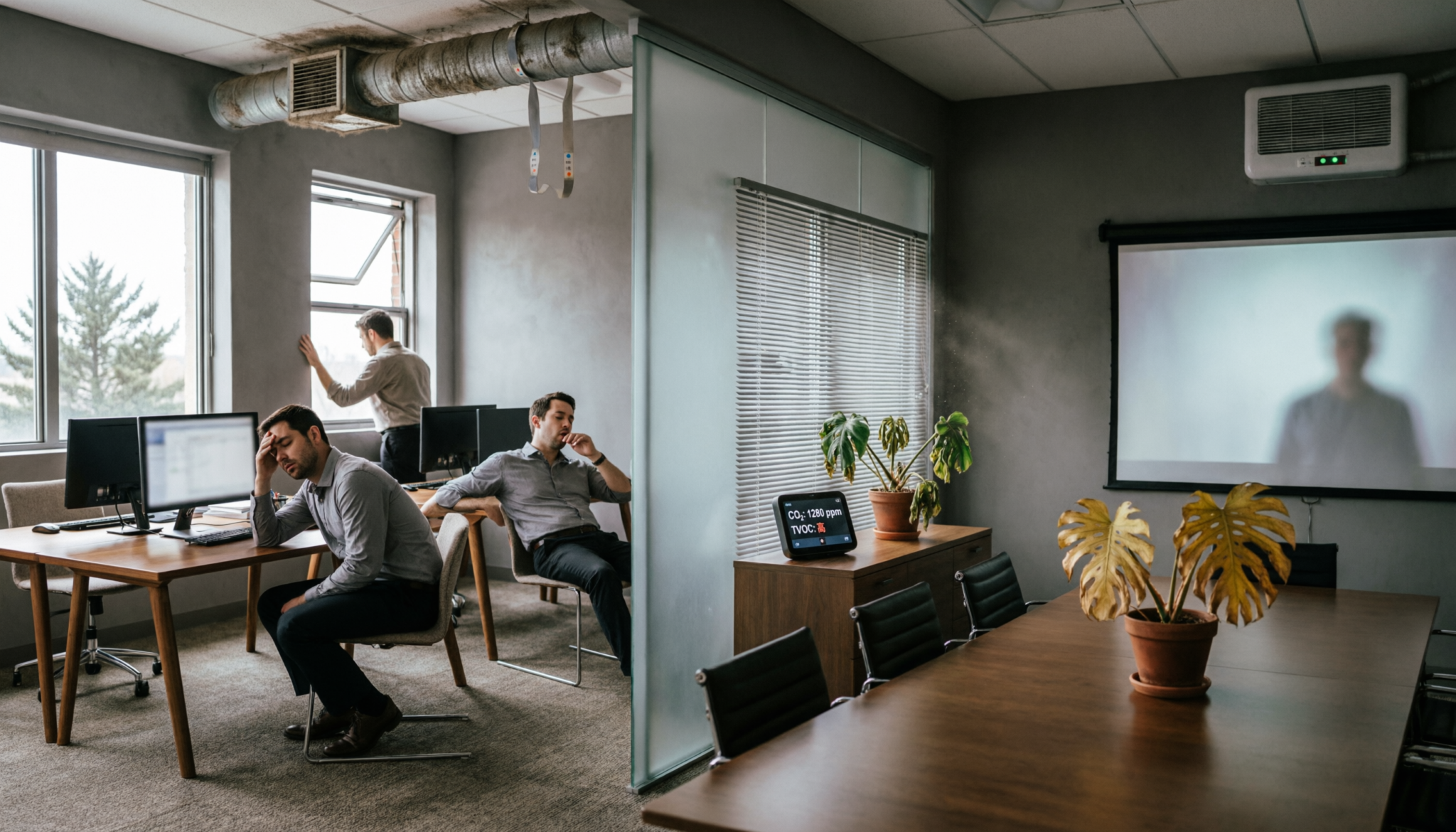
Stale indoor air quietly drains concentration, reaction speed, and mental endurance.
Poor ventilation increases carbon dioxide accumulation, airborne pollutants, humidity imbalance, and thermal discomfort, creating measurable productivity losses across offices, classrooms, workshops, and home workspaces daily.
Verdict
Poor ventilation reduces cognitive accuracy, slows task completion, increases fatigue, and raises absenteeism.
Elevated carbon dioxide, trapped contaminants, humidity imbalance, and heat accumulation impair workplace performance long before obvious discomfort appears.
Consistent fresh-air exchange supports sharper concentration, faster decision-making, healthier respiratory conditions, and sustainable mental endurance throughout prolonged indoor activity.
Comparison Table
| Ventilation Condition | Cognitive Performance Impact | Physical Workplace Effect | Productivity Outcome |
|---|---|---|---|
| High carbon dioxide buildup | Reduced concentration accuracy | Drowsiness and headaches | Slower task completion |
| Humidity imbalance indoors | Mental fatigue increase | Respiratory irritation | Lower work consistency |
| Poor air circulation patterns | Decision-making decline | Temperature discomfort | Higher error frequency |
Carbon Dioxide Accumulation and Cognitive Suppression
Poor ventilation rarely causes immediate physical collapse. Productivity damage develops gradually through chronic low-grade physiological stress.
Indoor carbon dioxide functions as a ventilation marker. Outdoor atmospheric CO2 averages roughly 420 ppm.
Poorly ventilated offices frequently exceed 1,200 ppm before midday occupancy peaks. Conference rooms often exceed 2,000 ppm within 60 minutes.
High CO2 concentration affects cognitive throughput in several ways:
- Reduced alertness
- Slower information processing
- Decision fatigue acceleration
- Increased error frequency
- Shortened concentration span
Complex analytical tasks suffer first. Strategic planning, financial calculations, coding accuracy, and memory recall decline before basic conversational ability changes.
Many workplaces misinterpret ventilation-related fatigue as:
- Burnout
- Lack of motivation
- Poor time management
- Insufficient caffeine intake
Air quality frequently acts as the hidden variable.
Ventilation Physics: Why Pollutants Accumulate Indoors
Indoor environments trap contaminants through pressure imbalance and insufficient air exchange.
Modern buildings prioritize energy retention:
- Airtight windows
- Dense insulation
- Reduced outdoor airflow
- Recirculated HVAC operation
Energy efficiency improves utility costs but reduces pollutant dilution capacity.
Without fresh-air exchange, indoor contaminants continuously accumulate:
- Exhaled CO2
- Respiratory aerosols
- VOC emissions
- Cooking particles
- Dust fragments
- Ozone byproducts
- Cleaning chemical residues
Air stagnation creates pollutant layering zones near workstations and seated breathing height.
Mechanical ventilation failure commonly occurs in:
- Closed meeting rooms
- Basement offices
- Shared classrooms
- Small apartments
- Remote work setups with sealed windows
The result resembles low-grade oxygen deprivation combined with chemical exposure.
The Cognitive Load Effect: Why Brain Performance Drops First
Human cognitive systems consume enormous oxygen resources.
Although brain tissue represents only a small percentage of body mass, neurological activity demands continuous oxygen and glucose delivery.
Poor ventilation disrupts optimal neurological efficiency before severe respiratory symptoms appear.
Common early-stage indicators include:
- Frequent rereading
- Reduced typing accuracy
- Delayed reaction time
- Midday exhaustion
- Poor meeting retention
- Increased irritability
Productivity software cannot compensate for physiological limitations caused by poor indoor air.
Many organizations track:
- Workflow metrics
- Attendance
- Output volume
- Time management
Few track indoor CO2 concentration despite measurable performance correlation.
Research repeatedly shows ventilation improvement produces:
- Faster task completion
- Better cognitive testing performance
- Lower error rates
- Higher attendance consistency
Air quality acts as infrastructure, not comfort decoration.
Expert Insight:
Use a portable CO2 monitor during a long meeting. Concentration decline often begins before subjective discomfort appears. A room reading above 1,200 ppm frequently correlates with visible attention drift, posture collapse, eye rubbing, and slower conversational response time. Cognitive suppression develops silently long before occupants recognize air stagnation.
Particulate Exposure and Neurological Fatigue
Poor ventilation traps microscopic particulate matter inside the breathing zone.
PM2.5 particles measure 2.5 microns or smaller. Ultrafine particles measure below 0.1 microns. Common indoor sources include:
- Frying oils
- Candles
- Laser printers
- Traffic infiltration
- Smoke residue
- Dust agitation
Small particle size creates biological danger.
Large dust fragments remain trapped in nasal passages. Fine particulates bypass upper airway filtration and penetrate deep lung tissue.
Ultrafine particles may enter bloodstream circulation and contribute to systemic inflammation.
Inflammation affects:
- Energy regulation
- Sleep quality
- Cognitive clarity
- Mood stability
Office workers frequently describe particulate-heavy environments using phrases such as:
- “Stuffy”
- “Heavy air”
- “Mental fog”
- “Sleepy room”
Physical sensation often reflects measurable airborne contamination.
Humidity Imbalance and Productivity Loss
Ventilation controls moisture removal alongside pollutant dilution.
High humidity creates biological amplification:
- Mold spore growth
- Dust mite survival
- Bacterial persistence
- Odor retention
Low humidity creates different stressors:
- Dry eyes
- Throat irritation
- Static buildup
- Nasal inflammation
Optimal indoor humidity generally falls between 40% and 60%.
Poor ventilation destabilizes humidity control, particularly in:
- Bathrooms without exhaust systems
- Kitchens with weak range hoods
- Open-plan offices with poor airflow distribution
Humidity imbalance increases fatigue indirectly through sleep disruption and respiratory irritation.
Productivity loss often appears cumulative rather than immediate.
Infection Transmission and Workforce Disruption
Ventilation directly influences airborne disease transmission.
Respiratory aerosols remain suspended for extended periods in stagnant indoor air. Shared occupancy increases pathogen concentration.
Poor ventilation increases:
- Viral spread probability
- Sick leave frequency
- Workplace outbreaks
- Recovery duration
Airborne transmission risk rises dramatically in:
- Crowded offices
- Schools
- Gyms
- Call centers
- Public transport
Ventilation acts as dilution engineering.
Fresh outdoor air lowers infectious aerosol concentration before respiratory exposure reaches dangerous thresholds.
Many productivity studies underestimate infection-related output loss because presenteeism hides the damage. Employees often remain physically present while operating at reduced cognitive capacity.
Ventilation Standards and Real-World Failure Points
Building ventilation standards often target minimum compliance rather than optimal cognition.
Common failure points include:
- Dirty HVAC filters
- Closed outdoor air dampers
- Undersized ventilation systems
- Blocked vents
- Poor airflow balancing
- Overcrowded rooms
A technically functioning HVAC system may still provide inadequate ventilation.
Warning signs include:
- Persistent afternoon fatigue
- Window condensation
- Lingering odors
- Morning headaches
- Sleepiness during meetings
- Rapid room stuffiness after occupancy increase
Indoor air quality requires continuous management rather than occasional maintenance.
FAQs
1. Why does productivity crash during long meetings?
CO2 accumulation rises rapidly in enclosed rooms with high occupancy. Reduced ventilation increases cognitive fatigue, concentration loss, and reaction-time decline within 30 to 60 minutes.
2. Does opening windows actually improve concentration?
Yes. Outdoor air exchange lowers CO2 concentration and dilutes indoor pollutants. Even short ventilation intervals can improve alertness and perceived mental clarity.
3. Why do newer buildings sometimes feel worse?
Modern airtight construction improves energy efficiency but often reduces fresh-air exchange. Without strong ventilation engineering, pollutant concentration rises faster than in older draft-prone structures.
Final Take
Poor ventilation functions as an invisible productivity suppressant. Elevated CO2, trapped particulates, excess humidity, and airborne contaminants steadily reduce concentration, accuracy, and cognitive endurance.
Most productivity interventions target behavior while ignoring physiology. Indoor air quality determines mental performance capacity long before motivation, discipline, or workflow systems enter the equation.