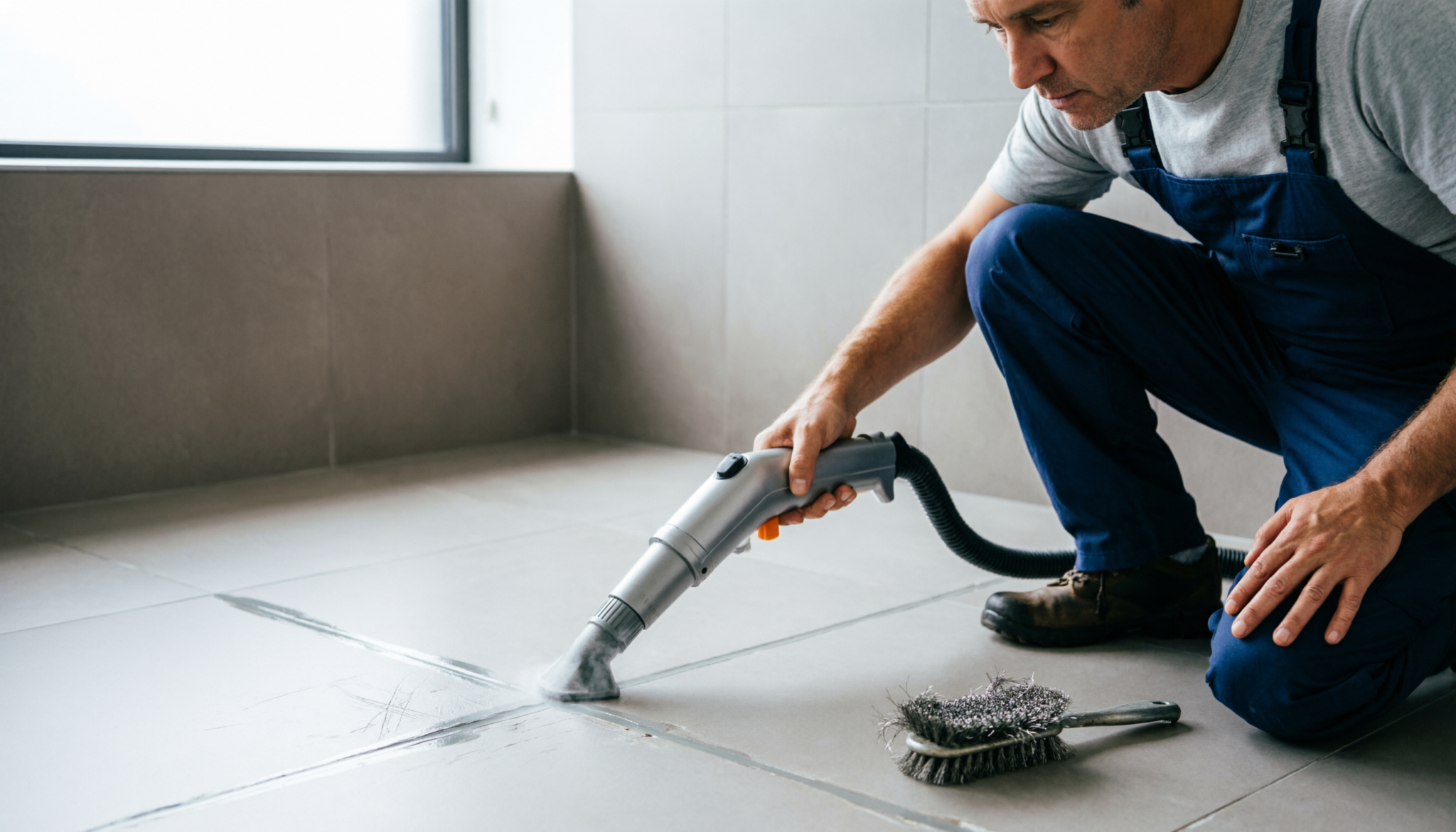
Vapor cleaning provides controlled heat and moisture for grout maintenance without the aggressive abrasion associated with wire bristles.
Wire brushes can erode cementitious grout, widen surface defects, scratch adjacent tile, and generate contaminated particulate matter.
For routine grout sanitation, controlled vapor, soft agitation, and thorough drying provide a safer mechanical strategy.
Vapor Cleaning Protects Grout Integrity
Vapor cleaning relies primarily on thermal energy and moisture rather than aggressive abrasion.
Steam penetrates surface contamination, softens detergent films, loosens greasy residues, and reduces adhesion between accumulated soil and grout.
Cementitious grout contains mineral aggregates and cement-based binders. Repeated aggressive abrasion can remove fine surface material and gradually alter the grout profile.
A wire brush concentrates mechanical force through rigid metal filaments, creating thousands of small contact points across a comparatively fragile surface.
Vapor application changes the cleaning sequence.
Heat softens contamination first. Controlled brushing then removes loosened material. Extraction or wiping captures residue. Drying completes the process.
Such sequencing reduces the mechanical force required for soil removal.
Vapor also provides an important moisture advantage. Wet cleaning suppresses many forms of dust generation compared with dry abrasion.
Reduced dust production supports cleaner surrounding air, particularly during maintenance involving neglected grout, deteriorated sealants, or heavily soiled floor joints.
Steam, however, does not automatically equal sanitation.
Adequate temperature, contact time, nozzle control, surface compatibility, and subsequent residue removal determine cleaning performance.
Rapid nozzle movement can provide insufficient thermal exposure. Excessive moisture can also delay drying and create unfavorable conditions within porous materials.
Effective vapor cleaning therefore requires controlled application rather than indiscriminate steam exposure.
Wire Bristles Damage Grout Surface
Wire brushes create a fundamentally different cleaning mechanism. Metal filaments scrape across grout and remove adhered material through abrasion.
Hard contamination can require mechanical force, but grout itself can become part of the removed material.
Several problems follow.
Surface erosion: Cementitious grout can lose surface particles under repeated metal abrasion. Erosion may produce a rougher, more porous profile that retains subsequent contamination.
Joint widening: Aggressive brushing along grout lines can gradually remove material from the joint edges. Repeated maintenance magnifies cumulative wear.
Tile scratching: Metal filaments can damage susceptible tile finishes, especially polished surfaces, soft natural stone, decorative coatings, and certain glazed materials.
Particulate generation: Dry brushing can release fine particles from grout, soil, mineral scale, old sealant, and embedded debris. Airborne particles can remain suspended long enough to affect indoor air cleanliness.
Sealant damage: Flexible grout sealants and adjacent caulk can suffer mechanical damage from rigid bristles. A damaged sealant joint can permit water penetration into vulnerable assemblies.
The term “wire brush” covers several filament types and stiffness levels, so every brush does not produce identical damage.
Nevertheless, metal abrasion provides little advantage for routine grout maintenance when controlled vapor and softer agitation can loosen contamination first.
A nonmetallic grout brush provides greater mechanical control. Nylon bristles, for example, can provide agitation without the same cutting action associated with metal filaments.
Brush stiffness still matters. Excessive pressure remains capable of damaging weak grout.
The safest principle remains simple: loosen contamination thermally before applying mechanical force.
Cleaning Method Determines Airborne Exposure
Indoor air quality changes during cleaning activity. Mechanical disturbance can release particles into the breathing zone, while chemical products can contribute volatile compounds depending on formulation and application.
Dry wire brushing creates a particularly avoidable particulate pathway. Friction breaks loose material from the grout surface and sends particles into surrounding air.
Vacuuming after dry brushing may capture some debris, but airborne dispersion can occur before collection.
Vapor cleaning uses a different sequence. Steam supplies heat and moisture directly to the contaminated surface. Dampened residues become easier to wipe or extract, while wet conditions reduce dry dust generation.
Indoor air quality still requires attention during vapor cleaning.
Ventilation should remain adequate for moisture management. Excess humidity can accumulate in bathrooms, kitchens, laundry areas, and other enclosed spaces.
Condensation on cool surfaces can prolong drying and create moisture-management problems.
Cleaning should therefore include four stages:
- Thermal loosening: Apply vapor with controlled nozzle movement.
- Mechanical agitation: Use a soft or medium nonmetallic grout brush where necessary.
- Residue removal: Wipe or extract loosened soil.
- Drying: Promote air exchange and complete moisture removal.
The sequence limits unnecessary abrasion while controlling particulate movement.
A clean grout line should not serve as the only endpoint. Surrounding tile, baseboards, fixtures, and floor surfaces require residue removal because vapor can mobilize contamination beyond the original grout joint.
Safe Grout Preparation Before Vapor Cleaning
Preparation determines whether vapor cleaning produces useful results or unnecessary surface stress.
Loose debris should receive removal before steam application. A dry microfiber cloth or suitable vacuum system can collect loose surface material without aggressive brushing.
Heavy mineral deposits may require a compatible descaling procedure rather than repeated abrasion.
Surface identification also matters.
Cementitious grout, epoxy grout, natural stone, ceramic tile, porcelain tile, and flexible sealants possess different tolerances. Manufacturer guidance remains the primary reference for surface compatibility.
Grout condition requires inspection before cleaning. Cracked, powdery, missing, severely recessed, or structurally deteriorated grout requires repair assessment rather than increasingly aggressive brushing.
Vapor temperature and nozzle distance require control. Concentrated steam applied too closely for prolonged periods can deliver excessive heat and moisture to vulnerable surfaces.
Short, controlled passes provide better process control than stationary steam application.
A narrow grout nozzle can concentrate vapor along the joint, while a brush attachment can provide simultaneous agitation. Excessive pressure remains unnecessary. Thermal softening should perform much of the work.
Following vapor treatment, residue removal remains essential. Soil suspended in moisture can redeposit after evaporation. A clean microfiber cloth, suitable extraction method, or controlled rinse can prevent residue migration.
Drying represents the final sanitation step. Grout requires sufficient air exchange and evaporation before normal wet-area use resumes. Persistent moisture can undermine cleaning quality even after visible soil disappears.
Expert’s Insight
Metal abrasion solves a contamination problem by creating a surface problem. Vapor cleaning reverses that sequence. Heat loosens adhered soil before controlled agitation removes residue.
Soft bristles preserve grout geometry, while moisture suppresses dry particulate release. Complete residue removal and drying remain essential for durable sanitation and cleaner indoor air.
Vapor Cleaning Requires Controlled Contact Time
Steam cleaning performance depends on thermal exposure rather than nozzle speed alone. Heat must reach contaminated material sufficiently to soften deposits and reduce adhesion.
Fast sweeping can provide impressive visual movement while delivering inadequate thermal contact. Slow, controlled passes provide greater heat transfer but require attention to moisture accumulation.
Grout cleaning benefits from sectional work.
A manageable grout section receives vapor treatment first. Loosened soil then receives gentle agitation. Residue receives immediate removal.
The next section follows only after the previous section receives adequate drying attention.
Such workflow prevents dirty moisture from migrating across already-clean surfaces.
Heavy organic soil may require repeated treatment rather than stronger mechanical force. Repeated controlled passes generally provide better surface protection than a single aggressive brushing session.
Detergent residue deserves particular attention. Some household cleaners leave surfactant films that trap additional soil after incomplete rinsing.
Vapor can soften such films, but residue removal remains necessary. Steam alone does not remove every contaminant from porous grout.
Mineral scale presents another limitation. Hard calcium-based deposits can resist steam and mechanical brushing.
Excessive wire brushing remains an inferior response because grout erosion can occur before scale removal becomes satisfactory.
Compatible descaling chemistry, appropriate dwell time, and controlled agitation can provide a more technically sound approach when material compatibility permits.
Vapor cleaning therefore works best as part of a controlled sanitation protocol rather than as a universal replacement for every cleaning method.
FAQs
1. Can steam damage grout?
Excessive heat, prolonged moisture exposure, or concentrated vapor can damage vulnerable grout or adjacent materials.
Controlled passes, suitable nozzle distance, surface compatibility checks, residue removal, and complete drying reduce unnecessary thermal and moisture stress.
2. Why does a wire brush damage grout?
Metal filaments create abrasive contact capable of removing grout particles along with contamination.
Repeated brushing can erode joint surfaces, enlarge defects, damage adjacent finishes, and generate airborne particulate matter. Soft nonmetallic bristles provide more controlled agitation for routine maintenance.
3. Does vapor cleaning improve indoor air quality?
Vapor cleaning can reduce dry particulate generation compared with dry wire brushing because moisture suppresses dust during contamination removal.
Indoor air quality still depends on ventilation, residue collection, moisture control, and complete drying. Vapor cleaning does not eliminate every airborne contaminant or replace adequate ventilation.
Final Word
Vapor cleaning provides controlled heat, moisture, and low-abrasion soil removal for grout maintenance. Wire brushing introduces unnecessary mechanical wear and can increase particulate release.
Soft agitation after thermal loosening offers better surface protection. Proper residue removal, ventilation, and drying complete the sanitation process while preserving grout structure and indoor air quality.