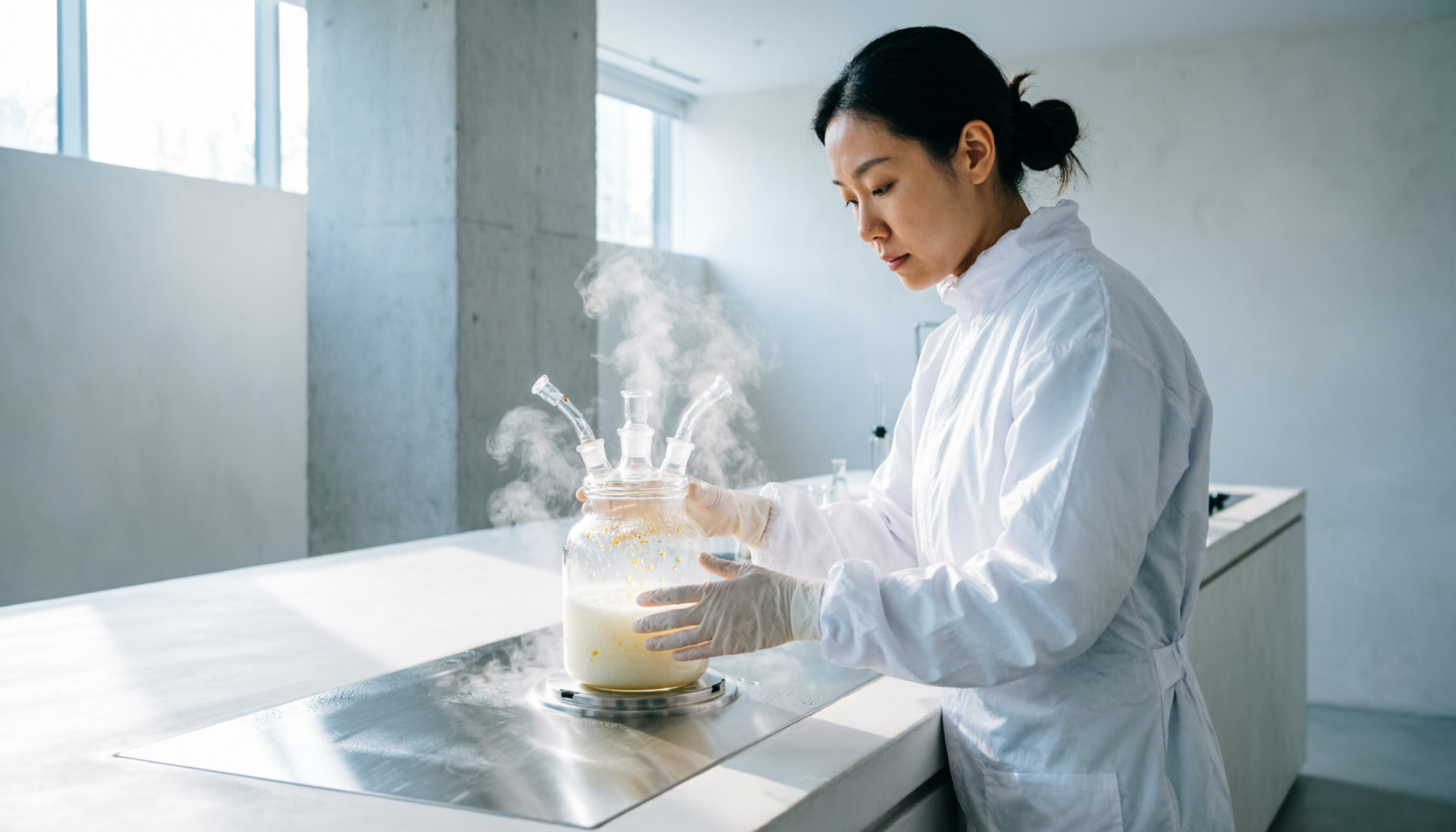
Steam does not chemically split oil molecules during normal household cleaning. High temperature lowers oil viscosity, softens oxidized residues, and promotes physical dispersion through condensation, pressure, and surface shear.
True emulsification requires water, mechanical action, and often surfactants. Residue removal supports indoor air quality by reducing oily films and vapors.
Steam And Oil Interaction Compared
| Mechanism | Primary Molecular Action | Effect on Oil | Indoor-Air Relevance |
|---|---|---|---|
| Thermal Softening | Increased molecular motion lowers viscosity | Softens and mobilizes grease | Facilitates surface removal |
| Steam Condensation | Water contacts heated oil at the surface | Promotes dispersion of softened residue | Supports residue capture |
| Surfactant Emulsification | Surfactant molecules stabilize oil-water interfaces | Creates a more stable oil-water dispersion | Improves washing and residue removal |
Steam Temperature Changes Oil Viscosity
Viscosity represents resistance to flow. Most household oils become progressively less viscous as temperature rises. The reduction allows an oily film to move more readily across a surface under pressure or wiping action.
Polymerized grease presents a more complicated structure. Repeated heating causes oxidation, cross-linking, and polymer formation.
A hardened residue therefore contains altered compounds rather than a simple layer of unchanged cooking oil.
Steam supplies concentrated thermal energy at the contamination interface. Vapor contacting a cooler surface condenses into liquid water while releasing substantial latent heat.
That heat penetrates the residue and raises local temperature.
Higher temperature increases molecular motion within the oily matrix. Intermolecular attractions become less dominant, while the softened material develops greater flow.
Adhesion between residue and substrate can consequently decrease.
Steam pressure also contributes mechanical force. A narrow nozzle can concentrate vapor against a contaminated surface, producing localized shear and displacement.
A scraper or brush adds additional mechanical energy after thermal softening.
For indoor air quality, this mechanism has an important consequence: removal occurs at the surface rather than through prolonged heating of airborne oil.
Controlled steam application can therefore reduce residual films without requiring aggressive chemical volatility.
Condensation Creates Water Oil Interfaces
Steam reaching a cooler surface undergoes condensation. Liquid water then forms directly at the contamination boundary. The interface between water and oil becomes central to steam-assisted soil removal.
Oil and water naturally resist complete mixing because of different molecular polarity. Water molecules form strong hydrogen-bond networks.
Most common oils contain largely nonpolar hydrocarbon structures. The energetic difference discourages spontaneous molecular-level mixing.
Mechanical energy can nevertheless disperse oil into small droplets surrounded by water. This process represents dispersion rather than permanent emulsification.
A stable emulsion generally requires an emulsifying agent capable of reducing interfacial tension and stabilizing droplets.
Surfactants perform that function effectively. One portion of a surfactant molecule interacts with water, while another portion interacts with oil.
The resulting molecular arrangement helps maintain dispersed droplets within the water phase.
Steam alone lacks a conventional surfactant system. Steam therefore should not receive credit for chemically emulsifying grease in the strict technical sense.
Thermal softening followed by condensation and mechanical agitation provides the more accurate description.
Surface geometry also matters. Porous materials, textured metals, grout, and rough polymers create microscopic spaces capable of retaining oily contamination.
Condensed water can enter accessible surface irregularities while softened grease moves under mechanical force.
Heat, Shear, And Water Drive Removal
Three mechanisms dominate effective steam-assisted oil removal: thermal softening, water interaction, and mechanical shear.
Thermal softening reduces viscosity and weakens the cohesive structure of heated or oxidized grease.
Water provides a separate phase capable of surrounding dispersed particles and carrying loosened material. Mechanical action physically separates contamination from the substrate.
No single mechanism explains complete removal.
Steam without sufficient dwell time may heat contamination without generating adequate softening. Steam without agitation may leave softened residue spread across the surface.
Mechanical agitation without thermal softening may require excessive force. Water without adequate heat may fail against heavily polymerized deposits.
The sequence therefore matters.
A contaminated surface receives thermal energy first. Residue softens as temperature rises. Condensation creates a water-rich interface.
Agitation then produces shear and displacement. A cloth, scraper, brush, or extraction system captures the loosened material.
Repeated passes can remove progressively deeper residue layers. Excessive heating, however, can create another problem.
Oil residues subjected to prolonged high temperatures may generate additional volatile compounds, especially when combustion or thermal decomposition occurs.
Indoor air quality therefore depends on controlled application rather than maximum temperature alone.
Expert’s Insight
Expert’s Insight: Steam-assisted oil removal represents thermal softening plus physical dispersion, not molecular destruction.
Temperature reduces viscosity; condensation establishes a water interface; mechanical shear separates residue from the substrate.
Surfactants improve true emulsification by stabilizing oil droplets. Indoor-air benefits arise primarily from residue removal and reduced secondary vapor release.
Molecular Structure Determines Cleaning Difficulty
Fresh oil and polymerized grease require different cleaning mechanisms because molecular structure changes during repeated heating.
Fresh triglyceride-rich cooking oil remains comparatively mobile. Moderate heating can reduce viscosity substantially, allowing wiping or washing to remove contamination.
Polymerized grease contains oxidation products, cross-linked structures, and strongly adhered compounds.
Oxidation introduces chemically altered functional groups into oil residues. Continued thermal exposure encourages polymerization.
Surface contamination can consequently become darker, harder, and more resistant to ordinary detergents.
Steam remains useful because thermal energy changes the physical properties of the residue even when chemical bonds remain intact. A hardened film can become more pliable and easier to scrape after sufficient heating.
Scraping pressure then converts softened material into displaced fragments or films. Water carries some material away, while absorbent wiping captures the remaining residue.
Chemical degradation requires different conditions.
Hydrolysis, oxidation, or other chemical reactions can alter oil molecules, but ordinary household steam cleaning should not be described as a process that destroys oil at the molecular level.
That distinction improves both cleaning expectations and indoor-air assessments.
Indoor Air Quality Depends On Residue Control
Oil contamination affects indoor air quality through more than visible grease. Heated cooking oils can produce particulate matter and volatile or semi-volatile organic compounds.
Persistent films can also retain dust and other contaminants on nearby surfaces.
Ventilation remains the primary control for airborne contaminants. Surface cleaning addresses a different exposure pathway by removing accumulated residues before subsequent heating or disturbance.
Steam can support this strategy when application prevents excessive aerosolization.
A focused nozzle, moderate dwell time, adequate ventilation, and immediate residue collection provide better control than indiscriminate high-temperature blasting.
Kitchen surfaces deserve particular attention because repeated heating cycles continually alter residual oil. Range hoods, backsplash areas, cabinet surfaces, appliance exteriors, and nearby walls can accumulate thin oily films.
Removal frequency matters. Thin deposits require less thermal energy and mechanical force than heavily polymerized layers. Early intervention therefore reduces the amount of heat required during later cleaning.
Steam also requires substrate compatibility. Certain plastics, laminates, painted finishes, adhesives, and moisture-sensitive materials can suffer damage from concentrated heat or moisture.
Material stability must remain part of any steam-cleaning protocol.
Steam Cleaning Mechanisms Compared
| Process | Molecular or Physical Mechanism | Oil Response | Indoor-Air Relevance |
|---|---|---|---|
| Thermal softening | Increased molecular motion and reduced viscosity | Grease becomes more mobile | Facilitates controlled surface removal |
| Condensation and dispersion | Water contacts softened oil under heat and shear | Oil separates into smaller dispersed portions | Supports residue capture rather than prolonged heating |
| Surfactant-assisted emulsification | Interfacial tension decreases and droplets stabilize | Oil remains dispersed in water | Improves washing and rinse removal |
The table clarifies a common misconception. Steam provides heat, water, pressure, and mechanical assistance, but conventional steam alone does not provide the molecular architecture required for stable emulsification.
Detergent chemistry can supply the missing surfactant function. A detergent solution combined with appropriate agitation can stabilize dispersed oil droplets and improve transport away from the contaminated surface.
Steam therefore works especially well as a preconditioning mechanism for stubborn grease. Thermal energy changes the physical condition of contamination, while detergent chemistry and mechanical action complete removal.
For indoor air quality, the practical target remains simple: reduce accumulated oil residue without generating unnecessary airborne contamination.
FAQs
1. Does steam chemically break down cooking oil?
Normal household steam does not chemically decompose cooking oil. Thermal energy primarily reduces viscosity, softens oxidized material, weakens adhesion, and assists physical displacement.
Genuine chemical degradation requires reactions involving appropriate chemical conditions rather than steam exposure alone.
2. Does steam actually emulsify grease?
Steam can help disperse softened oil into water through condensation and mechanical agitation. Strict emulsification requires stabilized oil droplets within water, commonly supported by surfactants.
Steam therefore assists emulsification but should not receive sole credit for stable emulsion formation.
3. Can steam cleaning improve indoor air quality?
Surface steam cleaning can reduce accumulated oily films, especially around cooking areas. Reduced residue can lower the quantity of material available for subsequent heating and vapor release.
Ventilation remains essential because steam cleaning does not remove airborne pollutants already suspended inside a room.
Final Word
Steam-assisted grease removal depends on physics more than molecular destruction. Heat reduces viscosity, condensation establishes a water interface, and mechanical shear dislodges softened residue.
True emulsification requires stabilized oil droplets, usually with surfactants.
For indoor air quality, controlled residue removal reduces contaminated surface reservoirs while ventilation controls airborne pollutants during cleaning.