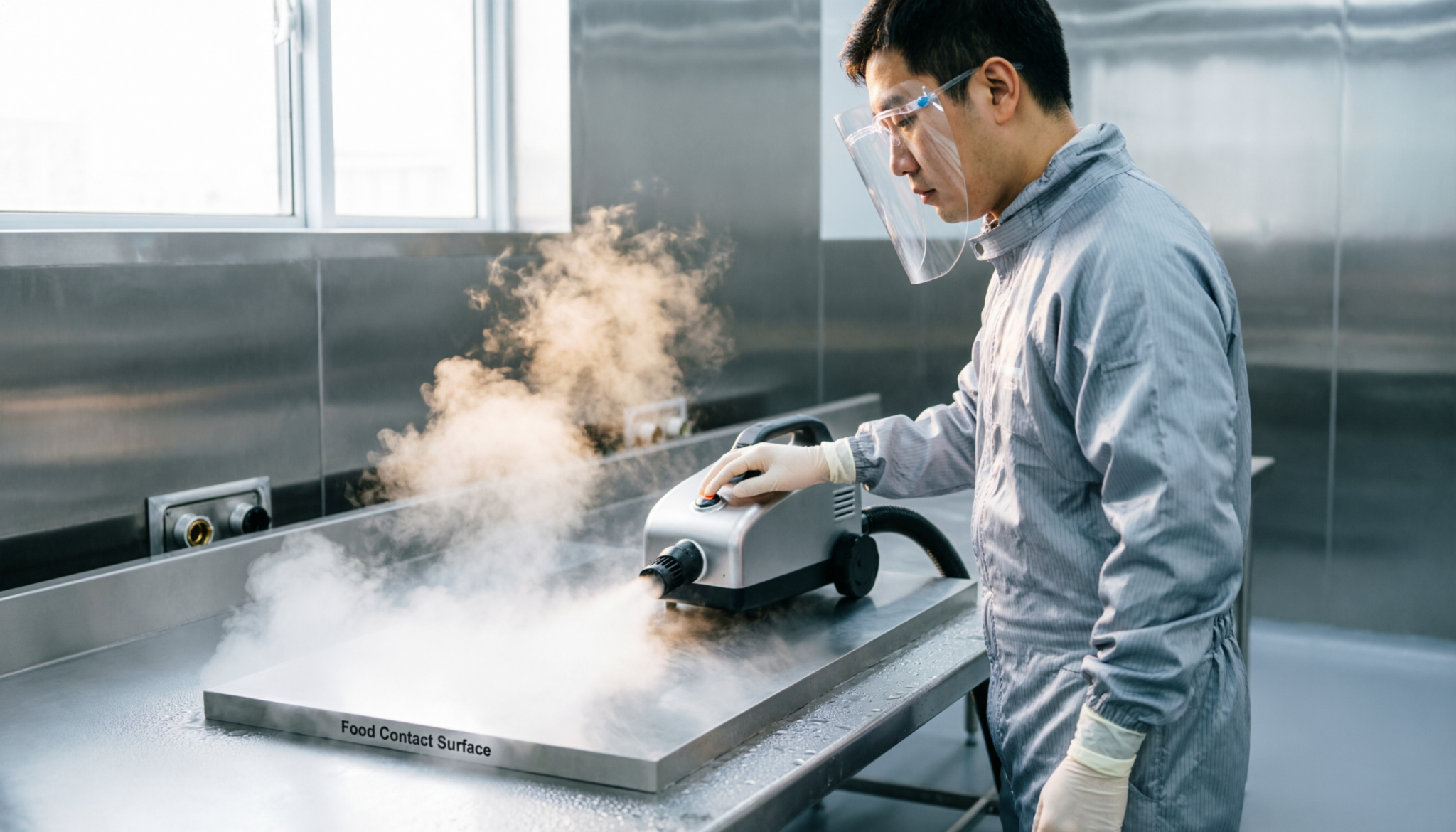
Steam generally offers the lower chemical exposure route for food-prep surface maintenance because vapor leaves no caustic chemical residue and adds fewer cleaning-product emissions to indoor air.
Proper cleaning remains essential, while validated heat exposure, surface compatibility, ventilation, and safe handling determine whether steam provides effective sanitization during routine maintenance.
Comparison Table
| Method | Indoor-Air Burden | Food-Contact Surface Consideration | Best Application |
|---|---|---|---|
| Steam vapor | Low chemical emission; mainly heat and moisture | No chemical residue; requires adequate heat and contact | Routine degreasing and compatible surface sanitation |
| Caustic cleaner | Potential fumes, aerosols, and volatile ingredients | Requires exact dilution, contact time, and appropriate rinsing | Heavy baked-on soil where chemical action is necessary |
| Mild detergent + steam | Low chemical burden with strong soil removal | Cleaning followed by heat-based sanitization when validated | General food-prep maintenance |
Why Steam Reduces Indoor Chemical Exposure
Household cleaning products can emit volatile organic compounds, while product handling can also create vapors, aerosols, or droplets.
EPA guidance identifies cleaning supplies as indoor pollutant sources and recommends ventilation during cleaning, sanitizing, and disinfecting.
Steam changes the exposure pathway. Heated water replaces caustic alkaline formulation during surface treatment, reducing routine handling of corrosive concentrates and potential inhalation or skin and eye exposure.
Caustic cleaners remain useful for stubborn grease, especially polymerized fats and carbonized residues. Strong alkaline chemistry can break down organic soil efficiently.
However, chemical strength creates a safety tradeoff. Concentrated alkaline products can irritate or burn skin and eyes, and certain formulations can contribute to indoor air contaminants or irritating vapors.
Steam does not create a chemical-free indoor environment automatically. Heated vapor increases moisture, and poor ventilation can raise local humidity. Steam application also creates thermal burn hazards.
Safe operation requires controlled nozzle movement, appropriate personal protection, surface compatibility, and adequate ventilation.
For routine food-prep maintenance, lower chemical dependence can support cleaner indoor air without sacrificing soil removal when the correct cleaning sequence remains in place.
How Heat Handles Food Surface Contamination
Sanitization requires more than visible cleanliness. FDA guidance defines food-contact surface sanitization around effective reduction of microorganisms after cleaning.
The FDA Food Code specifies approved hot-water and chemical sanitization methods, including temperature and contact requirements for applicable operations.
Steam provides strong thermal action because condensed vapor transfers heat efficiently to surfaces. However, a steam nozzle does not guarantee a particular surface temperature.
Nozzle distance, movement speed, pressure, surface geometry, soil thickness, and equipment output all influence thermal exposure.
Validated temperature and contact conditions matter. Food-service operations requiring regulatory compliance should follow approved equipment specifications, sanitation procedures, and local food-code requirements.
Caustic cleaners present a different mechanism. Alkaline chemistry attacks grease and organic deposits, making heavy soil easier to remove.
Chemical sanitizers, however, require approved formulations, correct concentration, adequate contact time, and proper application. FDA Food Code criteria govern chemical sanitizers used on food-contact surfaces.
Steam can support cleaning and, under validated conditions, sanitization. Steam cannot compensate for heavy soil that blocks heat transfer.
Textured plastic, worn cutting surfaces, seams, and joints require additional attention.
FDA research found surface material and texture influence allergen removal, while full wash-rinse-sanitize-air-dry procedures improve removal and reduce transfer.
When Caustic Cleaners Still Make Sense
Steam carries a strong advantage for routine maintenance, but caustic chemistry remains valuable for selected soils.
Polymerized grease, carbon deposits, baked-on starch, and long-neglected residues can resist ordinary detergent and short steam passes.
A caustic cleaner provides chemical energy alongside mechanical action. High-pH formulations can soften or hydrolyze fatty residues, reducing scrubbing requirements.
Such chemistry can outperform steam alone when thick deposits block direct heat transfer.
Food-prep applications require strict product selection. A general-purpose drain cleaner, oven cleaner, or industrial degreaser cannot automatically qualify as a food-contact surface product.
Food-contact compatibility, dilution, contact time, rinsing requirements, and label directions require verification before use.
Caustic chemistry also demands disciplined handling. Gloves, eye protection, ventilation, accurate dilution, and chemical segregation reduce exposure risk. Mixing cleaning products can generate dangerous vapors.
EPA and CDC guidance specifically warns against mixing household cleaning products and recommends fresh-air ventilation during chemical use.
How To Build Safer Cleaning Sequences
A safer food-prep cleaning sequence separates soil removal from sanitization. Skipping the cleaning stage can leave grease, proteins, starches, and biofilm-like residues that shield microorganisms from heat or sanitizer action.
Step 1: Remove gross soil. Scrape or wipe loose food residues into appropriate waste containers. Avoid high-pressure actions that aerosolize contaminated material.
Step 2: Apply steam where compatible. Use controlled passes across stainless steel, sealed hard surfaces, or other manufacturer-approved materials.
Keep nozzle movement consistent enough to provide useful thermal exposure without damaging seals, plastics, adhesives, or finishes.
Step 3: Remove loosened residue. Use a clean microfiber cloth or suitable food-contact cleaning implement. Change cloths frequently to prevent redistribution.
Step 4: Verify sanitization requirements. Use a validated thermal procedure or an approved chemical sanitizer according to applicable food-safety requirements. Visual cleanliness alone does not establish sanitization.
Step 5: Dry appropriately. Air drying can reduce recontamination from towels. FDA food-safety guidance supports wash-rinse-sanitize-air-dry procedures for food-contact surfaces.
Step 6: Ventilate. Steam treatment still adds heat and moisture. Chemical cleaning requires particular attention to fresh-air exchange. EPA guidance recommends ventilation during cleaning and sanitizing activities.
A useful rule follows: use the mildest effective cleaning method that can remove the actual soil burden, then use a validated sanitization method.
Expert Opinion: Expert’s Insight
Steam deserves preference for routine food-prep maintenance when compatible surfaces permit controlled thermal treatment. Lower chemical use can reduce inhalation, residue, and handling concerns.
Caustic chemistry remains valuable for severe grease deposits. Effective practice requires cleaning first, validated sanitization second, ventilation throughout, and strict compliance with product and food-safety instructions.
What Steam Cannot Safely Replace Alone
Steam cannot replace every cleaning or sanitizing process. A steam cleaner lacks universal performance across all pathogens, soils, materials, and equipment designs.
Thermal efficacy depends on actual surface temperature and contact duration rather than steam temperature alone.
Steam also cannot replace detergent where surfactant action provides necessary soil suspension.
Grease, protein, starch, and particulate matter can require detergent-assisted cleaning before sanitization. Heavy deposits can insulate microorganisms from thermal treatment.
Surface compatibility presents another limitation. Excessive heat or moisture can damage laminated counters, unsealed wood, some plastics, adhesives, painted finishes, electronics, and sensitive seals.
Caustic products also require careful limits. Strong alkaline chemistry can corrode unsuitable metals and damage finishes.
Steam generally offers the cleaner indoor-air profile for routine maintenance, while controlled chemical cleaning can remain the correct intervention for difficult soil.
FAQs
1. Is steam safer than caustic cleaner for kitchen surfaces?
For routine maintenance, steam can reduce chemical exposure because water vapor supplies thermal action without applying a caustic formulation.
Safer operation still requires controlled temperature, appropriate ventilation, surface compatibility, and protection against burns. Food-contact sanitization claims require validated conditions rather than steam temperature alone.
2. Can steam sanitize food-prep surfaces?
Steam can contribute to sanitization when validated temperature and contact conditions reach the required microbial reduction. A visible steam plume does not prove sanitization.
FDA guidance treats sanitization as a controlled process applied after cleaning, with approved thermal or chemical methods.
3. Should caustic cleaners be avoided completely?
No. Caustic cleaners can provide efficient removal of severe grease and baked-on organic deposits.
Food-contact applications require suitable products, correct dilution, required contact time, thorough rinsing where specified, and adequate ventilation.
Routine use without a soil-based reason can increase chemical exposure unnecessarily.
Final Word
Steam offers a lower-chemical pathway for routine food-prep surface care and can support validated thermal sanitization. Caustic cleaners retain value for severe organic deposits.
Neither method guarantees sanitization without correct procedure. Clean first, apply validated heat or sanitizer, control moisture, ventilate chemical work, and follow surface and food-safety requirements consistently.