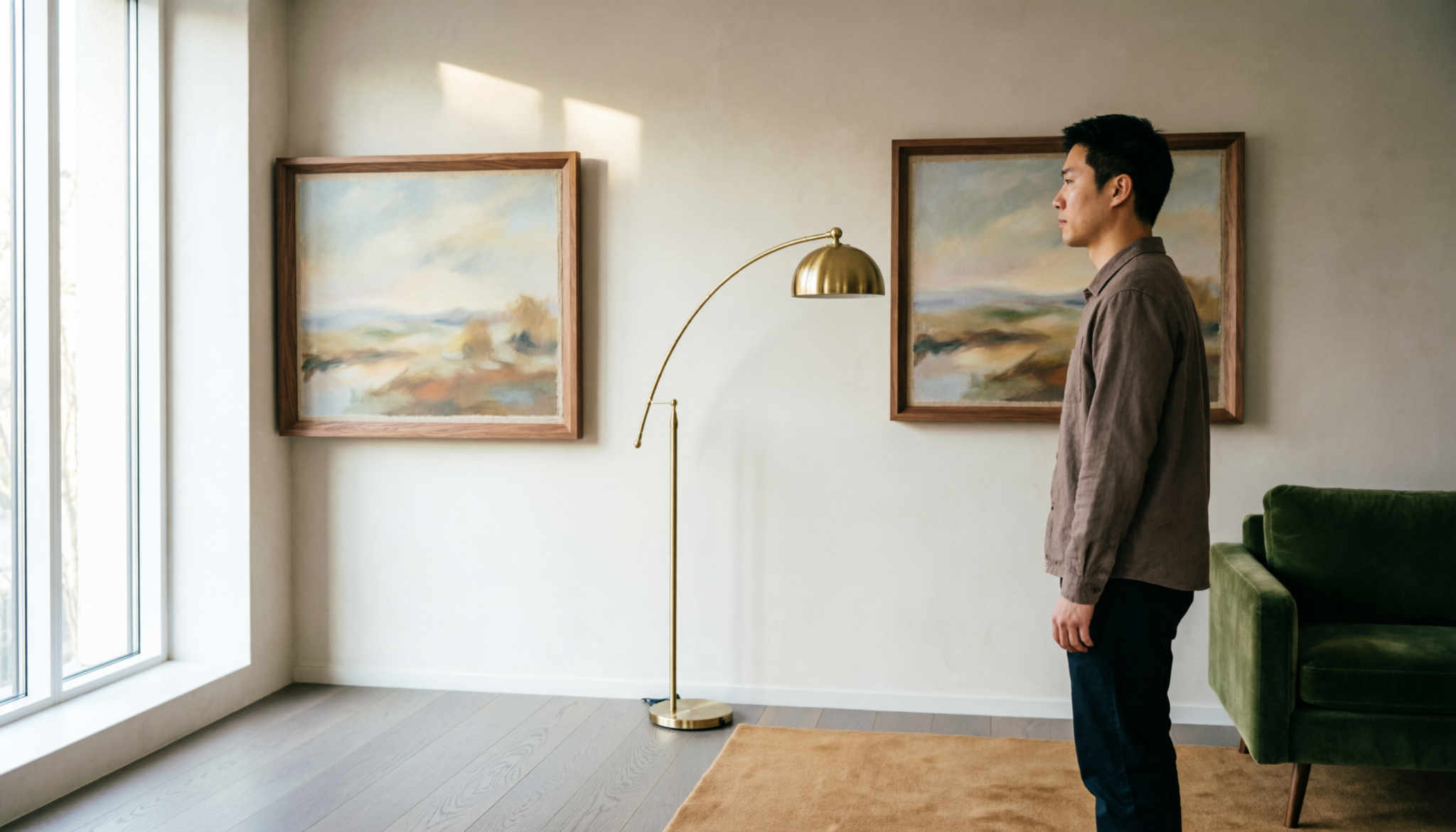
A room can carry expensive furniture, layered lighting, and quality finishes yet still feel awkward because of one mistake: artwork placed too high on the wall.
Poor art placement disconnects furniture from the architecture, weakens visual balance, and creates empty space where the eye expects cohesion. Correct placement restores proportion, improves flow, and makes even modest rooms feel intentional.
Spatial Logic Summary: Artwork should align with average standing eye level at approximately 57 to 60 inches from the floor to the center of the frame. Large empty gaps between furniture and artwork create visual imbalance and weaken room cohesion.
Maintain 6 to 10 inches between furniture tops and frame bottoms to establish proper visual connection. Overscaled vertical spacing causes ceilings to appear disconnected from the furnishing layout, resulting in a fragmented and uncomfortable room flow.
Common Art Placement Outcomes
| Placement Style | Visual Balance | Furniture Connection | Room Proportion |
|---|---|---|---|
| Artwork hung at eye level | Strong and cohesive | Tight visual anchor | Balanced ceiling height |
| Artwork hung too high | Disconnected and awkward | Weak connection | Walls feel empty |
| Artwork hung too low | Heavy and compressed | Overcrowded appearance | Ceiling feels shorter |
Calculating the ‘Hook Point’: The Math Behind the 57-Inch Rule
Getting the height right comes down to a simple formula:
Formula:
57 inches − (half the artwork height) + (distance from top of frame to hanging hardware) = hook placement on wall
Example:
- Artwork height: 24 inches
- Half height: 12 inches
- Wire drop from top: 2 inches
Calculation:
57 − 12 + 2 = 47 inches (place hook here)
This method avoids guesswork. It also prevents repeated nail holes, which weaken walls over time and leave visible marks.
Tools That Make Accurate Hanging Easier
The right tools remove frustration and improve precision, especially on heavier frames or gallery walls.
A laser measure speeds up wall-to-floor calculations. A level ensures frames sit straight the first time. Strong hanging kits prevent shifting, especially in homes with movement or vibration.
The Biggest Reasons People Hang Art Too High
Fear of Furniture Crowding
Many walls contain large sofas, headboards, or cabinets. This often creates hesitation about placing art “too close” to furniture. The result becomes excessive blank space between the two elements.
That empty zone weakens the room more than slightly close spacing ever will.
Professional designers intentionally tighten that relationship because artwork and furniture should read as one composition.
Ceiling Height Confusion
Tall ceilings encourage upward placement. Many homeowners assume artwork should “fill the wall” vertically. That instinct creates visual drift.
A 10-foot ceiling does not require artwork near the top third of the wall. Human sightlines still operate at average eye level regardless of ceiling height.
Tall walls need layered vertical elements such as:
- Drapery
- Floor mirrors
- Shelving
- Lighting
- Tall plants
Artwork alone should not carry vertical scale.
Standing Versus Sitting Perspective
Living rooms and dining rooms function primarily from seated positions. Art hung for standing height often feels too elevated once seated.
This becomes especially obvious above sofas and dining buffets.
The fix remains straightforward:
- Sit first
- View the wall naturally
- Adjust height downward if the frame feels detached
Professional staging teams regularly test placement from seated angles before final installation.
Correct Artwork Height for Different Rooms
Living Room
Center artwork at standard eye level unless hanging above furniture. For sofas:
- Maintain 6 to 10 inches above the backrest
- Use artwork approximately two-thirds the width of the sofa
- Avoid tiny frames on large walls
Oversized blank margins weaken the entire seating arrangement.
Bedroom
Artwork above beds should sit lower than most people expect.
Ideal spacing:
- 5 to 8 inches above the headboard
- Centered with the bed width
- Large enough to visually anchor the bed
Tiny artwork floating high above a bed creates a hotel-waiting-room effect instead of warmth.
Dining Room
Dining rooms benefit from slightly lower placement because occupants remain seated most of the time.
Lower art placement:
- Improves intimacy
- Softens wall scale
- Strengthens lighting reflections
- Makes rooms feel fuller
Candles and wall sconces also visually connect better with properly lowered artwork.
Hallways and Staircases
Hallways should maintain standard eye-level alignment throughout the path.
Staircases follow the incline:
- Keep frame centers aligned with the stair angle
- Maintain consistent spacing
- Avoid random height changes
Uneven stair placement immediately reads as amateur installation.
The Role of Scale and Proportion
Correct height alone cannot fix poor scale.
Small artwork on large walls often causes upward placement because homeowners attempt to “fill space.” The real issue comes from undersized frames.
A better solution:
- Use larger artwork
- Pair multiple frames together
- Add wider mats
- Incorporate layered wall compositions
As a rule:
- Art above furniture should span roughly 60 to 75% of furniture width
- Tiny frames belong in grouped arrangements, not isolated placement
Large walls require visual weight, not excessive height.
Expert Opinion
Painter’s tape placed directly on the wall provides a full-scale preview before drilling. Mark frame dimensions and test viewing angles from seated and standing positions.
Incorrect placement damages visual balance far more than slightly oversized artwork. Proper wall anchors prevent shifting, tilting, and drywall stress over time.
Common Art Hanging Mistakes That Ruin Room Balance
Centering Art to the Wall Instead of the Furniture
Artwork should relate to nearby furnishings first, not empty wall dimensions.
A sofa-centered arrangement feels intentional. A wall-centered arrangement often feels disconnected.
Using Tiny Frames on Large Walls
Small artwork creates visual weakness. This usually triggers upward placement in an attempt to compensate.
One large statement piece almost always outperforms several scattered mini frames.
Ignoring Negative Space
Blank wall space matters. Rooms need breathing room around artwork.
However, excessive empty space above furniture creates tension rather than elegance.
Balance matters more than symmetry.
Hanging Every Piece at the Same Height
Gallery walls need rhythm, not rigid uniformity.
Maintain:
- Consistent spacing
- Shared visual center
- Balanced outer edges
Avoid staircase-like drifting patterns unless intentionally following stair architecture.
Professional Placement Tricks That Instantly Improve a Room
Use Paper Templates First
Tape paper cutouts to the wall before committing to nails or anchors. This prevents unnecessary holes and reveals spacing problems immediately.
Start Lower Than Expected
Most first attempts still land too high.
Professional installers often lower placements by 2 to 4 inches after initial testing.
Check Placement From Across the Room
Stand in entryways and adjacent spaces. Artwork should connect naturally to furniture from multiple angles.
Match Frame Weight to Room Style
Heavy black frames lower visual weight. Thin brass frames feel lighter and more elevated.
Frame style affects perceived height more than many realize.
FAQs
1. What is the standard eye level for hanging art?
Professional galleries typically place the center of artwork 57 to 60 inches from the floor. This aligns naturally with average human sightlines and creates balanced visual flow.
2. How far above a sofa should artwork hang?
Maintain approximately 6 to 10 inches between the sofa back and the bottom of the artwork. Larger gaps weaken the relationship between furniture and wall decor.
3. Does large artwork need to hang higher?
No. Large artwork still follows eye-level principles. Bigger walls require larger scale, not excessive height placement.
Final Take
The eye-level rule exists because human sightlines respond best to balanced visual anchoring. Artwork hung too high separates walls from furniture and weakens room cohesion.
Correct spacing creates structure, warmth, and proportion without expensive renovations. Small placement adjustments often improve a room more effectively than replacing furniture or repainting walls entirely.