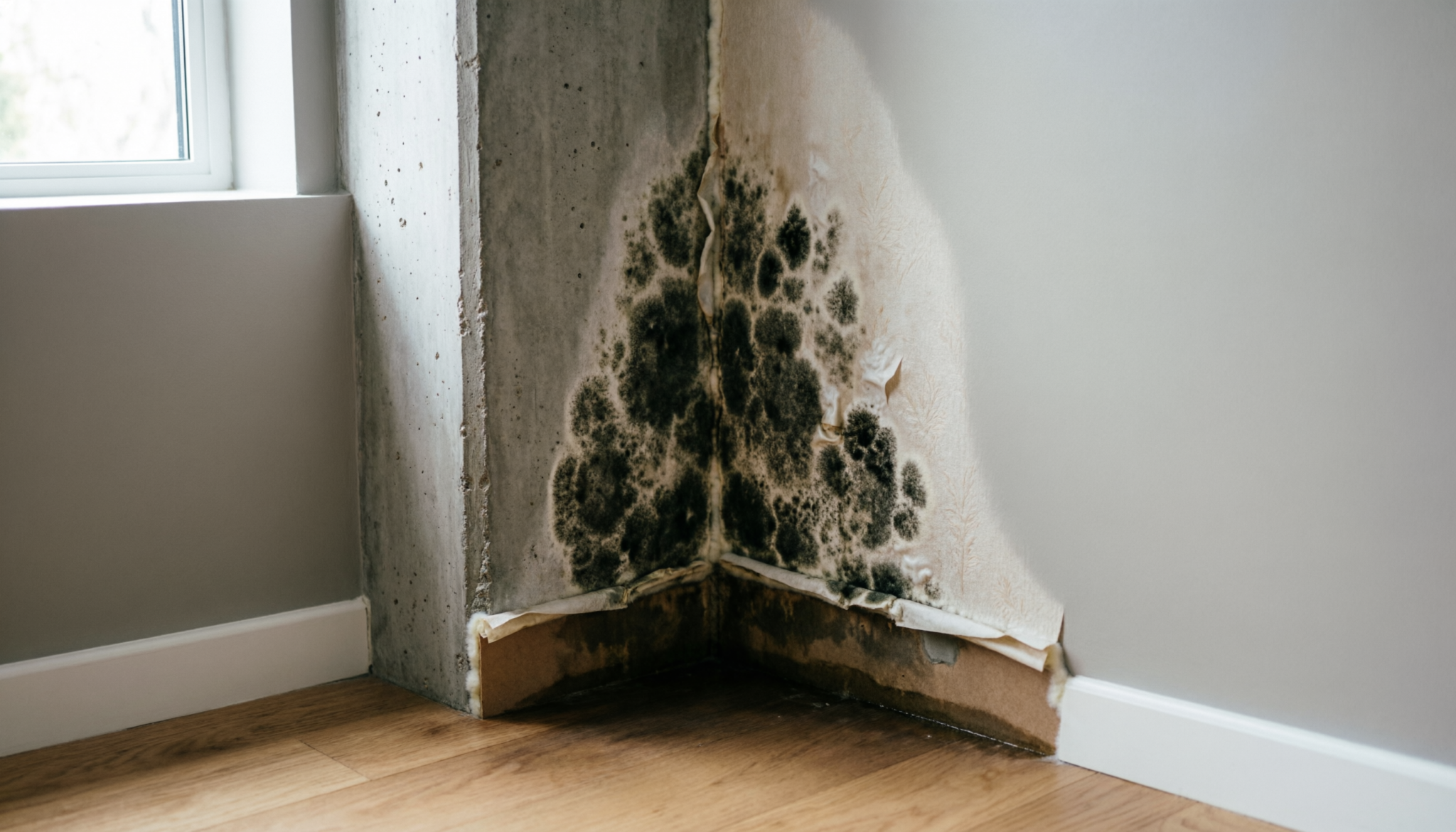
Short on time? Black mold growth in cold room corners starts with condensation physics, not poor housekeeping. Cold wall surfaces drop below the dew point, causing airborne moisture to condense into microscopic water films.
Persistent humidity above 60%, thermal bridging, and weak airflow create an ideal fungal incubation zone inside painted drywall and insulation cavities.
THE CONDENSATION RISK MATRIX
| Surface Condition | Common Location | Relative Humidity Threshold | Mold Colonization Risk |
|---|---|---|---|
| Uninsulated exterior corner | Bedroom ceiling edge | 55%+ | Moderate spore activation |
| Thermal bridge near concrete beam | Apartment wall junction | 60%+ | Hidden condensation behind paint |
| Furniture pressed against cold wall | Wardrobe corners | 65%+ | Reduced airflow and fungal growth |
| Single-pane window corner | Window sill edge | 50%+ during winter | Surface moisture accumulation |
| HVAC dead zone | Upper room corner | 60%+ | Persistent stagnant humidity |
| Basement concrete intersection | Floor-to-wall joint | 70%+ | Deep hyphal penetration into porous material |
Dew Point Physics: Why Moisture Targets Cold Corners
Indoor air always contains water vapor. Warm air holds significantly more moisture than cold air.
During contact with a cold surface, airborne vapor loses thermal energy and condenses into liquid water.
Cold corners create ideal condensation zones because surface temperatures often fall below surrounding wall temperatures.
Exterior walls, concrete beams, steel framing, and poorly insulated junctions accelerate conductive heat loss. Surface cooling follows.
Once surface temperature drops beneath the dew point, invisible moisture deposition begins immediately.
Example:
- Indoor air temperature: 72°F
- Relative humidity: 60%
- Dew point: approximately 57°F
Any wall surface below 57°F becomes a condensation surface.
Most homeowners never notice this process because condensation frequently develops as a microscopic moisture film instead of visible water droplets.
Black mold requires only trace moisture for colonization. Surface dampness invisible to the eye still supports fungal metabolism.
Thermal Bridging: The Structural Cause Behind “Cold Spots”
Thermal bridging describes rapid heat transfer through dense building materials.
Common thermal bridges include:
- Concrete lintels
- Steel framing
- Window frames
- Ceiling joists
- Exterior wall studs
- Balcony slab connections
These materials bypass insulation layers and conduct outdoor temperatures directly into interior surfaces.
Result:
- Lower wall temperature
- Higher localized humidity
- Repeated condensation cycles
Corner geometry worsens the problem. Two exterior walls meeting at a corner lose heat faster than a flat wall surface. Air circulation also weakens inside corners, allowing moisture accumulation to remain trapped longer.
Infrared thermal imaging regularly shows corner temperatures 5°F to 15°F colder than surrounding drywall.
That difference determines whether fungal spores remain dormant or begin active growth.
Why Black Mold Prefers Painted Drywall
Black mold rarely starts on clean glass or metal. Porous cellulose-rich materials provide superior fungal nutrition.
Common indoor mold food sources include:
- Drywall paper backing
- Dust accumulation
- Latex paint residue
- Wood framing
- Carpet fibers
- Wallpaper adhesive
Drywall performs especially poorly under repeated humidity exposure because gypsum absorbs and releases moisture continuously.
Once absorbed moisture raises material water activity above critical fungal thresholds, hyphae penetrate beneath paint layers and spread invisibly inside the substrate.
Surface cleaning often fails because root-like fungal structures remain embedded within porous material.
The Airflow Failure Problem
Cold corners almost always contain stagnant air.
Air movement equalizes temperature and reduces humidity accumulation. Weak circulation prevents evaporation and allows localized moisture buildup near surfaces.
Common airflow blockers include:
- Large wardrobes against exterior walls
- Overfilled closets
- Closed curtains
- Sealed room layouts
- Blocked HVAC vents
Furniture pressed directly against exterior walls creates miniature microclimates.
Conditions inside these trapped zones often include:
- Lower temperature
- Higher humidity
- Minimal evaporation
- Reduced light exposure
Perfect fungal incubation conditions.
A gap of even 2 to 4 inches behind furniture significantly improves convective airflow and lowers condensation persistence.
Relative Humidity Thresholds and Mold Activation
Mold spores exist in nearly all indoor environments. Active growth depends primarily on sustained moisture exposure.
Critical indoor humidity thresholds:
| Relative Humidity | Environmental Effect |
|---|---|
| Below 50% | Low fungal activity |
| 50% to 60% | Increased condensation risk |
| Above 60% | Active mold-supporting environment |
| Above 70% | Accelerated colonization and sporulation |
Many occupants focus only on room temperature while ignoring humidity load.
Example:
A warm room at 75°F with 70% humidity creates substantially higher mold risk than a cooler room at 68°F with 40% humidity.
Humidity control matters more than heat alone.
Ventilation Imbalance and Moisture Accumulation
Modern energy-efficient homes frequently trap moisture indoors.
Common moisture sources include:
- Cooking steam
- Shower vapor
- Clothes drying
- Human respiration
- Humidifiers
- Gas combustion appliances
Without adequate ventilation, moisture concentration rises continuously.
Bathroom exhaust failure creates especially severe corner mold patterns because steam migrates upward and condenses near ceiling intersections.
Typical warning signs include:
- Peeling paint
- Musty odor
- Dark spotting near corners
- Window condensation
- Damp wardrobe interiors
Persistent overnight bedroom humidity also contributes heavily. Sleeping occupants release substantial water vapor through respiration during closed-window conditions.
Expert Insight:
Use an infrared thermometer on room corners during cold weather. Surface temperatures below the indoor dew point indicate active condensation risk even without visible moisture.
Black spotting usually appears weeks after moisture accumulation begins. Fungal colonization often spreads behind paint first, making visible stains a late-stage warning sign.
Hidden Mold vs Surface Mold
Surface spotting represents only part of the contamination.
Cold-corner mold often spreads inside:
- Wall cavities
- Insulation layers
- Carpet underlay
- Ceiling voids
- Wood framing joints
Repeated condensation cycles saturate porous materials beneath visible surfaces.
Signs of hidden colonization include:
- Persistent earthy odor
- Recurring stains after cleaning
- Paint bubbling
- Soft drywall texture
- Chronic allergy symptoms
Bleach rarely solves embedded fungal growth inside drywall because moisture remains trapped beneath the surface.
Moisture-source correction remains the primary intervention.
Prevention Strategy: Interrupt the Condensation Cycle
Effective prevention focuses on surface temperature and humidity control simultaneously.
High-impact interventions
Improve airflow
- Maintain furniture clearance from exterior walls
- Open interior doors periodically
- Unblock HVAC vents
- Use ceiling circulation fans
Lower indoor humidity
- Maintain indoor RH between 35% and 50%
- Use bathroom exhaust fans for 20 minutes after showers
- Vent clothes dryers outdoors
- Reduce humidifier output
Increase surface temperature
- Upgrade insulation
- Seal air leaks
- Install thermal curtains
- Replace single-pane windows
Monitor conditions
- Use hygrometers in bedrooms and corners
- Track condensation-prone areas during winter mornings
- Use infrared thermometers for surface diagnostics
Small environmental corrections prevent large-scale fungal remediation costs later.
FAQs
1. Why does black mold grow only in room corners?
Corners experience faster heat loss, weaker airflow, and colder surface temperatures. Condensation persists longer in these zones, creating ideal fungal growth conditions.
2. Can black mold grow without visible water leaks?
Yes. Chronic condensation from humidity and cold surfaces frequently supports mold growth without plumbing leaks or flooding.
3. Does repainting solve corner mold?
No. Paint covers stains temporarily but fails to remove embedded fungal growth or correct condensation physics. Moisture-source correction remains essential.
Final Take
Black mold in cold corners results from building physics, moisture dynamics, and airflow failure. Surface temperature below dew point creates persistent microscopic condensation.
Thermal bridging, elevated humidity, and stagnant air accelerate fungal colonization inside porous materials.
Long-term prevention requires humidity control, improved insulation, and continuous air circulation rather than cosmetic cleaning alone.